Published: May 28, 2026 | Updated: Live during rollout
The Problem With Most Advice You’re Reading Right Now
Your rankings moved. Maybe they dropped. Maybe they jumped. Either way, you opened Google Search Console, stared at the impression graph, and started Googling “May 2026 core update” – only to find the same article cloned 40 times.
“Focus on E-E-A-T. Create helpful content. Wait for the rollout to finish.”
That advice isn’t wrong. It’s just incomplete. Because this update landed the day after Google announced that AI Mode crossed one billion monthly users – at the same moment Google I/O reshaped how search fundamentally works. Ranking changes and click-behavior changes are happening simultaneously. That makes attribution harder than any previous update cycle.
This article gives you what the generic roundups don’t: the context behind the timing, the data on who got hit and why, and a clear diagnostic process that separates signal from noise.
What Is the Google May 2026 Core Update?
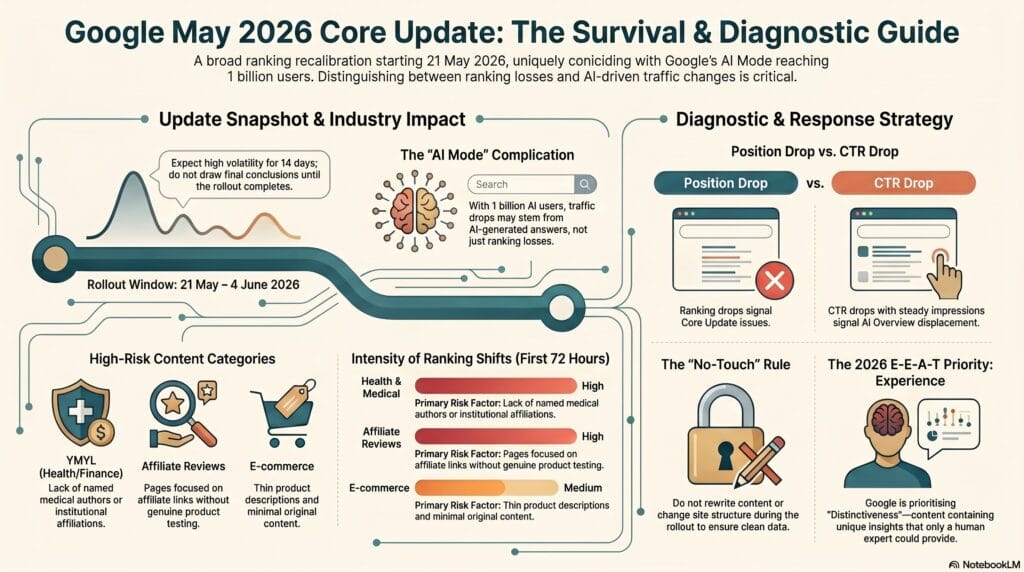
The short definition: The May 2026 core update is a broad, system-wide ranking change that began rolling out on May 21, 2026. It is not a penalty. It is Google recalibrating how its core ranking systems evaluate content quality, relevance, and user satisfaction across the entire index.
Google confirmed the update via the Google Search Status Dashboard at 08:40 PDT on May 21. The rollout window is up to two weeks, putting completion around June 4, 2026.
It is the second broad core update of 2026 and the fourth confirmed ranking update of the year.
How This Differs From a Targeted Update
This distinction matters more than most people realize.
| Update Type | What It Does | Who It Targets | Recovery Path |
|---|---|---|---|
| Core Update | Re-weights quality signals across the entire index | All sites simultaneously | Improve content quality broadly; biggest changes come after the next core update |
| Spam Update | Removes specific violators (link spam, scaled content abuse) | Sites with active policy violations | Fix the specific violation; request reconsideration |
| Targeted Update (e.g., Helpful Content) | Adjusts a specific signal or system | Sites with a particular content pattern | Address the specific signal flagged |
| Discover Update | Changes how content surfaces in Google Discover feeds | Publishers and content-heavy sites | Optimize for Discover separately from Search |
A core update drop doesn’t mean you did something wrong. It means Google changed what it considers “good enough” and your pages now have to compete on a recalibrated scale.
Where This Sits in the 2026 Update Timeline
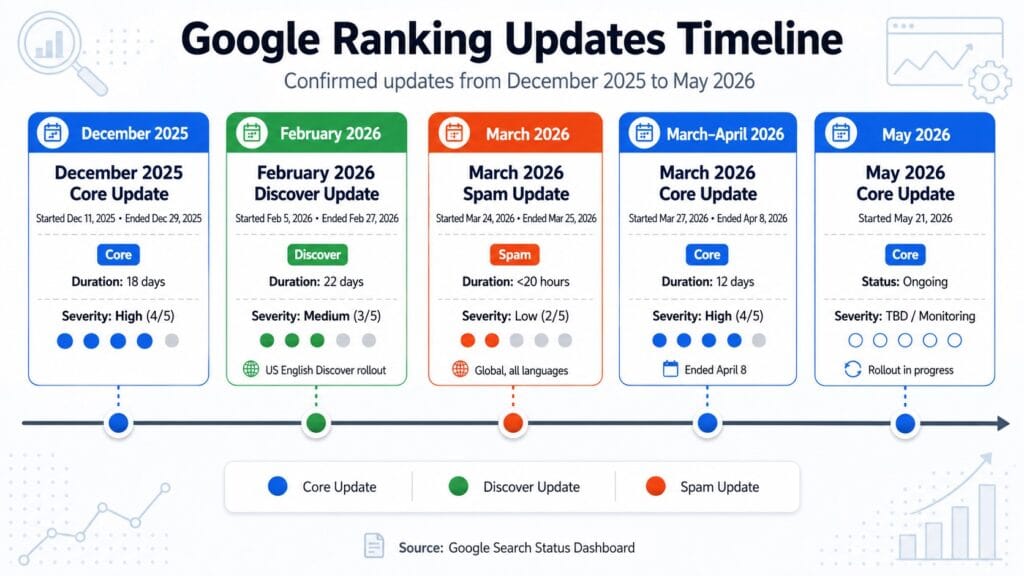
Here’s the quick timeline:
- December 2025 Core Update — 18 days (Dec 11 – Dec 29)
- February 2026 Discover Update — 22 days (Feb 5 – Feb 27)
- March 2026 Spam Update — under 20 hours (Mar 24 – Mar 25)
- March 2026 Core Update — 12 days (Mar 27 – Apr 8)
- May 2026 Core Update — started May 21, ongoing
Six weeks separated the end of the March core update and the start of this one. Many SEOs expected more frequent updates. The pace has been deliberate.
Why This Update Is Harder to Read Than Previous Ones
Most core updates are messy during rollout. This one has an additional complication that most coverage is glossing over.
The Google I/O Problem
The May 2026 core update started rolling out on May 22 – one day after Google I/O wrapped. At that event, Google announced:
- AI Mode passed one billion monthly users
- Gemini 3.5 Flash was deployed globally inside AI Mode
- Significant changes to how the search box and results interface work
These aren’t background news items. They directly change how users interact with search results – which means click-through rates and impression data are shifting at the same time rankings are shifting.
If you opened Search Console on May 22 and saw a drop, you face a real attribution question: did your rankings move because of the core update, or did user behavior change because of AI Mode? Or both?
How to Tell the Difference
This is the diagnostic framework most articles aren’t giving you.
Signals that point to the core update:
- Pages that dropped in position (average ranking fell, not just clicks)
- Drops concentrated in specific content types (thin articles, AI-generated pages, affiliate reviews)
- Sitewide pattern rather than isolated URLs
- Your competitors in the same niche show similar movement
Signals that point to AI Mode / behavioral shift:
- Impressions stayed the same or rose, but clicks dropped (zero-click behavior – Google answered the query before the user reached your result)
- Drops concentrated on informational queries that AI Overviews now answer directly
- Branded queries held; non-branded informational queries fell
Pull your Search Console data and segment by query type. The pattern will tell you which cause is dominant for your site.
What a Billion AI Mode Users Means for Organic CTR
This isn’t a temporary blip. Zero-click rates have been rising for years. AI Mode accelerating past one billion users is the clearest signal yet that click-through rates on informational queries will continue to decline – regardless of where your pages rank.
That changes the value calculation for certain content types. A page ranking #1 for a definitional query returns less traffic than it did two years ago. The SEO conversation needs to catch up with that reality.
Who Got Hit? Ranking Volatility by Industry
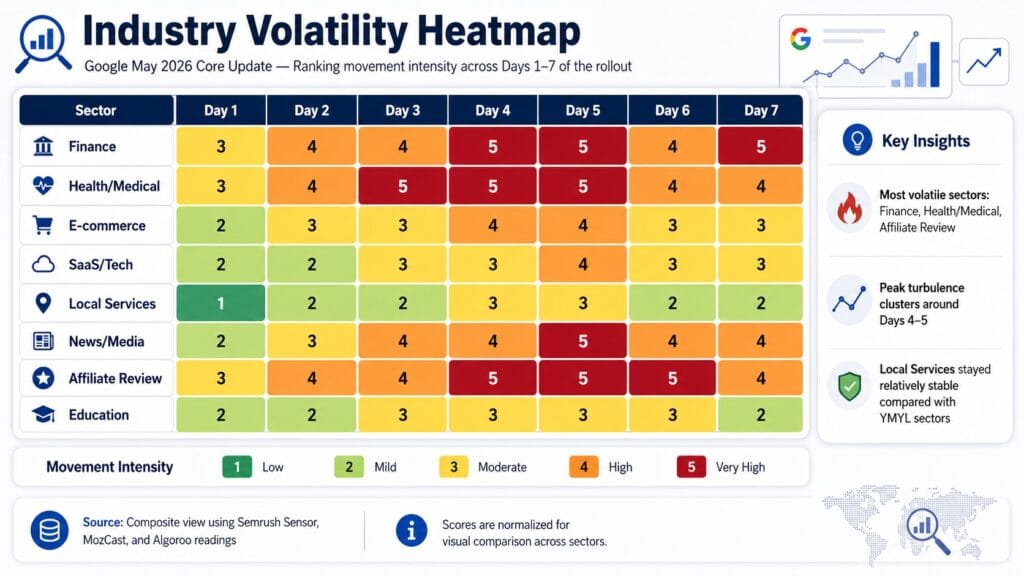
How Volatility Is Being Measured
Before reading industry data, understand the tools producing it:
- Semrush Sensor — 0 to 10 scale; readings at 8+ confirm a major update is active
- MozCast — baseline is 70°F; spikes above 100°F indicate significant turbulence
- Algoroo — 0 to 1+ scale; readings above 0.6 confirm update activity
- WireBoard — 0 to 10 proprietary scale; used for cross-reference
No single tool is authoritative. Directional agreement across multiple sensors is the reliable signal. In the first 72 hours of this update, Algoroo hit 0.67 and Semrush Sensor readings were consistent with March 2026 levels – a high-amplitude update by any measure.
Industries Seeing the Most Volatility
Hardest hit in the first 72 hours:
- Health and medical — YMYL content under the heaviest scrutiny. Sites without named medical authors or institutional affiliations are losing ground fast.
- Finance and legal — Same YMYL dynamic. Generic explainer content is falling behind sites with genuine expert authorship.
- Affiliate review sites — This category is taking significant damage. Pages that exist primarily to funnel clicks to affiliate products, without genuine first-hand product experience, are losing visibility.
- E-commerce — Thin product description pages and category pages with minimal content are seeing drops. Sites with detailed, original product content are holding steadier.
- SaaS and technology — Mixed picture. Authoritative comparison and review content is gaining; thin feature-list pages are losing.
What’s gaining visibility:
- Sites with original research or primary data
- Content with clearly identified expert authors and verifiable credentials
- Publishers with strong brand signals and healthy backlink profiles
- Local service businesses with complete, active Google Business Profiles and detailed service pages
The Affiliate Review Problem
This deserves its own paragraph because the pattern is consistent across multiple updates now.
Google has been tightening quality signals around affiliate content for several update cycles. The profile of a site getting hit: multiple product reviews across diverse categories, no genuine first-hand testing, thin “what is” sections padded with obvious keyword targeting, and affiliate links as the primary page purpose.
If your site has this profile, this update is not a one-off. It reflects a direction Google has been moving for two years.
What Google Is Actually Rewarding — E-E-A-T in 2026
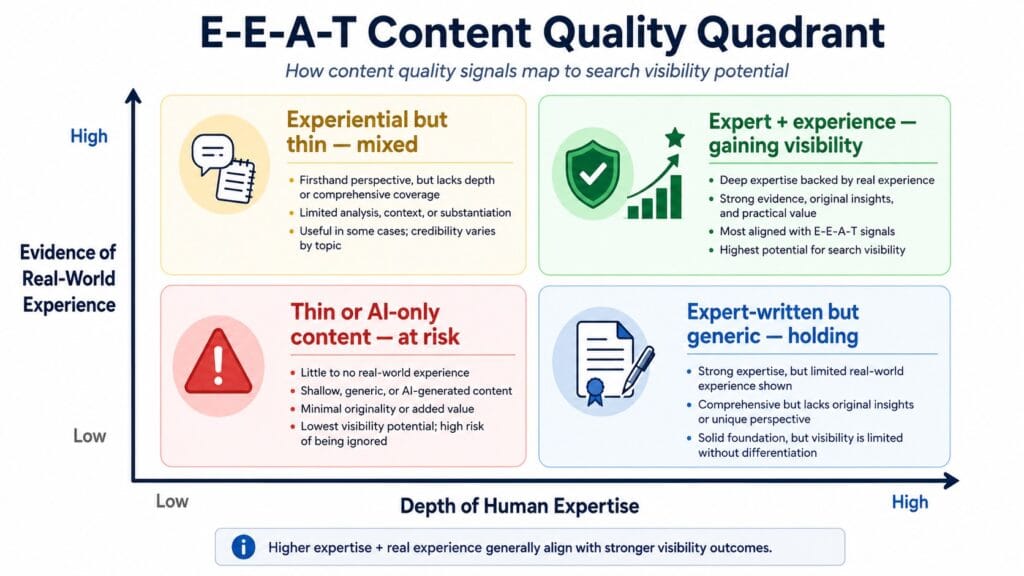
The Four E-E-A-T Signals – What’s Shifted
Experience is the newest addition to the framework and arguably the most undervalued. Google is trying to reward content produced by people who have actually done the thing they’re writing about – not just researched it. A review written by someone who used a product for six months carries different signals than one written from a spec sheet.
Expertise is still critical, but it’s being evaluated more contextually. A gastroenterologist writing about digestive health carries authority. That same person writing about mortgage rates doesn’t and Google is getting better at making that distinction.
Authoritativeness comes through inbound links, mentions, and citations from other authoritative sources in the same topic space. It’s not just about having links; it’s about having links from sites that are themselves trusted on that specific subject.
Trust is the hardest to build and the easiest to undermine. Clear authorship, transparent sourcing, accurate information, secure infrastructure, and honest disclosure of commercial relationships – these are all trust signals. Missing any one of them is a liability.
The AI Content Distinction You Actually Need to Make
The question is no longer “is this AI-generated?” – Google doesn’t care about the production method. The question is: does this content demonstrate genuine human expertise and editorial judgment?
There’s a meaningful difference between:
- AI content with no human editorial layer — Published at scale, no named author, no unique perspective, no original insight. This is what’s getting filtered.
- Human-edited AI content — A subject-matter expert uses AI to draft, then rewrites, restructures, adds original examples, and brings their own knowledge to the page. The output reflects real expertise.
If you can’t distinguish your content from what any AI would produce without your input, that’s a problem and it’s becoming a more urgent one.
What Topical Authority Actually Means
People read “topical authority” and think it means publishing more content on a subject. That’s half of it.
The full picture: topical authority is about covering a subject at sufficient depth and breadth that Google can confidently surface your site for queries across the full topic space – not just the head terms.
A site that covers “diabetes medication” in one article doesn’t have topical authority on diabetes. A site with 40 articles covering symptoms, diagnosis, medication types, diet, lifestyle, comorbidities, and patient experience – written by medical professionals – does.
Volume matters less than coherence. A smaller site with 15 tightly organized, expert-authored articles on a narrow subject can outperform a large site with 200 thin, scattered pieces.
Does a Named Author Byline Actually Matter?
Yes. But not for the reason most people think.
The byline isn’t a signal by itself. What matters is whether the name on the article resolves to a real person with a verifiable presence in that subject area – publications, credentials, a LinkedIn profile, citations from other sources.
An anonymous article or one bylined to “Staff Writer” doesn’t give Google anything to evaluate. Named authorship with verifiable expertise gives the algorithm a data point it can actually use.
How to Diagnose Your Site’s Impact — Step-by-Step
Step 1 — Set Your Baseline Correctly
Don’t compare last week to this week. The rollout is still in progress, and day-to-day data during a core update is unreliable.
Use these comparison windows in Search Console:
- Date range A: May 1 – May 20, 2026 (pre-update baseline)
- Date range B: May 22 – present (post-update window — expand as more days accrue)
Pull data at the page level and query level separately. Sitewide averages will hide the actual pattern.
Step 2 — Segment Your Drops
Once you have the comparison, run these three filters:
- By page — Which specific URLs lost the most impressions? Are they concentrated in one content type (e.g., all your roundup posts, all your AI-generated articles)?
- By query — What were these pages ranking for before? Are the queries informational (now potentially answered by AI Overviews) or commercial?
- By device — Mobile vs. desktop drops sometimes point to different issues.
Step 3 — Cross-Reference With GA4
Search Console shows impressions and clicks. GA4 shows sessions and behavior.
If Search Console shows impressions held but clicks dropped, the issue is CTR (zero-click or AI Overview displacement). If both impressions and clicks dropped, the ranking itself moved.
These require different responses. Don’t conflate them.
Step 4 — Identify the Pattern
After segmenting, ask: is this sitewide or content-type specific?
- Sitewide drop — Points to a domain-level signal issue (trust, authority, backlink quality) or an accidental technical block.
- Content-type specific — Points to a quality signal issue in that content category. This is the more common core update pattern.
What a Core Update Drop Looks Like vs. Other Issues
| Signal | Core Update | Technical Issue | Manual Penalty |
|---|---|---|---|
| Pattern | Gradual, across multiple pages | Sudden, often sitewide | Sudden, specific pages or domains |
| Search Console notification | None | Possibly (crawl errors) | Yes (manual actions report) |
| Impressions | Drop with rankings | Drop (pages not indexed) | Drop (pages demoted) |
| Recovery path | Content quality improvements | Fix the technical block | Address violation, request review |
| Timeline | Biggest gains after next core update | Faster once fixed | After reconsideration request approved |
What to Do Now vs. After the Rollout Completes
This is the section where most people make their biggest mistake. They panic, start rewriting articles, change their site structure, and end up with data that can’t tell them anything.
What NOT to Do During Rollout
Do not make major content changes right now. Not because improvement is bad — because you can’t measure the impact of changes made while the algorithm is still shifting. If you change 20 articles this week and see a recovery, you won’t know whether your changes helped or whether the update just settled in your favor.
Do not draw permanent conclusions from current data. The first 72 hours of any core update are the noisiest. Rankings can swing significantly before settling. Volatility on Day 3 is not your new normal.
Right Now: Diagnostic Mode Only
| Action | Status | Why |
|---|---|---|
| Document your pre-update rankings and traffic | ✅ Do this now | You need the baseline before it gets harder to reconstruct |
| Set up comparison windows in Search Console | ✅ Do this now | You’ll need this data for post-rollout analysis |
| Identify which pages dropped, which held, which gained | ✅ Do this now | Pattern recognition is the only useful output right now |
| Rewrite major content sections | ❌ Wait | Can’t measure impact during active rollout |
| Change site structure or internal linking | ❌ Wait | Same reason |
| Panic-disavow your backlink profile | ❌ Never | Core updates are not link penalties |
After June 4: The Improvement Roadmap
Once the rollout is confirmed complete, you have clean data to work with. Here’s the sequence:
- Run a full content audit. Identify pages that lost the most visibility. For each, ask: Does this page demonstrate genuine expertise? Does it have a named author with verifiable credentials? Is there anything here that a user couldn’t get from 10 other sites?
- Do a competitive gap analysis. For each dropped page, look at what’s ranking above you now. Don’t copy it — understand what they have that you don’t. That’s your improvement target.
- Prioritize your highest-traffic losses first. Don’t try to fix everything at once. Triage by impact.
- Update and consolidate before you create. Improving an existing page that already has backlinks and index history is almost always more effective than publishing a new one.
- Add the E-E-A-T signals your pages are missing. Named authors with bio pages, cited sources, original examples, first-hand experience markers — these are additive improvements that don’t require rebuilding from scratch.
The one exception for immediate action: If Search Console shows a manual action notification, or if your crawl check reveals pages are accidentally noindexed or blocked by robots.txt — fix those immediately. Technical blocks are not a “wait for the rollout to finish” situation.
The Bigger Picture — Where Google Search Is Going
This section matters more than most people want to hear right now, because it reframes the entire premise of “recovering from a core update.”
From Index to Evaluator
Google Search is no longer primarily an indexing engine that matches keywords to pages. It’s increasingly a contextual evaluation system — one that asks not just “does this page contain the query term” but “is this source one a user should trust for this topic, given what they’re actually trying to accomplish?”
That’s a fundamentally different problem. And it doesn’t get solved by keyword optimization alone.
The Volume Strategy Is Running Out of Runway
The playbook of the past decade: publish more content, target more keywords, build more links. At scale, that works — until it doesn’t.
Core update after core update is showing the same pattern: sites built on volume without depth are losing ground to smaller sites with genuine authority. A 10-article site written by a practicing cardiologist can outrank a 500-article health site produced at scale by generalists.
This doesn’t mean volume is irrelevant. It means volume without substance is a liability that gets more exposed with each update cycle.
What “Distinctiveness” Means as a Ranking Signal
Google has been increasingly clear in its guidance: it wants to surface content that couldn’t be replicated without the author’s specific experience, knowledge, or access.
Ask this about every piece of content you publish: what does this page contain that only we could have written?
If the answer is “nothing in particular” — that’s the problem you need to solve. Not the keyword density. Not the meta description. The fundamental value of the content itself.
LLMO Alongside SEO — Not Instead Of It
Large language model optimization (LLMO) is the emerging discipline of structuring content so that AI answer engines — ChatGPT, Perplexity, Google’s own AI Overviews — cite your content when answering queries.
The good news: most of what makes a page rank well in traditional search also makes it more citable by AI systems. Clear structure, named entities, direct answers, authoritative sourcing — these work for both.
The difference is emphasis. Traditional SEO optimizes for position. LLMO optimizes for citation and inclusion in synthesized answers, even when the user never clicks through to your page. Both matter in 2026. Build for both.
FAQ: Google May 2026 Core Update
Structured for featured snippets and AI answer engine citation.
What is the Google May 2026 core update?
The Google May 2026 core update is a broad algorithm change that began on May 21, 2026. It recalibrates how Google evaluates content quality, relevance, and user satisfaction across the entire search index — not a penalty, but a reweighting of quality signals.
Core updates are Google’s way of recalibrating its ranking systems at scale. Unlike spam updates or targeted algorithm changes, a core update doesn’t target specific violations — it shifts what Google considers high-quality content across all sites and topic areas simultaneously. This update is the second broad core update of 2026, following the March 2026 core update that ended April 8.
How long will the May 2026 core update take to finish?
The May 2026 core update started rolling out on May 21, 2026. Google says the rollout may take up to two weeks. Based on the March 2026 update completing in 12 days, most SEOs expect this one to wrap around June 2–4, 2026.
Google has not given a specific completion date. The safest approach is to avoid drawing firm conclusions from ranking data until Google confirms the rollout is complete via the Search Status Dashboard. Rankings can swing significantly before settling, especially in the first 72 hours. The March 2026 update peaked in volatility during Days 1–3, then began stabilizing from Day 7 onward.
Why did my website lose rankings after the May 2026 core update?
A ranking drop after a core update usually means Google has re-weighted quality signals in your content category — not that your site was penalized. Sites that lost ground are being outperformed by pages that better satisfy what Google now prioritizes: expertise, experience, trust, and genuine user value.
The most common causes of a core update drop are: thin content with no original insight, AI-generated pages without meaningful human editorial input, affiliate content without first-hand product experience, and pages that lack verifiable author expertise. Drops can also reflect a competitor’s improvement rather than a fault in your own content. Diagnosis through Search Console before any remediation is the right first step.
What type of content is most affected by the May 2026 core update?
The hardest-hit content types in the first 72 hours are: thin informational articles, AI-generated sites without human editorial oversight, and affiliate review sites without genuine first-hand product experience. YMYL (health, finance, legal) sites without expert authorship are also seeing significant drops.
The pattern is consistent with previous core updates: content created primarily for search engines rather than for real user needs loses visibility. Gaining visibility are sites with original research, named expert authors, strong topical coherence, and genuine first-hand experience demonstrated in the content. Industries seeing the most volatility include health, finance, e-commerce, SaaS, and local services.
What should I do if the May 2026 core update hit my website?
Do not make major content changes while the rollout is in progress. Use this time to diagnose: document your pre-update baseline, identify which pages dropped and what they have in common, and build the data foundation for post-rollout improvements. Wait until around June 4 before implementing changes.
Once the rollout completes, the priority order is: (1) Run a full content audit to identify pages that lost visibility. (2) Do a competitive gap analysis on what’s outranking you. (3) Improve and consolidate existing pages before creating new ones. (4) Add E-E-A-T signals — named authorship, cited sources, original examples, and first-hand experience markers. (5) Reassess after 6–8 weeks with clean post-rollout data.
Watch the youtube video here 👇
Last updated: May 28, 2026. This article will be updated as the rollout progresses and completion data becomes available.