You’re ranking on page one. Traffic is flat anyway. Click-through rates are sliding, and your boss wants to know why.
Here’s the part nobody tells you: a growing share of your buyers never reach Google at all. They ask ChatGPT, Perplexity, or Gemini and those systems recommend a competitor. Not because that competitor has better content. Because their brand is embedded deeper in the web’s evidence layer, and yours isn’t.
That gap has a name. It’s the distance between Search Engine Optimization and Answer Engine Optimization and most marketing teams are optimizing for only one of them.
By the end of this article, you’ll be able to run a three-question audit that tells you exactly where your brand stands in both channels and what to do about it.
What Is the Difference Between AEO and SEO? (The One-Sentence Version)
SEO (Search Engine Optimization) helps web pages rank in traditional search results and is measured by clicks and traffic. AEO (Answer Engine Optimization) helps brands and entities get recommended by AI systems like ChatGPT, Perplexity, and Google AI Overviews – influencing buyer decisions before any click occurs.
That distinction sounds small. It isn’t.
SEO is a page-level game. You optimize a URL, it climbs the rankings, people click it. The feedback loop is clean and measurable. AEO is an entity-level game. There’s no single page to optimize, no ranking to track, and no click to count. Your brand either exists in the AI’s understanding of your category or it doesn’t.
Most brands don’t.
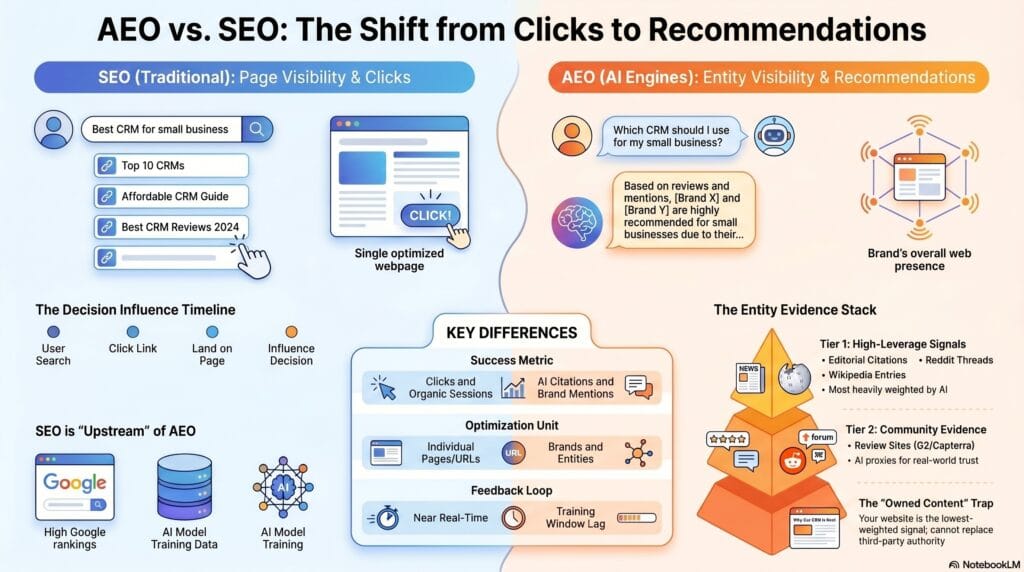
The Shift from Page Visibility to Entity Visibility – Why It Changes Everything
AI systems don’t crawl your website the way Google does. They were trained – past tense. What they know about your brand was absorbed from the web as it existed during their training window. That means a blog post you published last week may not affect what ChatGPT says about you for months, if ever.
This is the structural fact that changes everything. SEO operates in near-real-time. AEO operates on a lag. And the brands winning in AI search today started building their entity signals before most marketers knew AEO existed.
The shift isn’t from SEO to AEO. It’s from optimizing one signal (your page) to owning a signal network (everything the web says about your brand).
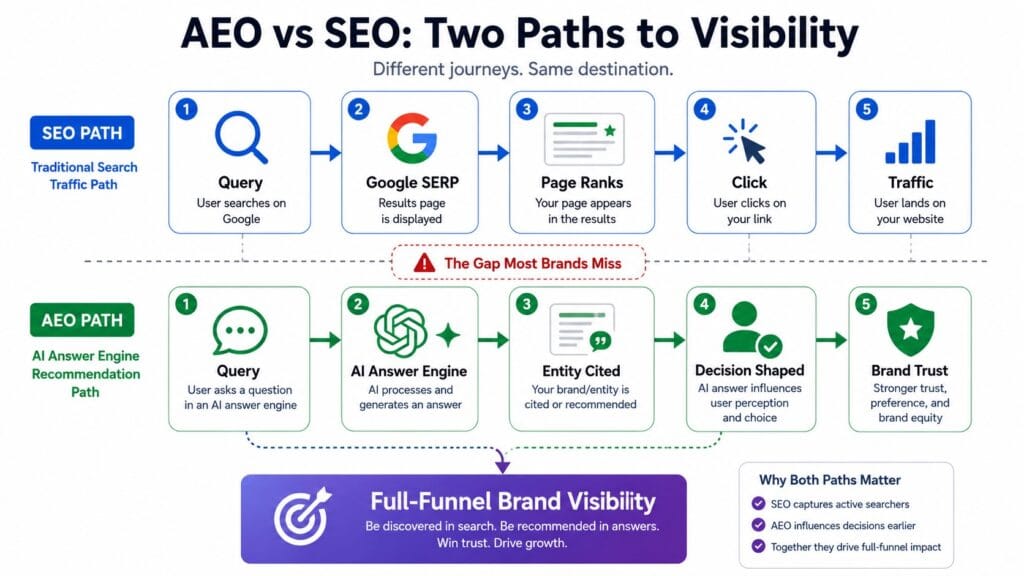
How AI Answer Engines Decide What to Recommend (It’s Not Your Homepage)
AI systems recommend brands whose entities are reinforced across the web’s evidence layer – not brands with the best homepage or the most blog posts.
Apple doesn’t surface when someone asks ChatGPT for the “best laptop” because Apple has a good website. Apple surfaces because its entity is cited across thousands of review sites, comparison articles, YouTube videos, Reddit threads, editorial publications, and product roundups. The AI absorbed all of it. Now the recommendation feels obvious – because the evidence was overwhelming.
Your brand with one well-optimized landing page is competing against that. The page isn’t the problem. The absence of a signal network is.
What Is Entity Visibility? (Definition + Why Google and AI Care About It)
Entity visibility is the degree to which an AI system recognizes and recommends your brand, product, or organization as a trusted answer to a query. Unlike page visibility – which measures URL rankings – entity visibility measures how deeply your brand is embedded across the web’s evidence layer: reviews, editorial mentions, forums, and comparison content that AI models are trained on.
Google began shifting toward entity understanding with the Knowledge Graph, Wikidata integration, and named entity recognition in search quality algorithms. AI answer engines accelerated that shift entirely. A brand without entity visibility doesn’t rank lower – it simply doesn’t exist in the AI’s world.
This distinction was formalized through entity-based SEO frameworks developed by practitioners including Jason Barnard at Kalicube and research surfaced in the Princeton GEO Study (2024).
AEO vs SEO: Side-by-Side Comparison
| Dimension | SEO (Traditional Search) | AEO (AI Answer Engines) |
|---|---|---|
| Measures | Page visibility (URL rankings) | Entity visibility (brand recognition) |
| Optimizes | Individual URLs and pages | Brands, products, and entities |
| Goal | Ranking and traffic | Recommendation and inclusion |
| Success metric | Clicks and organic sessions | AI citations and brand mentions |
| Decision influence timeline | After the search — user clicks through | During the query — before any click occurs |
That fifth row is the one most comparison tables omit. SEO influences users after they’ve already decided to search and click. AEO influences users while they’re forming their decision – inside the AI conversation, before a browser tab opens. That’s not a minor difference in timing. It’s a different point in the buyer journey entirely.
Both channels matter. They just operate at different moments.
Does SEO Still Matter? Why You Need Both (Not One or the Other)
Yes, SEO still matters. Traditional search and AI search are not competing; they’re sequential. Brands that rank in Google generate the editorial coverage, backlinks, and third-party citations that become the AI’s training signal.
Here’s the dependency that nobody explains clearly: SEO is upstream of AEO. When your content earns links from authoritative publications, those publications become part of the evidence layer. When your brand appears in comparison roundups because it ranked well enough to be noticed, those roundups feed the AI’s understanding of your category. Abandon SEO and you eliminate the mechanism that builds AEO credibility.
The brands invisible in AI search today didn’t fail at AEO directly. They failed to build the organic presence that generates the signals AEO runs on.
The bottom line: Track only rankings and you’ll miss AI visibility. Track only AI mentions and you’ll miss search visibility. You need both. That’s the whole game now.
Run the Visibility Split Test: 3 Questions to Know Exactly Where You Stand Right Now
Before any strategy, any tool, any agency brief – run this. Three questions. Ten minutes. They tell you whether you have an SEO gap, an AEO gap, or both.
Question 1: Do You Rank in Traditional Search? (Your Organic Baseline)
Open Google. Search the exact keyword your buyer uses when they’re ready to evaluate solutions. Are you on page one?
If the answer is no, you have zero organic visibility and almost certainly zero AEO credibility either. Your topical authority hasn’t been established with Google, which means the editorial coverage, third-party mentions, and link signals that feed AI training are sparse or absent. Fix SEO first. AEO without an organic foundation is building on sand.
If the answer is yes, move to question two.
Question 2: Are You Recommended in AI Answers? (How to Check in 5 Minutes)
Open ChatGPT, Gemini, and Perplexity. Search your primary category query – not your brand name, your category. “Best CRM for small business.” “Top project management tools for agencies.” Whatever your buyer actually asks.
Does your brand appear? Take note of which competitors are named instead. Run the same query three times across the three platforms – AI responses are non-deterministic, meaning the same question can surface different brands across runs. A single snapshot is not a measurement. You need frequency and query variation to get an accurate picture of your AI share of voice.
For tracking this systematically, see our roundup of the [best tools to track your brand in AI search].
Question 3: If Not You, Who Is Winning? (Diagnosing the Authority Gap)
The entity taking your place in AI answers is compounding authority. Every recommendation they receive trains the model to weight them more heavily. Every day that gap exists, it widens.
Identify one competitor who consistently appears where you don’t. That’s your benchmark. Your job now is to reverse-engineer their entity signal network – which review platforms they appear on, which editorial sites have covered them, which comparison articles include them. That’s not your content strategy. That’s your evidence-layer strategy.
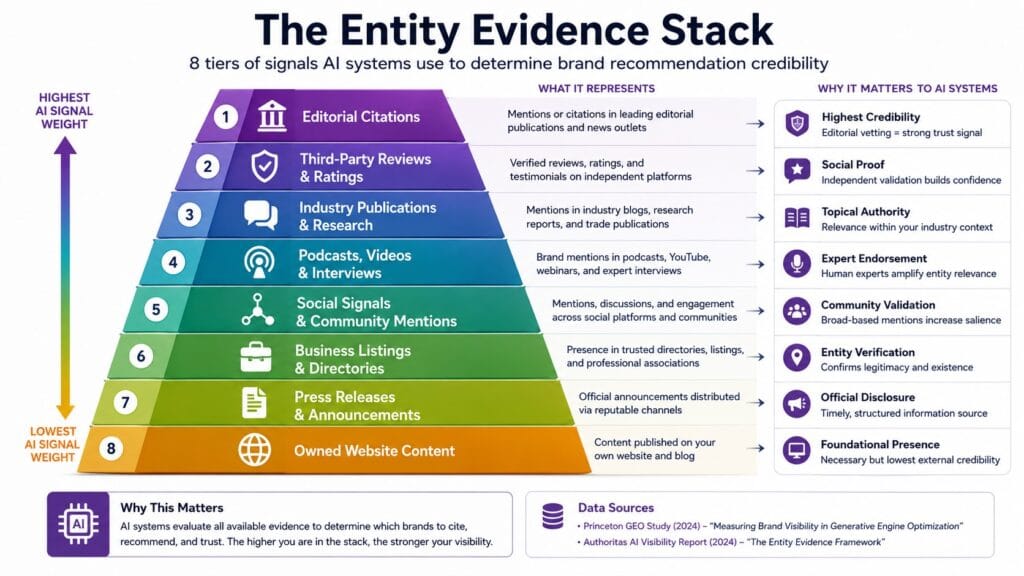
How to Optimize for AEO: The Entity Evidence Stack Explained
AI answer engines don’t read your homepage. They read the web around your brand and they weight those signals in a strict hierarchy.
The Entity Evidence Stack ranks eight signal types by the weight AI systems assign them. The signals at the top are hardest to earn and most heavily weighted. The signals at the bottom are easiest to produce and carry the least influence. Most brands invest almost entirely in the bottom tier and wonder why AI doesn’t recommend them.
Tier 1–3: The High-Leverage Signals (Hardest to Build, Most AI-Weighted)
1. Editorial citations from authoritative domains. A mention in a recognized industry publication, a news outlet, or a respected research source carries more AI credibility than any content you could publish on your own site. The Princeton GEO Study (2024) found that source authority is the single strongest predictor of LLM citation. One editorial mention from a domain with genuine authority outweighs hundreds of self-published blog posts.
2. Wikipedia and Wikidata presence. AI models are trained heavily on Wikipedia. A well-sourced Wikipedia entry not promotional, genuinely encyclopedic is one of the clearest entity signals that exists. Wikidata, its structured data counterpart, feeds the Knowledge Graph directly. If your brand doesn’t have a verifiable Wikipedia entry, your entity is harder for AI to anchor.
3. Review site coverage. G2, Capterra, Trustpilot, and category-specific review platforms are the AI’s proxy for social proof. The Authoritas AI Visibility Report (2024) identified review platform presence as a consistent predictor of brand inclusion in AI answers for commercial queries.
Tier 4–6: The Mid-Layer Signals (Achievable, Often Overlooked)
Reddit threads and forum discussions are underestimated. AI systems treat community-generated content as an unfiltered signal of how real users perceive a brand and they weight authentic peer discussion above brand-controlled content. If your brand doesn’t appear in relevant subreddits or industry forums, that’s a gap.
YouTube review coverage works the same way. A third-party reviewer mentioning your product on a channel with genuine subscribers is evidence the AI can point to. Comparison articles – “X vs Y” posts from independent blogs are similarly high-signal because they demonstrate that your brand is considered alongside established alternatives. Product roundups (“best tools for X”) place you in a defined category, which directly supports the AI’s entity understanding of what your brand does and who it serves.
Tier 7–8: Your Owned Content (Necessary but Lowest Signal Weight)
Your own website and content are necessary but they are the weakest signal in the stack. Brand familiarity signals (consistent naming, entity home pages, About pages with structured data) and historical knowledge (how long your entity has been consistently described across the web) matter at the margins.
The counterintuitive implication: producing more blog posts without investing in Tier 1–6 signals is a ceiling, not a strategy. You’re building on the weakest foundation while leaving the high-leverage signals untouched.
Structured Data and Content Format for AEO: What AI Systems Actually Need to Cite You
The format of your content matters as much as its substance. AI systems — and Google’s Passage Indexing algorithm — extract answers from web pages based on structural signals, not just topical relevance.
Three schema types drive AEO content performance. Definition schema fits single-concept queries: “What is entity visibility?” HowTo schema fits process queries: “How do I check my AI visibility?” FAQ schema fits multi-question landing pages where you’re answering several related queries in one piece of content. Apply the schema that matches the query type — not the one that’s easiest to implement.
The opening 40–55 words of any section carry disproportionate weight. Both Google Passage Indexing and AI training corpus selection favor content where the answer appears before the explanation. Lead with the claim. Follow with the evidence. Never bury the answer at the end of a paragraph.
The six Q&A pairs below demonstrate the format. Each opens with a bolded direct answer. Each follows with a citation-ready expansion. That structure is intentional — and replicable across every page on your site.
For step-by-step implementation including code examples, see our dedicated [FAQ schema for AEO] tutorial.
How to Track AI Visibility: Measuring What You Can’t See in Google Search Console
Google Search Console doesn’t show you ChatGPT citations. There is no “AI Impressions” dashboard yet. That doesn’t mean AI visibility is unmeasurable — it means you need different instruments.
| Tool | What It Tracks | Cost Tier |
|---|---|---|
| Profound | Brand mentions in AI answers across major LLMs | Paid |
| Authoritas | AI citation frequency and competitor comparison | Paid |
| Semrush AI Toolkit | Brand visibility in AI Overviews and generative results | Paid (add-on) |
| Manual prompt testing | Direct query testing in ChatGPT, Gemini, Perplexity | Free |
| Ahrefs AI rank tracker | AI Overview inclusion for tracked keywords | Paid |
Manual testing is free but unreliable as a sole method for one specific reason: AI responses are non-deterministic. Run “best CRM for small businesses” in ChatGPT three times in a row and you may get three different brand sets. Effective AI visibility tracking requires consistent query sets, multiple runs per query, and tracking over time — not a single screenshot.
The metric to pursue is AI share of voice: across your top 20 category queries, what percentage of AI answers include your brand? Track that number weekly. When it moves, investigate what changed in your evidence-layer signals.
Frequently Asked Questions
What is the difference between AEO and SEO?
SEO helps pages rank in search results. AEO helps brands get recommended by AI. The core difference: SEO optimizes URLs for clicks; AEO optimizes entities for AI recommendations that influence decisions before any click occurs.
SEO and AEO operate at different layers of search. SEO is a page-level discipline — you optimize a specific URL with keywords, links, and technical signals so Google ranks it. AEO is an entity-level discipline — you build a web of third-party signals so AI systems like ChatGPT, Perplexity, and Google AI Overviews recognize your brand as a credible answer to category queries. Both measure success differently: SEO counts clicks; AEO counts citations and brand inclusions in AI-generated answers.
How do I optimize my website for AI answer engines?
Build entity authority across third-party sources first. Structured data, concise answer formatting, and consistent brand description across the web are the execution levers. Your own website content is the last priority, not the first.
To optimize for AI answer engines: (1) Earn editorial coverage from authoritative domains in your category. (2) Establish or update your Wikipedia and Wikidata entries. (3) Accumulate review platform presence on G2, Capterra, or industry-specific sites. (4) Write concise, direct answers (40–55 words) at the top of each page using FAQ or Definition schema. (5) Monitor your brand in ChatGPT, Gemini, and Perplexity weekly. The sequence matters — high-tier evidence signals before content volume.
Does SEO still matter now that AI search is taking over?
Yes. SEO is upstream of AEO — the organic credibility you build in traditional search generates the third-party signals that AI systems use to assess your brand. Abandoning SEO removes the foundation that AEO runs on.
Brands that rank in Google attract editorial coverage, comparison article mentions, and backlinks from authoritative sources. Those signals become the evidence layer that AI systems are trained on. A brand with no organic presence has no evidence layer. The correct framing isn’t “SEO vs AEO” — it’s SEO and AEO operating in sequence. Build organic visibility first. It generates the entity signals that make AI recommendation possible.
What is entity visibility and why does it matter for AEO?
Entity visibility is the degree to which an AI system recognizes and recommends your brand as a trusted answer to a query — measured by web-wide evidence, not page rankings.
Unlike page visibility — which tracks where your URLs rank in a SERP — entity visibility measures how deeply your brand is embedded in the web’s evidence layer: the reviews, editorial citations, forum discussions, and comparison content that AI models absorbed during training. A brand with high entity visibility appears in AI answers without any direct SEO effort on that specific query. The evidence network speaks for the brand. That network is built over time through Tier 1–6 signals in the Entity Evidence Stack — not through any single piece of content.
How do I know if my brand is being recommended by AI chatbots?
Open ChatGPT, Gemini, and Perplexity. Search your category query — not your brand name. Note whether your brand appears. Run the same query three times across all three platforms.
A single query run is not a measurement — AI responses are non-deterministic, meaning the same question surfaces different brands across runs. To get reliable data: (1) Define your top 20 category queries. (2) Run each query in ChatGPT, Gemini, and Perplexity. (3) Record which brands appear. (4) Repeat weekly using the same query set. (5) Track your AI share of voice — the percentage of results where your brand is included. Paid tools like Profound and Authoritas automate this process.
What is the “evidence layer” and how does it affect AI recommendations?
The evidence layer is the web-wide collection of third-party signals — reviews, editorial coverage, forums, and comparison content — that AI models absorbed during training to assess brand credibility.
AI systems don’t evaluate your brand in real time. They surface brands whose entities were deeply reinforced in their training data. The evidence layer is the mechanism: a brand cited across G2, industry publications, Reddit, YouTube reviews, and comparison articles becomes recognizable as a credible entity in its category. Apple surfaces for “best laptop” not because of its homepage — but because thousands of independent sources in the evidence layer all point to the same entity. Building your evidence layer is the work of AEO.
The Two-Channel Reality
Search split. Most brands didn’t notice.
The buyer who types a query into Google and the buyer who asks ChatGPT the same question are both real. They’re both in your market. One channel measures clicks. The other shapes decisions before a click is ever made. Ignoring either one means handing your competitors a channel you’ve conceded entirely.
The Visibility Split Test takes ten minutes. Run it this week. Question one tells you whether you exist in traditional search. Question two tells you whether you exist in AI search. Question three tells you who’s winning the ground you’ve ceded.
If you wait — that competitor cited in AI answers today is compounding. Their entity signals grow stronger with every recommendation. The gap doesn’t stay the same size. It widens.
Run the full Visibility Split Test for your brand →
Ready to go deeper? Learn [GEO vs AEO vs SEO: which strategy to prioritize first] →
Signal hierarchy informed by the Princeton GEO Study (2024) and the Authoritas AI Visibility Report (2024). Entity framework informed by Kalicube’s Brand SERP methodology (Jason Barnard).
Watch the youtube video here 👇