You pay for good ads. You built a great website. But when shoppers ask an AI to find a product, your brand is missing.
This is frustrating. Competitors with worse products are getting suggested by AI. You are losing free sales every single day because AI cannot read your data.
The fix is simple. You must change how you build your product lists. Here is how to make AI notice you.
Does Your Product Feed Actually Show Up in AI Search?
Try a quick test right now. Open OpenAI’s ChatGPT or Perplexity. Ask for a product you sell. Ask it exactly how a real customer would talk.
Do your items appear? For most brands, the answer is no. Even with a huge budget, you might be totally hidden.
AI shopping assistants pull from specific data sources. If your data is messy, you do not exist to them.
How AI Shopping Actually Works (The Big Shift)
What Happens to Your Products When AI Answers Instead of Google?
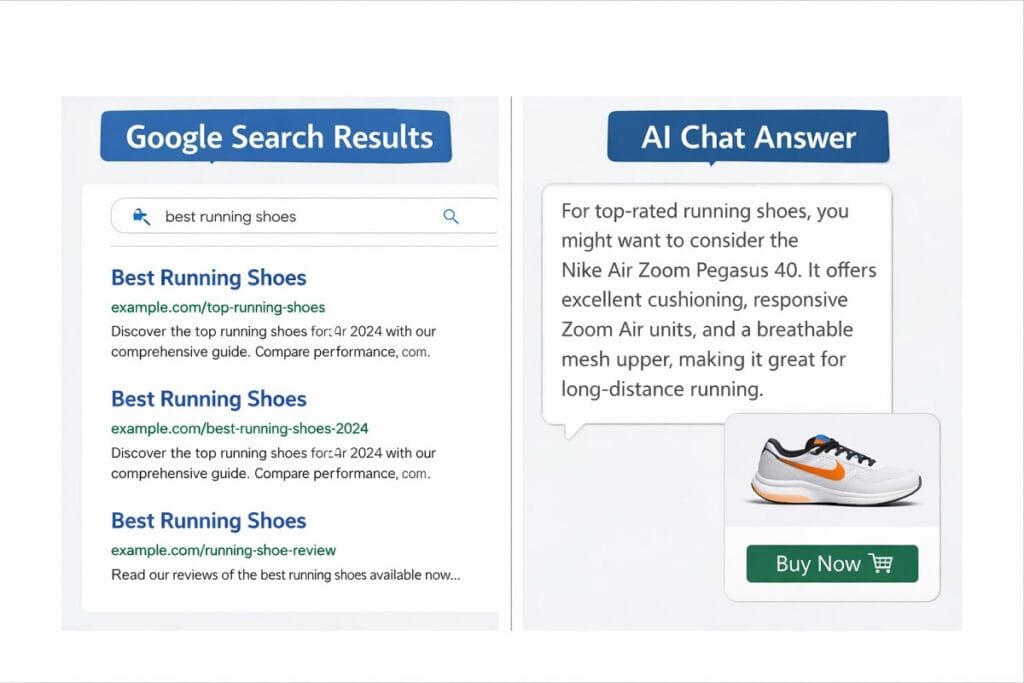
Shopping online is changing fast. People do not click ten blue links anymore. They ask an AI search engine a full question.
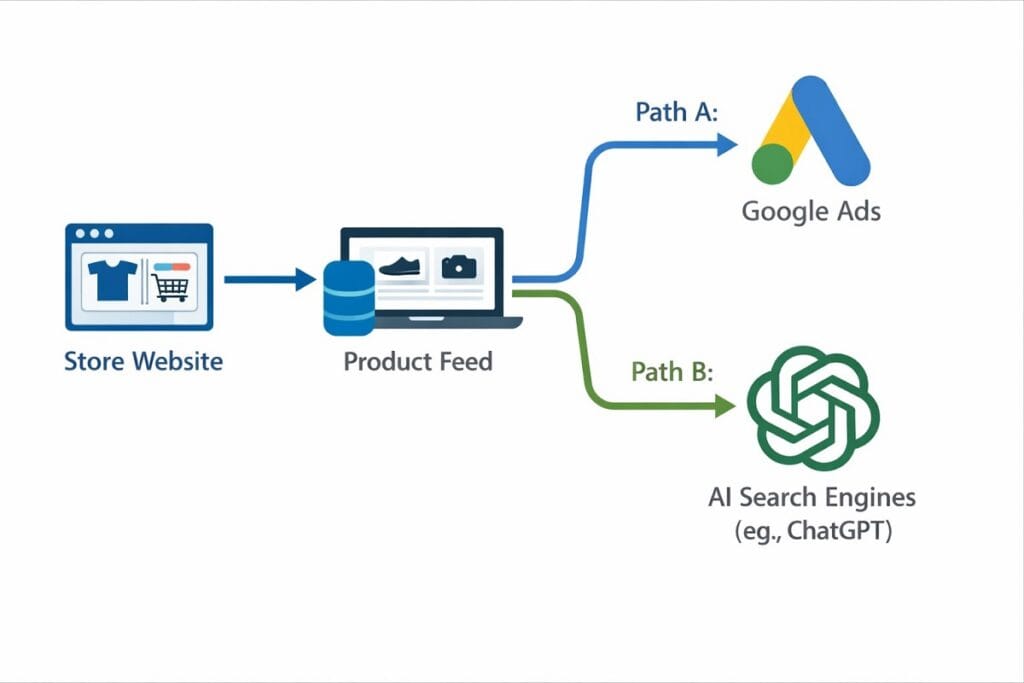
The AI acts like a smart personal shopper. It reads the Google Shopping Graph and builds a short list. If you are not on that list, you lose the customer completely.
Your Product Feed Was Built for Google Ads. AI Works Differently.
For years, feeds were just a tool for paid ads. You uploaded a list, set a budget, and hoped for clicks.
Tools like Amazon Rufus do not care about your ad budget. They care about facts. They want exact details to answer specific questions.
| Feature | Traditional Paid Feed | AI Organic Feed |
| Main Goal | Win ad auctions. | Answer user questions. |
| Titles | Stuffed with keywords. | Written like normal sentences. |
| Details | Basic info is enough. | Deep attributes are required. |
| Cost | Pay per click. | Free organic traffic. |
The Real Reason Your Products Don’t Show Up in ChatGPT or Perplexity
AI ignores your products because your data is weak. These tools do not guess. They read structured data.
If a buyer wants a “waterproof blue hiking jacket,” the AI looks for those exact words. If your feed just says “Jacket Blue,” you lose.
AI Search Won’t Find Your Products If You’re Doing This
You must fix feed errors right now. AI will skip you if you keep doing these things:
- Writing lazy titles that miss key details.
- Leaving attributes like sizes, colors, or dimensions blank.
- Forgetting to add the exact barcode.
- Showing items as in stock when they are actually out of stock.
How to Get Your Products Found in AI Search (Without Paid Ads)
Why You Need an Organic Product Feed Now
You need a dedicated organic product feed. This is your best tool for AI product feed optimization.
An organic feed focuses on natural language. It trains the AI to understand exactly what you sell so you can win organic product listings.
Simple and Direct Steps to Fix Your Data
You can fix this easily. Follow these steps to clean up your Google Merchant Center data:
- Write clear, natural titles.
- Add the correct Global Trade Item Number to every single item.
- Fill out every attribute box available.
- Make sure your website matches your feed perfectly.
The Real Numbers
Stat 1: Users now click traditional search results only 8% of the time when an AI summary appears on the page, and AI Overviews are now triggering on 48% of all queries. That means almost half the time someone searches, AI is answering them directly, and most people never scroll past it.
Stat 2: In the beauty category alone, 98% of ChatGPT’s shopping citations went to third-party sources like publishers and retailers. Only 25% of AI-cited sources were brand-owned. Translation your product detail page, which you spent real money building, is barely in the game.
A Wise Word
“Optimizing your feed is no longer a backend task. It’s a visibility strategy.” — Neil Patel, Co-Founder, NP Digital
What this means in plain English: your product feed used to be something you handed off to the tech team and forgot about. Now it’s the thing that decides whether AI can find you at all. It’s not a spreadsheet. It’s your storefront.
Key Information at a Glance
| Feature | Why It Matters | How It Helps You |
|---|---|---|
| Human-sounding titles | AI interprets natural language queries into semantic filters, not keyword matches | Your products show up when someone types “best rain jacket for commuting,” not just “men’s jacket” |
| Complete product attributes | Missing data quietly disqualifies you from entire categories of queries – it’s binary: you’re either matched or invisible | Filling in material, use case, audience, and fit notes puts you in front of the right buyer |
| Consistent data everywhere | Contradictory product data across your feed, website, and schema can dramatically reduce your likelihood of appearing in AI-powered results | Your feed, your site, and your schema all telling the same story builds trust with AI systems |
| Specific, factual descriptions | Content with clear factual claims is up to 40% more likely to be cited by generative AI systems | “Burns for 60 hours” beats “long-lasting” every single time |
Simple Tips You Can Use Today
Start Small: Don’t try to rebuild your entire feed this week. Pick your top 20 products and rewrite just the titles. Read them out loud. Do they sound like something a real person would type into Google or ask ChatGPT? If not, that’s your starting point.
Ask Why: When AI skips your product, it’s usually not mysterious. Ask: is my title too vague? Are my attributes empty? Does my feed say something different than my website? The answers are almost always in one of those three places.
Keep Track: AI shopping features typically surface products four to six weeks after feed submission. So keep a simple log of what you changed and when. You’ll need it to know what’s actually working.
A Surprising Fact
Did you know that a smaller brand with a perfectly structured feed can now beat a major retailer in AI search results?
Most people assume AI search works like traditional Google, where big brands with massive ad budgets always win. But this shift levels the playing field. A brand with a niche product but a perfectly structured feed can now show up alongside big-box retailers in AI-powered results. But if your product feed is messy, incomplete, or inconsistent, you might get skipped over entirely, even if you have the best product for the job.
The brands winning in AI search right now aren’t always the biggest. They’re the most readable.
The Bottom Line
AI isn’t ignoring your product feed out of spite. It’s ignoring it because the feed wasn’t built for it. It was built for paid auctions, not for answering a human’s question.
The fix isn’t complicated. Write titles the way your customers actually talk. Fill in every attribute you’ve been leaving blank. Make your data consistent across your feed, your site, and your schema. Use specific numbers and real descriptions instead of marketing fluff.
That’s it. Those are the puzzle pieces. And right now, while most of your competitors are still running their old paid feed on autopilot, putting them together is the easiest competitive edge you’ve got.
Frequently Asked Questions
Why are my products not showing up in ChatGPT?
ChatGPT uses Google Shopping data for product answers. If your feed is missing key details like sizes or barcodes, the AI ignores your items. ChatGPT needs rich context to confidently recommend your brand over a competitor.
Does AI look at my Google product feed?
Yes. AI platforms like Google Gemini and ChatGPT rely heavily on structured product feeds. They use this organized data to understand your inventory and answer complex shopper questions directly.
What is an organic product feed?
An organic product feed is a list of items made specifically for free search results. It uses natural words to answer questions, rather than stuffing keywords to win paid ads.
What data matters most for AI product searches?
The most critical data points are natural titles, accurate pricing, exact stock levels, and detailed attributes. Filling out details like color, weight, and material gives AI the exact facts it needs.
How do I optimize my product feed for AI search?
Write titles like normal sentences, include exact barcodes, list all features, and match your inventory to your website. Clean, complete data is the only way to earn AI recommendations.

Hi, I am Khalid. I am an SEO and AI Search Specialist.
My goal is simple: I help your business get found by the right people.
For a long time, getting found just meant showing up on the first page of regular Google search. Today, the internet is changing. People are asking their questions to AI tools like ChatGPT and Google’s new AI features.
My job is to connect the old way of searching with the new way. When a potential customer asks an AI a question about what you do, I make sure your business is the trusted answer they get.
I do not use confusing words or secret tricks. I use clear and honest plans to get you noticed and bring real buyers straight to your website.
Want to see how I can make your brand the top answer? Connect with me on social media or read my exact steps at khalidseo.com.