Traffic is sliding and your client wants to know why. You pull up Search Console, and the impressions are holding. But clicks are down, and the AI Overview is sitting right where your featured snippet used to be. You know SEO is not dead, but you cannot quite explain why to the room.
That uncertainty is expensive. Budgets get cut when leaders cannot see the return. Strategies get abandoned right before they compound. Agencies lose retainers not because the work stopped working, but because no one could translate what “working” looks like now.
Here is the honest answer: SEO still has a long game, but the scoreboard changed. This article gives you the framework to read the new one and a scored audit to find exactly where your content stands today.
What “Ranking” Even Means in AI Search (And Why the Old Definition Is Getting You Confused)
Ranking used to mean one thing: position on a blue-link results page. It now means two things that require different strategies. The first is visibility for humans, measured in clicks and conversions. The second is visibility for AI systems, measured in citations and answer inclusion. Most practitioners are optimizing for the first and wondering why the second is not following.
These are not the same outcome. A page can rank first and never appear in an AI answer. A page can sit at position six and get pulled into every AI Overview for that query. The split is real, and pretending it is not is why so many SEO strategies feel broken right now.
How Google AI Overviews, Perplexity, and ChatGPT Search Source Content Differently
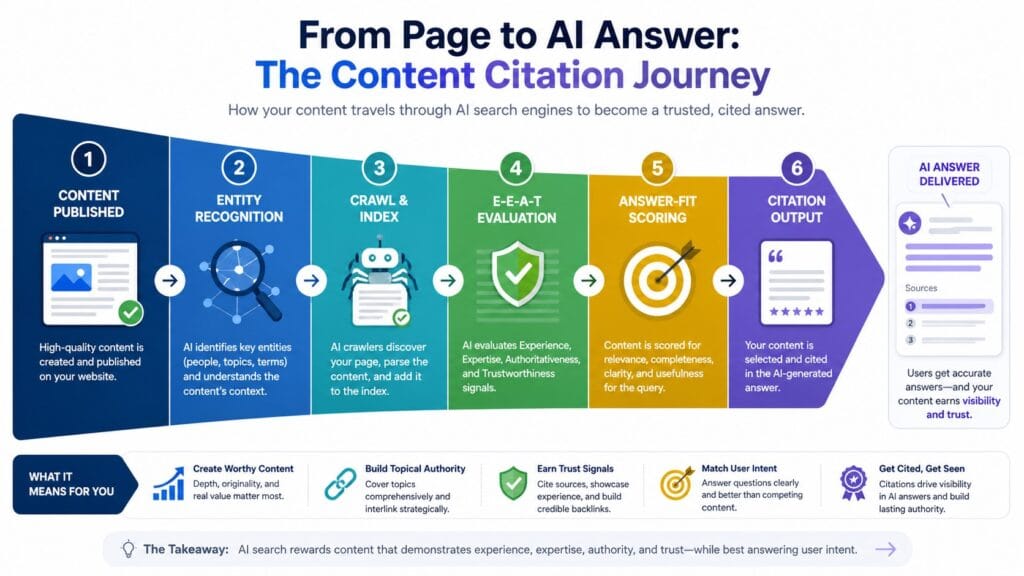
There is no single AI search algorithm to optimize for. Google AI Overviews, Perplexity, and ChatGPT Search each use a different sourcing logic, and confusing them leads to the wrong fixes.
Google AI Overviews pull predominantly from pages already ranking in the top 10 organically. Strong traditional SEO is still the entry requirement. Perplexity operates differently. It runs a real-time crawl, surfaces citations visibly to users, and favors content that is direct, structured, and verifiable. ChatGPT Search pulls from Bing’s index with a clear preference for sources that are citable and clearly structured. BrightEdge and Semrush research consistently shows these platforms disagree on sourcing for the same query.
This matters because the fix for one platform is not always the fix for another. Gaining traction in Perplexity requires different content signals than moving up in Google AI Overviews. Knowing which platform your audience uses most is no longer optional background knowledge.
Why Your Page Can Rank #1 and Still Be Invisible to AI Answers
AI systems do not select the most authoritative page for a query. They select the most directly useful response. A #1 ranking page that buries its answer in paragraph six will consistently lose to a lower-ranking page that opens with a clean, two-sentence answer.
This is the concept of answer-fit, and it is separate from domain authority, backlink count, or even E-E-A-T scores. Those signals get you into consideration. Answer-fit determines whether you get cited. The implication is uncomfortable for anyone who has spent years optimizing page authority: the page structure matters more than the page’s reputation at the moment of AI answer generation. Fix the structure first.
The Case for SEO’s Long-Term Relevance (Built on Actual Evidence, Not Reassurance)
SEO is not dying. It is bifurcating. The evidence for its continued relevance is not optimistic speculation – it is structural. AI systems need indexed web content to answer questions. They cannot cite what they cannot find. Pages with strong topical authority, clear entity signals, and E-E-A-T depth are the ones being pulled. Those are exactly the pages good SEO produces.
What the Traffic Data Is Actually Telling You (And What It Isn’t)
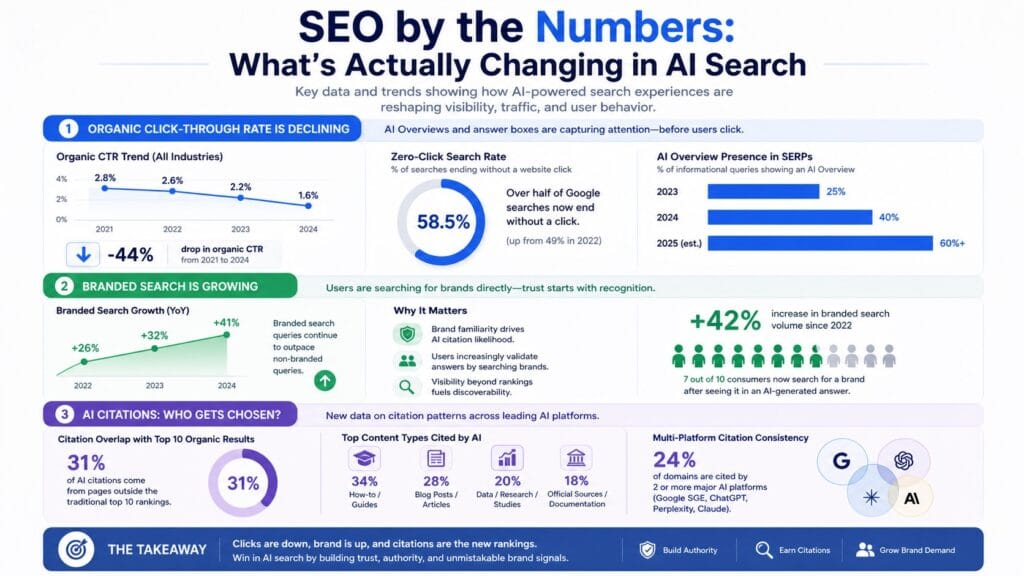
Click-through rate decline is real. It is not evenly distributed. Informational queries – “what is,” “how does,” “why does” – are absorbing most of the AI Overview impact. These are the queries where the answer fits cleanly into a generated response. Transactional and navigational queries are largely holding. Branded search is growing in many categories, not shrinking.
The strategic response is not the same for every content type. Informational content needs to shift toward citation optimization, not click optimization. Transactional and navigational content should still be optimized the traditional way. Treating declining clicks on informational queries as a total SEO failure is a misread of the data.
Brand Search Volume as the New Leading Indicator
When an AI system cites your brand in an answer, users who trust that answer search for you by name. Brand search volume becomes a downstream signal of AI citation activity. Most practitioners are not tracking this connection, which means they are missing the one metric that links AI visibility to real-world business impact.
Track branded search volume in Search Console alongside traditional ranking data. A rising brand search trend alongside flat organic clicks is not a problem. It is evidence that AI citation is working and that the measurement framework needs updating, not the strategy.
What Answer Engine Optimization Actually Is (And How It Differs from What You’re Already Doing)
Answer Engine Optimization (AEO) is the practice of structuring content to be cited or quoted by AI-powered search tools, including Google AI Overviews, Perplexity, and ChatGPT Search. Unlike traditional SEO, which targets ranked positions, AEO targets the AI answer layer directly through directness, content structure, and authority signals.
The distinction is not semantic. Traditional SEO asks: how do I rank higher? AEO asks: how do I become the source an AI system quotes? The tactics overlap, but the intent is different. Understanding that difference changes how you brief writers, structure pages, and measure success.
| Dimension | Traditional SEO | Answer Engine Optimization |
|---|---|---|
| Primary goal | Rank in the blue-link results page | Be cited in AI-generated answers |
| Success metric | Click-through rate, position ranking | Citation frequency, AI answer inclusion |
| Content structure | Keyword placement, depth, authority signals | Direct answers first, question-format headers, schema markup |
| Authority signals | Backlinks, domain authority, E-E-A-T | E-E-A-T, entity recognition, topical authority depth |
| Schema priority | General structured data | FAQ, HowTo, Definition schema |
| Best for | Navigational and transactional queries | Informational queries, definition searches, process queries |
The Content Structures That Get Cited by AI Systems
Content that gets cited by AI search engines shares one structural trait: the direct answer appears in the first one to two sentences of each section, before any context, background, or transition.
Most content is structured for human reading flow. That means easing in, providing context, then delivering the answer. AI systems do the opposite. They scan for the answer first and use surrounding content to evaluate credibility. Every H2 and H3 in your content should open with the answer, not with the setup. Write the punchline first. Use question-format headers so the AI knows what is being answered. Apply FAQ schema to any page with a Q&A structure and HowTo schema to any process content.
How to optimize content for AI search answers:
- Answer the query in the first sentence of each section
- Use question-format H2 and H3 headers throughout
- Implement FAQ schema on pages with explicit Q&A structure
- Apply HowTo schema to any step-based or process content
- Build topical authority through cluster-based content architecture
- Earn citations from authoritative external sources in your niche
Schema Markup That Still Moves the Needle
FAQ and HowTo schema are the two types with a direct and documented relationship to AI answer inclusion. FAQ schema tells search systems there is a structured question-and-answer relationship on the page. HowTo schema signals a process that can be extracted and presented step-by-step. Article schema alone does not meaningfully increase citation probability. Validate all structured data through Google’s Rich Results Test before publishing. A schema error is worse than no schema – it creates a false signal that damages crawl trust.
Building Topical Authority for AI Search (The Cluster Model That Works for Humans and Machines)
AI systems are more likely to cite sources that show deep, consistent coverage of a topic over time. A single well-written page on AEO is a weaker citation candidate than a site with ten interconnected pieces covering every dimension of AEO from definition to implementation to measurement. The content cluster is not just an SEO tactic. It is the proof of authority that AI systems use to decide who knows what.
The five-cluster model required to own this topic space covers: AI search mechanics, topical authority and entities, AEO and content structure, traffic measurement in a zero-click world, and the forward-looking LLMO playbook. Each cluster needs a pillar page and at least three supporting articles. None of them work in isolation.
How Internal Linking Communicates Topical Authority to AI Systems
Internal linking patterns tell AI systems something specific: this page exists within a network of related, credible content. A page on AEO that receives internal links from five other pages on semantic SEO, structured data, and topical authority sits in a richer semantic neighborhood than an isolated page on the same subject. That neighborhood is a signal. It tells the AI system that the source is not a one-off opinion but part of a sustained body of work.
Use anchor text that reflects the actual topic relationship, not just the page title. Link from specific claims to the deeper article that supports them. The internal link should feel like a citation, because that is exactly what it is.
How to Measure SEO Success When Click-Through Rate Is No Longer the Whole Story
The right measurement framework for AI search uses four metrics: branded search volume trend, share of voice in AI citations, topical authority score against competitors, and traditional impressions and position data from Search Console.
Click-through rate alone cannot tell you whether your SEO is working in an AI search environment. It can only tell you whether people who saw your result chose to click it. That is one signal among four, and it is the one most distorted by AI Overview behavior on informational queries.
How to Explain AI Search Impact to Clients Who Only Look at Rankings
Lead with what held. Impressions are stable on most sites even where clicks declined – that is your opening. Then show brand search volume as a positive trend where it exists. Frame declining clicks on informational queries as expected behavior given AI Overview expansion, not as campaign failure. The narrative is: the distribution of value in search changed, and our strategy is evolving to capture value in the new distribution.
Give clients a number they can hold. A topical authority score relative to two or three competitors, tracked monthly, gives stakeholders a metric that reflects strategic progress without depending on click behavior AI Overviews are actively suppressing.
Your AI Search Visibility Audit – Score Your Content Before You Rewrite Anything
The AI Search Visibility Audit scores your content across four weighted categories – Content Structure, Entity and Authority Signals, Technical Readiness, and Content Quality and AEO Fit – each worth 25 points, for a total of 100.
Before rewriting anything, run the audit. Most content has a clear failure pattern in one or two categories and is solid in the others. Knowing which category is dragging the score down tells you exactly where to spend the next 30 days.
Content Structure (25 pts)
- Pages use clear H2/H3 question-based headers
- Direct answer is given within the first 100 words of each section
- FAQ schema is implemented on key pages
- HowTo schema is used on process-based content
Entity and Authority Signals (25 pts)
- Author bio with credentials is present on content pages
- Brand is mentioned or linked on authoritative third-party sites
- Google Knowledge Panel exists for the brand or key individuals
- Internal linking reflects a clear topical cluster structure
Technical Readiness (25 pts)
- Structured data validates without errors in Google’s Rich Results Test
- Core Web Vitals pass on mobile
- Site is crawlable with no major indexation blocks
- XML sitemap is current and submitted
Content Quality and AEO Fit (25 pts)
- Content directly answers the query without burying the lead
- Pages cite reputable external sources
- Content has been updated within the last six months
- Reading level is appropriate for the target audience
| Score | What It Means |
|---|---|
| 0–40 | High risk. Your content is largely invisible to AI answer engines. Start with structure and schema. |
| 41–65 | Partial visibility. Gaps in entity authority or content structure are costing you citations. |
| 66–85 | Good foundation. You are in consideration. Deepen topical authority and improve content freshness. |
| 86–100 | Strong AI search readiness. Focus on expanding cluster depth and monitoring citation performance. |
AI Search Visibility Audit Checklist
Check the boxes below to evaluate your content’s Answer Engine Optimization (AEO) readiness.
The Forward-Looking Playbook – What to Keep, What to Drop, and What to Learn Next
SEO strategies that still work in AI search share a common trait: they build genuine signals that AI systems can evaluate. Backlink building from authoritative sources still matters. Topical cluster development still matters. E-E-A-T investment – author credentials, external citations, fact-checked content – still matters. Technical SEO still matters as the baseline that gets you into the indexation pool.
Keep: Backlink building from relevant, authoritative sources. Topical cluster architecture. E-E-A-T investment at the author and brand level. Core Web Vitals and technical crawlability. Structured data implementation on all content types.
Drop: Chasing individual keyword rankings without a cluster strategy behind them. Thin content written to target a single query. Keyword density as a quality signal. Introductory padding that delays the answer.
Learn next: LLMO – how large language models evaluate and weight source content. Entity-based SEO – how to build Knowledge Graph recognition for your brand and key authors. AEO content formatting – the structural rules that increase citation probability. AI citation tracking – how to measure where and how often your content is being sourced across AI platforms.
Two numbers that reframe everything:
68% — The share of URLs appearing in Google AI Overviews that also rank in the top 10 organic results, which means traditional SEO is still the entry requirement for AI citation, not an alternative to it. (Source: Semrush AI Overviews Study, 2024)
58.5% — The percentage of Google searches in 2024 that ended without a click, concentrated almost entirely in informational queries — which tells you exactly which content type needs a new optimization strategy and which does not. (Source: SparkToro / Datos Zero-Click Search Study, 2024)
The Insight That Changes How You Think About This
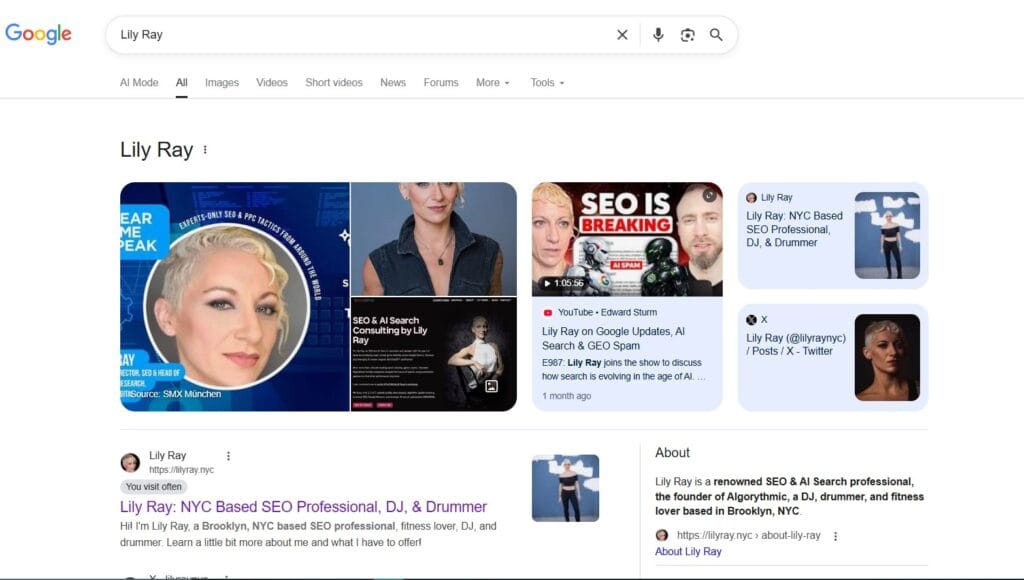
“The sites that will win in AI search are the ones that already won in semantic search — entities, authority, and topical depth. The tactics changed. The fundamentals didn’t.” — Lily Ray, VP of SEO Strategy & Research, Amsive
What this actually means in practice: If your content strategy was built on keyword volume and thin coverage, AI search accelerates your decline – it does not cause it. If your strategy was built on genuine topical authority and E-E-A-T signals, you are already most of the way to AI citation readiness. The gap between those two positions is not closing. It is widening.
What You Actually Need to Know (At a Glance)
| Factor | Why It Matters | What to Do With It |
|---|---|---|
| Answer-fit beats authority in AI citation selection | AI systems scan for the direct answer first, then evaluate the source — a lower-ranking page that opens with a clean answer beats a #1 page that buries it | Rewrite the opening of every high-priority page so the direct answer appears in the first two sentences, before any context or setup |
| Branded search volume is a downstream AI citation signal | When AI systems cite your brand in answers, users search for you by name — brand search growth is measurable evidence that AI citation is working | Add branded search volume trend to your monthly reporting dashboard alongside traditional rankings and impressions |
| Topical cluster depth signals sustained authority to AI systems | A single strong page on a topic is a weaker citation candidate than a network of interconnected pages covering that topic from every angle | Audit your existing content against the five-cluster model — identify which clusters are incomplete and prioritize filling gaps before producing new standalone content |
Three Things You Can Apply Before Tomorrow
1. Audit one page for answer-fit, not keyword coverage. Pick your highest-impression informational page. Find the H2 that matches the primary query. Check whether the direct answer appears in the first two sentences of that section. If it does not, that is the single fix most likely to improve AI citation probability. Restructure that section before touching anything else.
2. Run a branded search check in Search Console. Filter your Search Console data by queries that include your brand name. Compare the trend over the last 90 days to the prior period. If branded search is growing while informational click-through rate is declining, AI citation is likely working in your favor and your measurement framework is not capturing it. That data point changes the client conversation.
3. Map your existing content to the cluster model. Before writing anything new, list every published piece you have on this topic and group them by cluster. Most sites will find they have partial coverage in three or four clusters and zero coverage in one or two. The missing cluster is almost always the highest-priority next piece to write, not a new standalone article on a trending angle.
The Counterintuitive Truth Most People Miss
Here is what the data actually shows: the click-through rate drop from AI Overviews is concentrated almost entirely in informational queries and that is precisely the query type where ranking without clicking was already common.
The default assumption is that AI search is cannibalizing SEO value uniformly across all query types. What researchers at BrightEdge and SparkToro found is that transactional and navigational queries are largely unaffected by AI Overview insertion. The mechanism is straightforward: AI systems answer questions, not purchase decisions. A user searching “best project management software for remote teams” still needs to click something to evaluate, compare, and buy. An AI Overview does not close that loop for them.
This one shift – from treating AI search as a universal SEO threat to treating it as a query-type-specific challenge – is where most of the real strategic clarity comes from. Informational content needs citation optimization. Everything else needs the same SEO work it always did.
Frequently Asked Questions
Is SEO still worth investing in now that AI search is taking over?
Yes. AI search engines source their answers from indexed web content. Pages with strong topical authority, clear structure, and E-E-A-T signals are the ones getting cited. Strong SEO and strong AI citation require the same foundational work.
The tactical emphasis shifts, but the investment logic does not. Businesses that pull back on SEO in response to AI search are removing themselves from the exact sourcing pool that AI systems draw from. The risk of under-investing in SEO right now is not lower traffic — it is becoming invisible to both human searchers and AI-generated answers simultaneously. The two outcomes are increasingly linked.
How does Google’s AI Overview decide which pages to cite?
Google AI Overviews pull from pages already ranking in the top 10 organically. From there, the system filters for direct answers, clear structure, and strong E-E-A-T signals. Organic ranking is still the entry requirement.
Answer-fit determines what gets selected from that shortlist. A top-ranking page that does not open with a direct answer will lose to a lower-ranking page that does. Google’s sourcing behavior for AI Overviews has been analyzed by BrightEdge and Semrush, both of which consistently show that the overlap between AI-cited pages and top-10 organic results is high — but not total. Structure is the differentiator inside the shortlist.
What is Answer Engine Optimization and how is it different from traditional SEO?
Answer Engine Optimization (AEO) is the practice of structuring content to be cited by AI-powered search tools. Unlike traditional SEO, which targets ranked positions, AEO targets the AI answer layer directly through content structure, directness, and authority signals.
Traditional SEO optimizes for click-through from a results page. AEO optimizes for inclusion in an answer that may never generate a click at all. The content signals that drive each outcome overlap significantly — E-E-A-T, topical authority, structured data — but the formatting requirements diverge. AEO demands that the answer appear immediately. Traditional SEO allows for context-setting before the payoff. Writing for both simultaneously requires a deliberate structure: answer first, context second.
How do I optimize my content to appear in AI search answers?
Structure content so the direct answer appears within the first two sentences of each section. Use question-format headers, implement FAQ and HowTo schema, build topical authority through content clusters, and keep content updated and externally cited.
The order of priority matters. Start with content structure — answer placement and header formatting — because that is the fastest fix with the highest citation impact. Move to schema implementation next, since it gives AI systems an explicit structural signal. Build topical authority over time through cluster development. Freshness and external citations function as ongoing maintenance signals. None of these steps require starting from scratch. Most sites have content that is 70% of the way there and needs structure work more than new content.
Will AI search completely replace traditional search engines?
No, and not in any near-term timeframe. Traditional search engines are integrating AI capabilities, not being replaced by them. Most navigational and transactional queries still resolve through blue-link results.
The search landscape is fragmenting, not flipping. AI-native tools like Perplexity are growing, but they serve a research-oriented use case that occupies a different moment in the user journey than a Google navigational query. Informational queries are the segment where AI search is making the deepest inroads. That matters for content strategy. It does not signal the end of search as an acquisition channel. It signals that different query types now require meaningfully different optimization approaches.
What SEO strategies still work in an AI-first search environment?
The strategies that work are those that build genuine, evaluable signals: topical authority through content clusters, entity recognition, direct and well-structured answers, authoritative backlinks, and strong E-E-A-T. Tactics built on manipulation or thin content are accelerating their own irrelevance.
The underlying logic of good SEO — be the best, most credible, most clearly structured answer to a real question — maps directly onto what AI systems are trying to surface. Practitioners who built sustainable strategies before AI search are better positioned than those who relied on tactical workarounds. The practitioners in trouble are the ones whose rankings depended on volume-based content production without topical depth. That approach has no future in either traditional or AI search.
SEO Is Not Dying. It Is Splitting Into Two Jobs at Once.
The practitioners who treat AI citation and human ranking as two separate problems will do twice the work for half the result. The practitioners who recognize that topical authority, answer-fit content, and E-E-A-T signals drive both outcomes will work the same way they always have – just with a clearer understanding of where their results show up.
Start with the audit. Run your current content through the four categories, score it honestly, and identify the one category dragging your total below 65. Fix that category before touching anything else.
The sites that act on this now build a citation presence while the competition is still debating whether AI search is real. The sites that wait will be optimizing for a sourcing pool they never entered.
Watch the Video | The Zero-Click Fallacy Recalibrating SEO Metrics for AI Search 👇