Your analytics dashboard shows a traffic spike from AI referrals. Looks good, right?
Not necessarily.
That spike might mean AI tools are citing your content, but crediting someone else’s brand for it. Or mentioning your domain in a list of ten others, with zero context about who you are or why you matter.
This is the new visibility trap. AI search doesn’t show you rankings. It doesn’t send consistent clicks. It decides silently whether your brand is worth mentioning at all.
And most brands have no system to measure whether they’re winning or quietly disappearing.
This guide builds that system. You’ll walk away with a 3-layer framework that measures your citation share, authority weight, and AI sentiment and a clear action plan to improve all three.
What Is Brand Visibility in AI Search and Why Your Current Metrics Are Missing It
Brand visibility in AI search is how often, how prominently, and how credibly your brand appears inside AI-generated answers across platforms like ChatGPT, Perplexity, Google AI Overviews, and Microsoft Copilot.
It is not the same as referral traffic from those platforms.
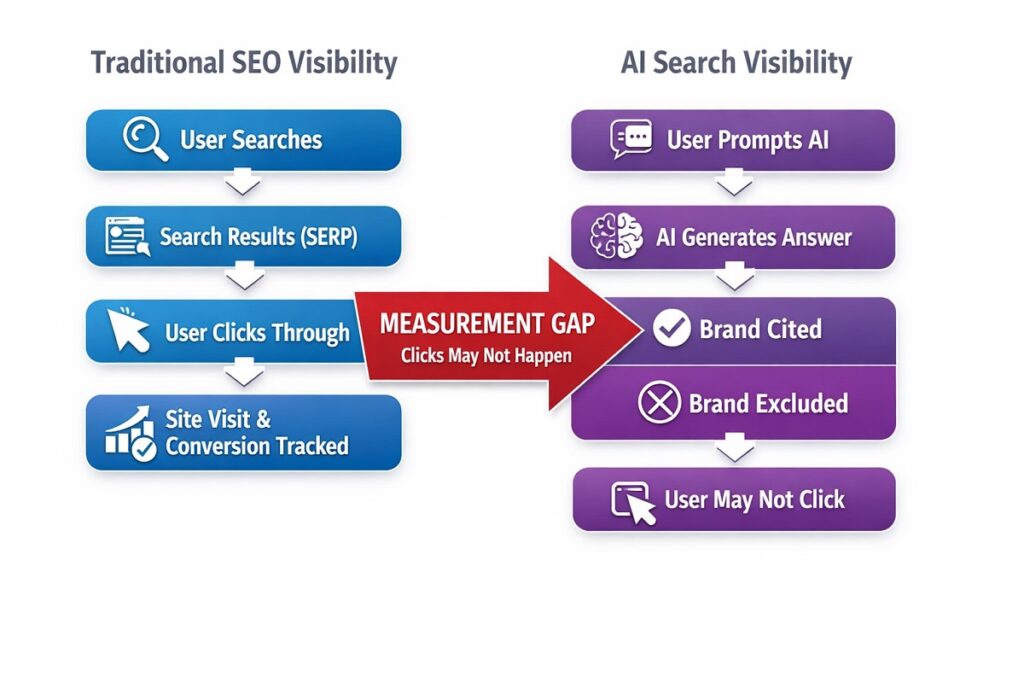
Here is the gap most teams miss: when a user asks ChatGPT “what’s the best project management tool,” they may never click anything. But the brand mentioned first described as the authority earns trust and recall that influences the next purchase decision. That influence never registers in Google Analytics.
The old model: impressions → clicks → conversions. Visibility meant your link appeared and people clicked it.
The new model: prompts → AI answers → brand inclusion (or exclusion). Visibility means the AI chose to mention you at all and how it described you when it did.
Why AI traffic growth is a misleading signal
When AI platforms surge in popularity, some brands see a jump in referral traffic. This feels like proof that AI search is working in your favor.
Often, it is not.
AI tools prioritize high-domain-authority aggregators – Reddit, Wikipedia, Quora, because they combine multiple viewpoints, attract constant engagement, and carry broad consensus signals. Your original research may be the source, but the aggregator gets the citation.
Even when your domain does get cited, the user may not process your brand name at all. They see a numbered source list. They click, read, and leave without forming any connection between the content and Khalid SEO (or your brand).
Traffic without recognition is not visibility. It is just a visit.
The three layers of AI visibility that actually matter
Once you accept that clicks are an incomplete signal, you need three new measurements:
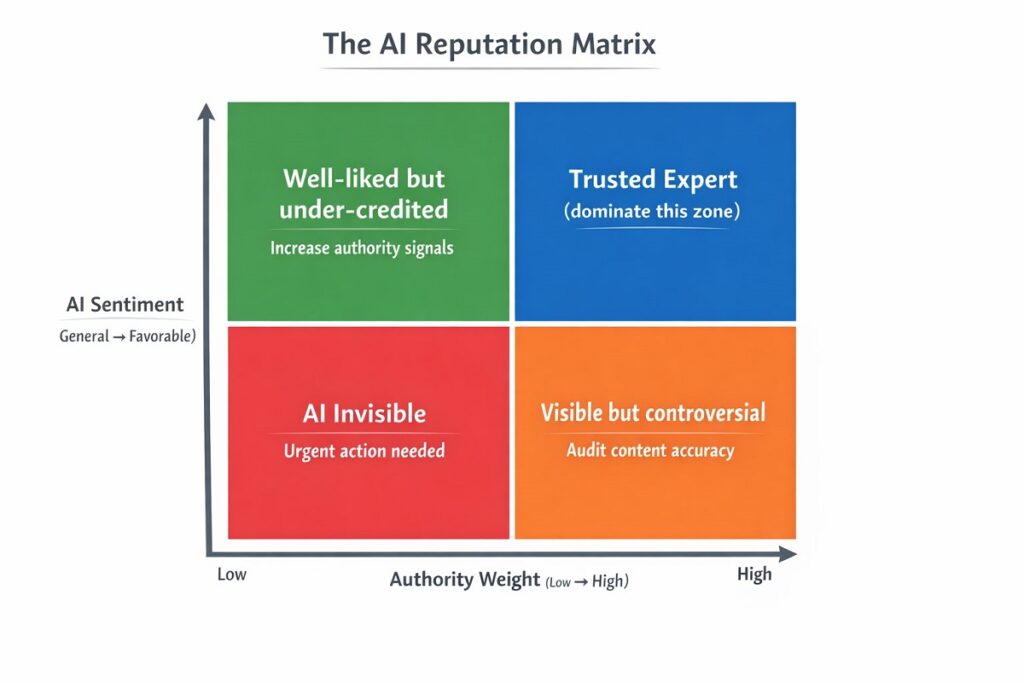
- Citation share — what percentage of AI-generated answers in your category mention your brand versus competitors
- Authority weight — whether AI frames you as a definitive source (“According to [Brand]…”) or a supporting one (“other sources include…”)
- AI sentiment — whether the tone of those mentions is favorable, general, or absent entirely
These three form what we at Khalid SEO call the AI Reputation Index a composite score you can track month over month. More on how to calculate it in section four.
How to Track Your Brand’s Citations in AI Search Engines (3 Methods, Ranked by Effort)
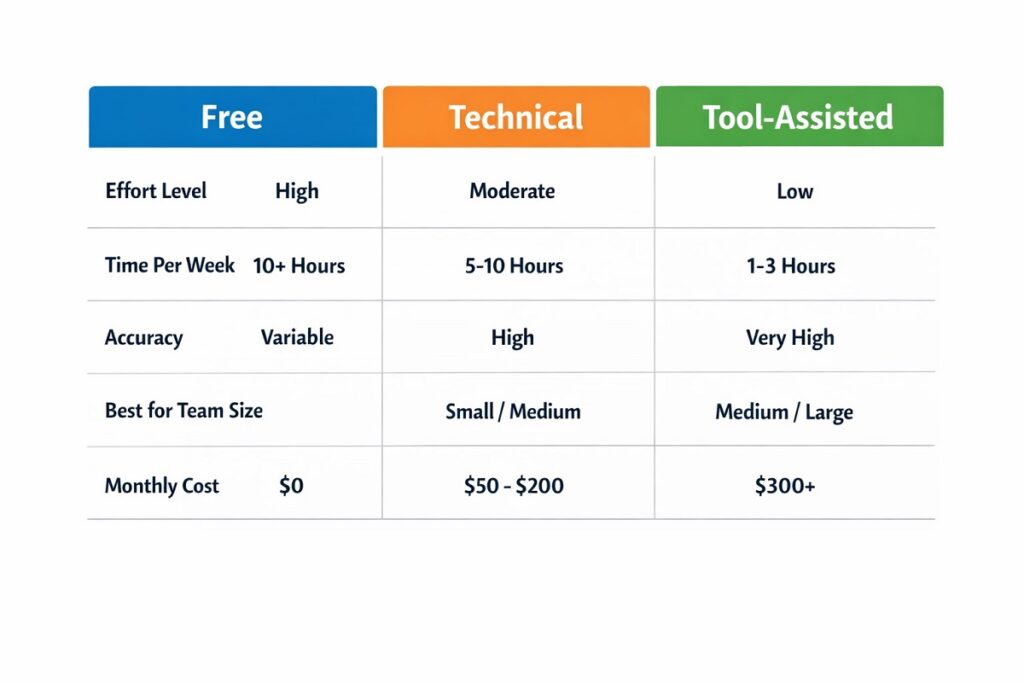
Before you can benchmark or improve your AI visibility, you need a reliable way to monitor it. There are three approaches, each suited to a different budget and team size.
Method 1 (Free): Manual LLM snapshot tracking
This costs nothing. It requires only a spreadsheet and 30–60 minutes per week.
How to set it up:
- Choose 8–12 priority queries your target audience would ask an AI tool (e.g., “best [your category] tools,” “how to [your core topic],” “what is [your primary concept]”)
- Query ChatGPT, Perplexity, and Google AI Overviews with each question — once per week or month
- Log results in a Google Sheet with these columns: Date | Platform | Query | Brand mentioned (Y/N) | Citation type (Definitive / Supporting / Absent) | Competitor mentions
- After four weeks, calculate your baseline citation rate per platform
The pattern you are looking for: are you appearing consistently, sporadically, or not at all? Is your frequency increasing or dropping? These shifts are your early warning system.
Limitation: This is time-intensive and not scalable beyond a small keyword set.
Method 2 (Technical): Custom AI SERP crawls with Puppeteer
If your team has developer resources, automating screenshot captures of AI responses gives you a scalable, repeatable audit trail.
Puppeteer is a Node.js browser automation library. You write a script that opens Perplexity or Google AI Overviews for a set of queries, captures the response, and saves it as a screenshot or text file.
Basic workflow:
- Install Node.js and run
npm install puppeteerin a new project folder - Write a script that loops through your target queries, navigates to each AI platform, waits for the response to load, and captures the output
- Store snapshots in dated folders — this gives you a visual changelog of how AI responses about your category evolve over time
- Review screenshots weekly: note whether your brand is cited, what language surrounds the mention, and which competitors appear alongside you
This method is best for teams tracking 50+ queries or running scheduled visibility audits for clients.
Method 3 (Tool-assisted): Dedicated AI visibility platforms
Several tools now automate the entire citation tracking process including sentiment classification and competitive benchmarking.
| Tool | Best for | Key feature | Free tier |
|---|---|---|---|
| Semrush AI SEO Toolkit | Full-stack AI visibility tracking | AI Visibility Score (0–100), sentiment, cited pages | No |
| Rankscale | Competitive share of AI mentions | Time-series trend visualization | Limited |
| Otterly AI | AI sentiment monitoring | Favorable vs general mention classification | Yes |
| Peec AI | Topic-level citation performance | Content category breakdown | Yes |
| Conductor | Enterprise citation tracking | AI mention tracking at scale | No |
| Manual snapshots | Any budget | Free, requires only a spreadsheet | Yes |
Khalid SEO’s recommended stack by team size:
- Solo consultants or small agencies → Manual snapshots + Otterly AI (free tier)
- Mid-size teams → Rankscale + manual spot-checks
- Enterprise or SEO agencies → Semrush AI SEO Toolkit + Looker Studio integration
How to Measure Your Share of AI Citations and Benchmark Against Competitors
Knowing you are cited is step one. Knowing how much of the conversation you own, compared to competitors is where strategy begins.
Define your AI competitive set first
Your competitive set in AI search is not identical to your traditional SEO competitors. It has two distinct groups.
Direct competitors are the brands your audience would compare you against directly same product category, same target audience.
Answer competitors are high-authority sources that dominate AI citations without selling anything in your space: Reddit threads, Wikipedia articles, G2 review pages, industry association sites. These are often the entities quietly absorbing the visibility that should belong to your brand.
Build a list of both types before running any benchmarking. If you only track direct competitors, you will miss the aggregators taking the largest share.
The citation share formula
Once you have tracked mentions for your brand and your competitive set over a defined period, the formula is straightforward:
Citation Share = (Your Brand Mentions ÷ Total Brand Mentions in Competitive Set) × 100
Example: Your brand appears in 48 AI-generated answers. Your two primary competitors appear 35 and 29 times respectively. Total = 112 mentions.
Your citation share = (48 ÷ 112) × 100 = 42.8%
Track this monthly. A declining share even if your raw mention count holds steady signals that competitors or aggregators are expanding faster than you.
How to identify your strongest content categories in AI
Not all of your content earns equal citation weight. Some topic areas will generate consistent AI mentions; others will produce none.
In Semrush AI SEO Toolkit, the Competitor Research → Topics & Prompts view shows which content categories are driving your citations and flags the topics where competitors are mentioned but you are not.
These filtered views are the highest-leverage insight in the entire tool:
- Missing topics — competitors cited, you are not → immediate content opportunity
- Weak topics — competitors cited more frequently → optimization priority
- Strong topics — you cited more than competitors → double down with more depth
- Unique topics — only your brand cited → protect these with regular content updates
Detecting AI citation consolidation before it’s too late
Citation consolidation is when AI platforms gradually narrow their trusted source pool citing fewer and fewer domains more and more often. If you are not in that narrowing pool, your share drops even if you publish consistently.
The signal to watch: your mention count holds steady month-over-month, but your citation share falls. That means the total pool of citations is growing driven by others and you are not keeping pace.
Plot your citation share as a time-series line graph alongside your two or three closest competitors. A crossing point where a competitor’s line rises above yours is a consolidation alert. Act within 60 days with content updates, structural improvements, and authority-building signals.
How to Interpret AI Sentiment and Authority Weight in Brand Citations
[This section is optimized for Position Zero — structured for featured snippet capture via ordered list format.]
Knowing your citation share tells you how often you appear. Authority weight and sentiment tell you how you appear which determines whether those mentions actually build brand equity.
Definitive vs supporting citations: what the difference means for your brand
AI-generated answers cite brands in two fundamentally different ways.
Definitive citations frame your brand as the primary authority behind a specific claim:
- “According to [Brand]’s 2025 research…”
- “[Brand] found that…”
- “Data from [Brand] shows…”
Supporting citations include your brand as one of several sources:
- “Other tools in this category include [Brand]…”
- “Sources such as [Brand], [Competitor], and [Aggregator] suggest…”
Definitive citations build brand authority. Supporting citations build brand awareness. You want both, but a portfolio heavy on supporting mentions signals that AI systems do not yet trust your brand as a primary source.
How to score AI sentiment
AI mentions fall into three tones:
- Favorable — the response actively recommends, endorses, or highlights your brand as a strong option
- General — the response includes your brand without characterization, as one item in a list
- Absent — your brand does not appear in the response at all
Tools like Semrush AI SEO Toolkit and Otterly AI classify mentions by sentiment automatically. If running manual snapshots, score each mention during your weekly review session.
Track the ratio of favorable to general mentions over time. A growing proportion of favorable mentions is the clearest sign your content strategy is working.
Calculating your authority weight score
Step 1: Run AI snapshot queries for your target keyword set (aim for at least 20 queries per tracking period).
Step 2: Extract all brand mentions from responses. Label each as Definitive (D) or Supporting (S).
Step 3: Score each mention — assign 3 points for definitive, 1 point for supporting.
Step 4: Sum the scores. Your authority weight = (D mentions × 3) + (S mentions × 1).
Step 5: Track this score monthly. A rising score means AI systems are increasingly framing your brand as a primary source, not just a list item.
Example: In October, your brand earns 6 definitive and 14 supporting citations. Authority weight = (6 × 3) + (14 × 1) = 32 points. In November: 9 definitive, 12 supporting = 39 points. That 7-point increase reflects real progress.
The AI Reputation Index: combining all three metrics into one score
The AI Reputation Index is a composite tracking metric developed at Khalid SEO. It brings citation share, authority weight, and sentiment ratio together into a single monthly score giving your team one number to report, trend, and optimize against.
AI Reputation Index = Citation Share (%) + Authority Weight Score + Favorable Sentiment Ratio (%)
This is not a rigid formula weight each component based on your strategic priority. A brand focused on category leadership should weight citation share most heavily. A brand recovering from negative press coverage should prioritize sentiment ratio.
The value of the index is in the trend, not the absolute number. Plot it monthly. An upward trend means the AI search ecosystem is increasingly associating your content with your brand name. A downward trend is an early warning before traffic drops, before leads dry up.
How to Map AI Visibility Metrics to Your Existing SEO KPIs
One of the most common internal blockers to AI visibility tracking: your team already has an SEO reporting framework, and adding new metrics feels like a separate workstream.
It does not have to be. Each AI visibility metric has a direct equivalent in the frameworks you already use.
| AI Visibility Metric | Traditional SEO Equivalent | How to Report It Together |
|---|---|---|
| Citation Share | Share of Voice (SOV) | Add “AI SOV” as a row alongside organic SOV in monthly reports |
| Authority Weight | E-E-A-T (Authoritativeness) | Flag pages with low authority weight as E-E-A-T optimization targets |
| AI Sentiment | Brand Trust / NPS | Compare AI sentiment trend against brand survey data quarterly |
| Citation frequency by topic | Topical authority by cluster | Map citation gaps directly to your content calendar |
| Competitive citation gap | Competitor gap analysis | Use “Missing Topics” reports to feed briefs directly to writers |
Citation share → share of voice
Your existing SOV report measures how much of the organic search traffic potential in a keyword set belongs to you. Add a parallel “AI SOV” metric using your citation share calculation.
Report both side by side. When organic SOV rises but AI citation share falls, AI systems are consuming your topic but crediting other sources. When AI citation share rises independently of organic rankings, your authority is growing in AI search which will eventually pull organic along with it.
Authority weight → E-E-A-T
Google’s E-E-A-T framework evaluates Experience, Expertise, Authoritativeness, and Trustworthiness. In AI search, authority weight is the closest proxy for “Authoritativeness” it measures how strongly AI systems trust your brand as a source.
Pages with low authority weight (many supporting, few definitive citations) are telling you something: the AI does not yet see that page as the expert voice on its topic. Cross-reference these pages against your E-E-A-T signals. Is there a named author? Is there firsthand data? Is there schema markup establishing the author’s credentials?
The fix is almost always the same as the E-E-A-T fix: add depth, add attribution, add original data.
How to build an AI visibility dashboard in Looker Studio
If you use Semrush, the AI SEO Toolkit connects directly to Looker Studio via a native connector.
Setup steps:
- Go to AI SEO → Prompt Tracking in Semrush
- Click the Looker Studio button and select “Visibility”
- Authorize the connector in Looker Studio
- Add fields: Estimated Traffic, Visibility Score, Average Position, Cited Pages
- Build a comparison view that shows AI visibility trends alongside your organic ranking trends on the same timeline
Once live, your team sees AI visibility drops and rises in the same dashboard where they track everything else. No separate report. No “we’ll check AI metrics separately.” One view, all signals.
How to Fix AI Visibility Blind Spots and Turn Gaps Into Content Opportunities
Every brand has topics where AI systems cite competitors or no one specific at all. These are not failures. They are the highest-value content opportunities in your entire editorial calendar.
How to identify your AI blind spots
In Semrush AI SEO Toolkit: AI SEO → Visibility → Topics & Sources → Topic Opportunities.
This view surfaces every topic where competitors appear in AI answers but your brand does not. Filter by your most strategically important topic clusters first not by volume, but by customer journey stage.
If a competitor is cited definitively for a topic that lives at the consideration or decision stage of your buyer’s journey, that is a revenue-impact blind spot. Prioritize it accordingly.
Without tool access, run your manual snapshot queries and flag every response where a competitor is cited but you are not. These are your gap topics.
The citation cliff: detecting and recovering from a sudden visibility drop
A citation cliff is a sudden disappearance your brand stops appearing in AI answers for a topic where it previously showed consistently. This can happen after an AI model update, a content refresh on a competitor’s page, or a structural change to your own site.
How to detect it: Your LLM snapshot log shows three or more consecutive weeks with zero citations on a topic where you previously had consistent mentions.
How to diagnose it: Compare the AI responses before and after the cliff. Did a new source enter the response? Did the framing of the topic shift? Did your page lose backlinks or update frequency?
How to recover:
- Refresh the affected page with updated data and a clear publication date
- Add firsthand expertise – a quote from a named author with credentials in the field
- Strengthen schema markup (FAQ, HowTo, or Article schema depending on content type)
- Build internal links from two or three stronger authority pages on your site pointing to the updated page
- Re-query AI platforms every two weeks and log when your brand re-enters the responses
On-page fixes that improve AI citation probability
Add data ownership cues. If your page contains research, statistics, or original analysis, make sure the brand attribution is explicit “According to Khalid SEO’s 2025 AI Visibility Report…” gives AI systems a citable anchor phrase.
Use structured data. FAQ schema on question-and-answer sections, HowTo schema on step-by-step processes, and Article schema with author markup all signal credibility to AI platforms pulling structured content.
Add named expert signals. An author bio with specific credentials, a headshot, and a link to a professional profile transforms a generic article into an attributed source. AI systems that evaluate E-E-A-T signals respond to this.
Strengthen internal linking. Your most cited pages should receive internal links from your site’s highest-authority content. This reinforces topical depth and signals to AI systems that the cited page sits within a trusted knowledge structure.
Keep content current. AI platforms strongly favor sources with recent publication or update dates for time-sensitive topics. If a key page has not been refreshed in 12+ months and a competitor has updated theirs recently, that is a likely cause of citation loss.
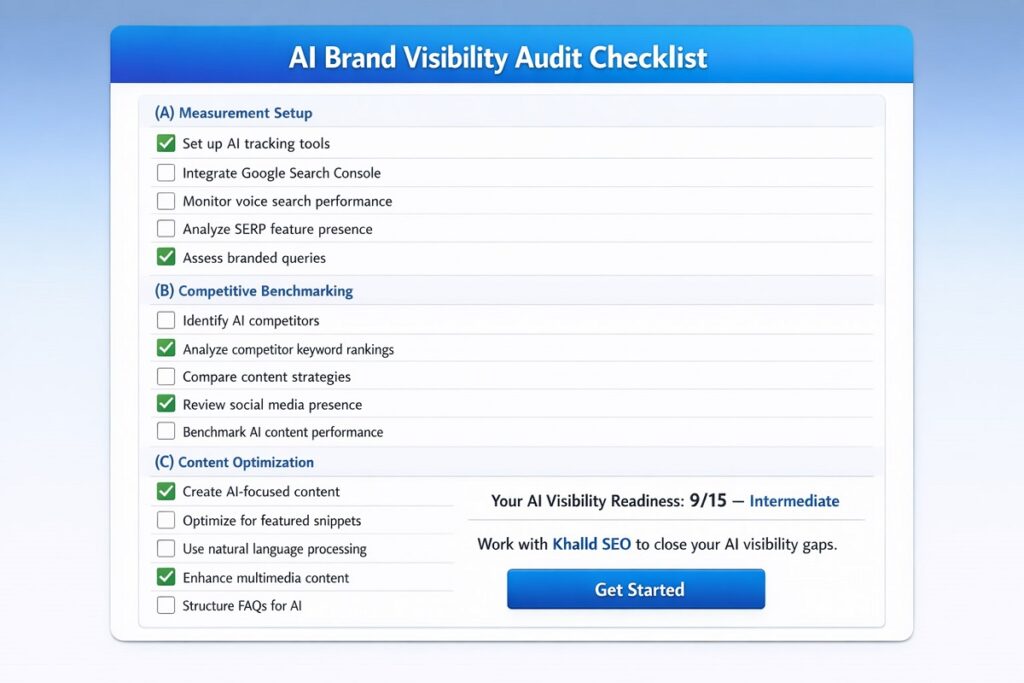
Your AI Visibility Measurement Plan: Start This Week
The goal is not a perfect system on day one. It is a baseline, something you can compare future data against.
Week 1: establish your baseline
- Choose 10 priority queries in your core topic clusters
- Run them through ChatGPT, Perplexity, and Google AI Overviews
- Log results in a Google Sheet using the snapshot tracking format from section two
- Record: which queries trigger citations, which do not, and how competitors appear
This gives you your starting citation rate. Everything you do next will be measured against it.
Weeks 2–4: benchmark and score
- Identify your three closest direct competitors and two key answer competitors (aggregators)
- Calculate your citation share using the formula from section three
- Score 20+ AI responses using the authority weight method from section four
- Classify sentiment: favorable, general, or absent
- Compute your first AI Reputation Index score
By week four, you have a composite baseline. You know your citation share, your authority weight, and your sentiment ratio all in one number.
Ongoing: integrate into monthly reporting
Add your AI Reputation Index to the same report where you track organic rankings, domain authority, and share of voice. Review it monthly.
When it rises, identify what changed which content was updated, which links were built, which new pages went live and replicate the pattern.
When it falls, run the citation cliff diagnostic from section six. Find the topic, find the cause, fix the page.
At Khalid SEO, we build AI visibility tracking into every ongoing SEO engagement because this is where brand equity is now being won and lost – quietly, in answers your customers see before they ever visit a search results page.
The brands that measure it now will be the ones AI systems trust first in 12 months.
FAQ
What is brand visibility in AI search, and why does it matter?
Brand visibility in AI search measures how often and how credibly your brand appears inside AI-generated answers from tools like ChatGPT, Perplexity, and Google AI Overviews separate from how much traffic those tools send.
It matters because AI search is projected to surpass traditional search by 2028. Users increasingly rely on AI-generated answers to make purchasing decisions without ever clicking a link. If your brand is not mentioned or mentioned poorly in those answers, you lose influence at the top of the decision funnel before a potential customer ever reaches your website. Referral traffic numbers do not capture this loss.
How do you measure brand visibility in AI search engines?
Measure AI brand visibility using five inputs: citation frequency, citation share, authority weight score, AI sentiment classification, and competitive positioning across platforms.
Start by querying AI platforms with your target keywords and logging whether your brand appears. Then calculate your citation share against competitors using the formula: (Your Mentions ÷ Total Competitive Mentions) × 100. Score each mention as definitive or supporting. Classify sentiment as favorable or general. Combine all three into a monthly AI Reputation Index score. Tools like Semrush AI SEO Toolkit, Otterly AI, and Rankscale automate much of this process but manual snapshot tracking works for teams starting with a limited budget.
What is an AI citation, and how do I know if my brand is being cited?
An AI citation is when a generative AI tool ChatGPT, Perplexity, Google AI Overviews references your brand, content, or website as a source within its generated answer.
To check for citations, query AI platforms directly with your priority keywords and scan responses for your brand name or domain. A definitive citation uses language like “According to [Brand]…” this is the highest-value type. A supporting citation lists your brand alongside others without specific attribution. Both count, but definitive citations carry significantly more authority weight. Dedicated tools like Semrush or Peec AI automate this check across multiple platforms and keyword sets simultaneously.
Why is my AI traffic increasing but my brand visibility decreasing?
This is the AI traffic illusion more referral clicks from AI platforms does not mean AI systems are recognizing or building awareness for your brand.
Several mechanisms cause the disconnect. AI tools may cite your content but attribute the information to an aggregator like Wikipedia or Reddit. Your domain may appear in a numbered source list without your brand name being mentioned in the response text. Users may click through out of curiosity without forming any brand association. The fix requires tracking citation share and authority framing directly not just referral sessions in GA4. When citation share and authority weight grow, traffic will follow. But the reverse is not always true.
What tools can I use to track my brand in AI search results?
The most effective tools for AI brand citation tracking are Semrush AI SEO Toolkit, Rankscale, Otterly AI, Peec AI, and Conductor with manual LLM snapshot tracking as the free alternative.
Semrush provides the most complete picture: an AI Visibility Score from 0–100, sentiment classification, cited page lists, and competitive benchmarking in one platform. Otterly AI and Peec AI offer free tiers suitable for solo practitioners and small teams. Rankscale excels at tracking citation share trends over time. For teams with no tool budget, a weekly Google Sheet log of manual AI queries provides a functional baseline. At Khalid SEO, we recommend starting with manual tracking to establish a baseline, then layering in tool data as the tracking matures.
Published by Khalid SEO — your resource for AI-era search strategy, brand visibility, and generative engine optimization.

AI Search Specialist (AEO, GEO) | Helping brands get found, answered, and cited | Win on Google & ChatGPT.
I help businesses show up where their customers are actually looking.
For a long time, that just meant chasing rankings on Google. Today, it means something entirely different: people are asking AI for answers.
My job is simple. I bridge the gap between traditional SEO and the new world of AI search. I make sure that when someone asks ChatGPT, Google’s AI, or any other engine a question in your industry, your brand is the definitive answer they get.
No magic tricks or complicated buzzwords – just clean, modern search strategies that get you visibility and highly qualified leads.
Want to see how we can make your brand the trusted answer?
👉 Let’s connect, or check out my exact strategies at khalidseo.com.