Your organic traffic is down, and the dashboard offers no obvious culprit. Rankings held. Content shipped. Yet sessions keep sliding, and leadership wants an answer you don’t have.
Here’s the downstream cost. Teams keep producing “what is” and “how to” content to chase blog traffic that no longer arrives. Budgets get defended on metrics that stopped working. Reputations ride on numbers that now mislead.
The cause is structural, not a fluke in your setup. In early 2026, 68.01% of US Google searches ended without a click anywhere, and the open web caught a shrinking slice of what remained. Read this, and you’ll know the real number, where the clicks actually go, and what to measure instead of traffic.
What the 2026 Zero-Click Study Actually Found
In the first four months of 2026, 68.01% of US Google searches ended without a click. That means fewer than one in three searches sent a click anywhere on the web.
Rand Fishkin published the finding on June 8, 2026, through his company SparkToro. The data came from Similarweb’s clickstream panel. The figure is up from 60.45% in 2024, a 7.56-point jump in two years.
This is the precise number, not the rounded “68%” floating around social feeds. The decimal matters because it signals the measurement is specific, not a vibe. Google now answers more and sends less, and the zero-click search rate is the cleanest evidence we have.
How the Study Was Measured
The study used Similarweb’s US desktop and mobile web panel, covering Google searches from January through April 2026. SparkToro weighted the results two-thirds mobile and one-third desktop.
One exclusion matters. The analysis left out searches inside Google’s mobile search app, where Fishkin says zero-click behavior is likely even higher. So the 68.01% figure may understate the real picture. The clickstream method tracks what users actually did, which beats survey recall for this kind of behavioral question.
How We Got from 45% to 68%
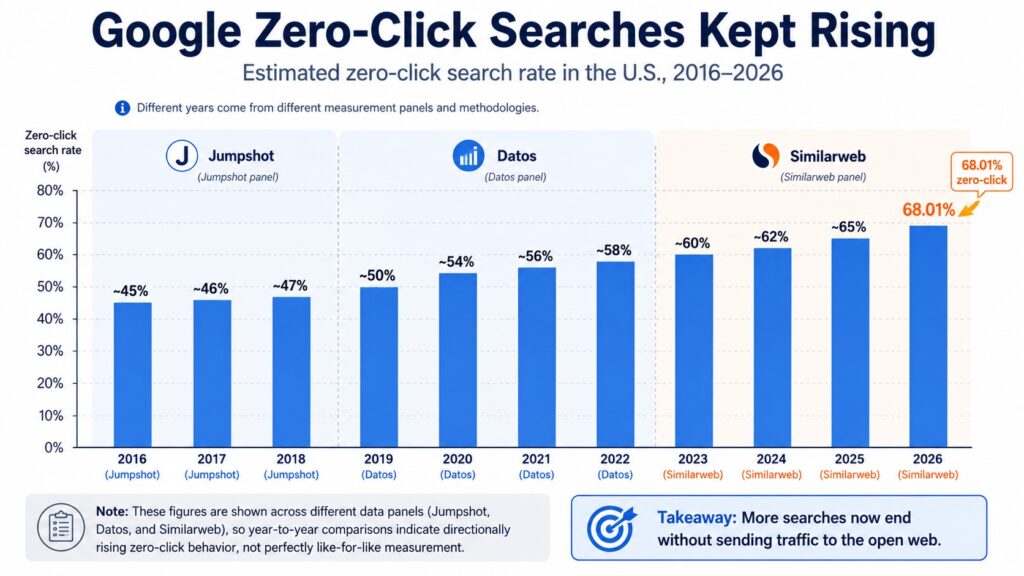
Zero-click is not a 2026 invention. The rate sat near 45% a decade ago and has climbed in steps ever since. AI did not start the trend. It accelerated one already in motion.
The two-year move is sharp: 60.45% in 2024 to 68.01% in 2026. But honesty requires a caveat here. The older figures came from different panels, the 2016 and 2019 numbers from the now-defunct Jumpshot, the 2024 read from Datos, and the 2026 read from Similarweb.
Fishkin himself calls the cross-year chart “a bit of apples and oranges.” The direction is reliable. The exact slope between any two distant years is not. Treat the trend as directionally true, not as a clean ruler.
Where the Clicks Actually Go
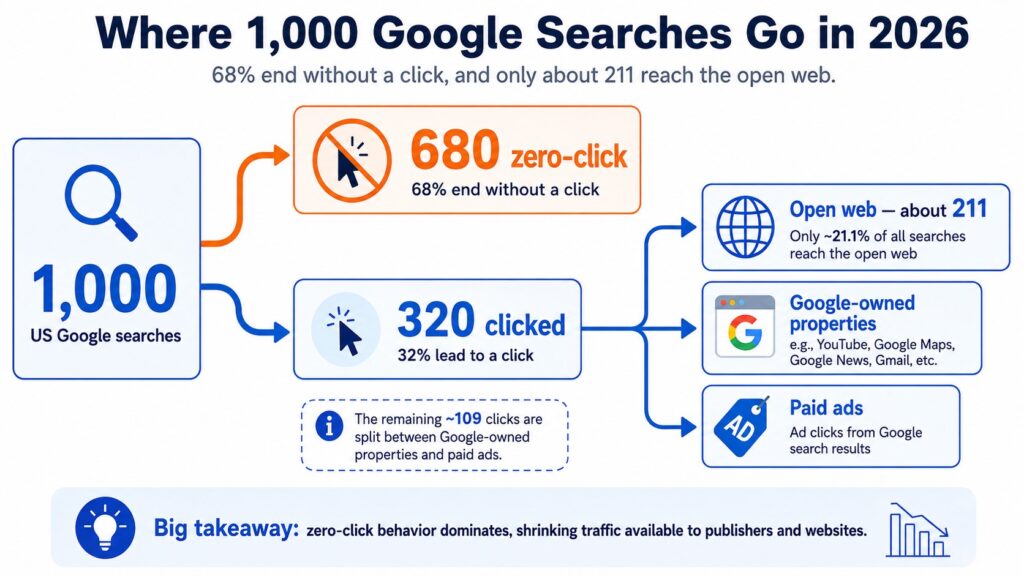
Only 320 of every 1,000 Google searches now produce a click. Of those, 66% reach the open web, 27% go to Google-owned properties, and 6% go to paid ads.
Run the math and the open web gets roughly 211 clicks per 1,000 searches. The Google-owned slice covers YouTube, Maps, and AI Mode, keeping users inside the ecosystem. Most coverage stops at the zero-click headline and never shows this second split.
That second split is the real story for publishers. Even the “winning” third of searches funnels a quarter of its clicks back to Google’s own surfaces. The open web competes for a shrinking share of an already shrinking pool.
Why Zero-Click Searches Are Climbing
AI Overviews are the main driver. They appear on more than 20% of Google searches, and when they show, click-through rates drop by nearly 60%.
The mechanism is simple. Google reads the question, writes the answer, and displays it before any link earns a click. Instant answers, knowledge panels, and “people also ask” boxes do the same job for simpler queries. Each feature resolves intent on the page and removes the reason to leave.
AI Mode is the quieter force. It handled just 0.34% of searches during the study window. But Google said at I/O 2026 that AI Mode passed 1 billion monthly users with query volume more than doubling each quarter.
AI Overviews vs AI Mode
These two features get confused, and the distinction shapes your strategy. AI Overviews are the present driver. AI Mode is the looming one.
AI Overviews sit at the top of a normal results page and summarize an answer. AI Mode is a separate conversational experience. The 0.34% usage versus 1 billion monthly users gap tells the whole story: small footprint in this data, large shadow over the next two years.
| Dimension | AI Overviews | AI Mode | What to Do With It |
|---|---|---|---|
| Current reach | 20%+ of all searches | 0.34% of searches in the study window | Optimize for AI Overviews now; monitor AI Mode |
| Format | Summary block atop standard results | Separate conversational experience | Structure content for extraction, not just ranking |
| CTR effect | Cuts click-through by nearly 60% when present | Likely as high or higher per query | Assume informational clicks keep shrinking |
| Trajectory | Established and expanding | Doubling query volume each quarter | Build GEO habits before AI Mode scales |
What This Means for Your Traffic
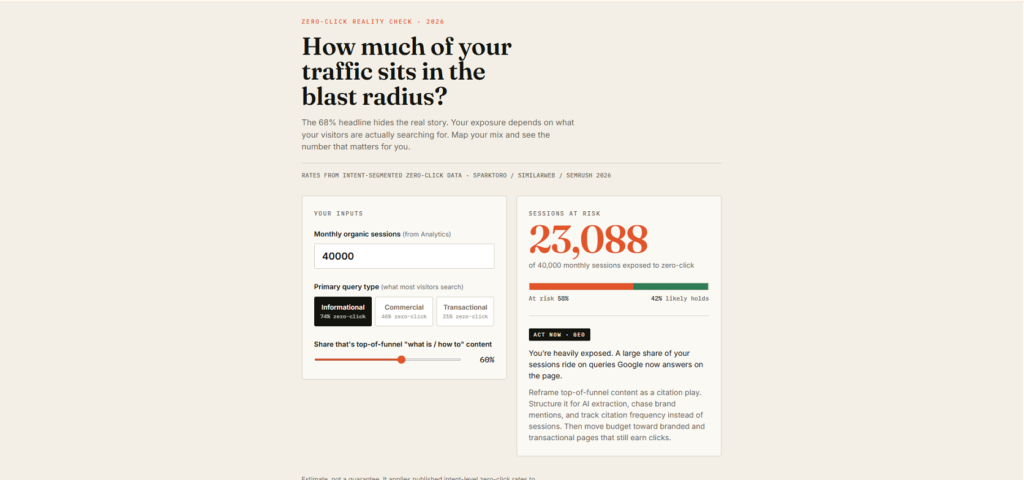
Your exposure depends on your content mix, not the flat 68% figure. Informational queries carry the highest zero-click rate. Transactional and local queries carry the lowest.
A site built on “what is” and “how to” content sits in the blast radius. A site built on branded, local, and high-intent transactional pages holds up far better. The same headline number means very different things for two different publishers.
So the question is not “how bad is zero-click.” The question is “how much of my content lives in the high-exposure zone.” Map your pages against intent before you panic about the average.
👉 Traffic Exposure Calculator: https://khalidseo.com/traffic-exposure-calculator/
How to Adapt Your Strategy
Stop optimizing for traffic and start optimizing for visibility and citation. Fishkin’s core recommendation: invest in brand awareness on the platforms where your audience already spends time, whether or not those efforts drive direct visits.
The shift is concrete. Top-of-funnel informational content becomes a citation play, not a traffic play. Generative Engine Optimization, or GEO, means structuring content so AI answers cite your brand. Earned media and brand mentions feed that visibility more than another blog post does.
Protect what still works. Branded, local, and transactional pages keep sending clicks, so defend them hard. Treat the open web as one channel among several, not the destination it used to be.
Metrics to Track Instead of Traffic
Replace sessions with three signals that survive in a zero-click world. Track brand search volume in Google Search Console. Track your AI citation footprint, sometimes called Share of Model. Track impressions over sessions for top-of-funnel content.
Brand search volume is the strongest tell. If people search your name despite falling generic traffic, the strategy is working, and AI cannot intermediate a branded search. Citation frequency and brand recall now measure top-of-funnel content, not raw clicks. Pick these before leadership asks why sessions dropped.
Frequently Asked Questions
What percentage of Google searches are zero-click in 2026?
In early 2026, 68.01% of US Google searches ended without a click, per SparkToro research using Similarweb data. That is up from 60.45% in 2024, so fewer than one in three searches sends a click anywhere.
The figure covers January through April 2026 on Similarweb’s US desktop and mobile panel. It excludes searches in Google’s mobile app, where zero-click rates are likely higher. The number counts searches with no click at all, not just searches that skip your specific site. So the real-world drag on open-web traffic may run deeper than the headline suggests.
Why are zero-click searches increasing on Google?
Zero-click searches rise because Google answers questions directly through AI Overviews, instant answers, and interface features that keep users searching within Google. AI Overviews alone cut click-through rates by nearly 60% when they appear.
AI Overviews now show on more than 20% of searches. Knowledge panels, featured snippets, and “people also ask” boxes resolve simpler queries the same way. The trend predates generative AI, stretching back to knowledge panels in 2012 and featured snippets in 2014. AI Overviews turned a slow structural shift into a sharp one by answering complex informational queries that previously required a click.
Who conducted the 2026 zero-click search study?
Rand Fishkin, co-founder of SparkToro, published the study on June 8, 2026. It used Similarweb clickstream data covering US Google searches from January through April 2026, weighted two-thirds mobile and one-third desktop.
Fishkin first quantified zero-click search in 2019 and has tracked it for years. The earlier readings drew on different panels, Jumpshot and later Datos, which is why he flags cross-year comparisons as imperfect. SparkToro sells audience research software, and Fishkin is publishing a book on zero-click marketing, context worth holding while reading any single-vendor study.
How do I adapt my SEO strategy for zero-click search?
Shift from traffic goals to brand visibility and AI citations. Track brand search volume, protect high-intent transactional and local pages, and invest in earned media so AI answers mention your brand by name.
Start by mapping your content against query intent. Informational pages carry the highest zero-click exposure, so reframe them as citation plays measured by brand recall. Transactional and local pages still earn clicks, so defend and expand them. Then build GEO habits now, structuring content for AI extraction, before AI Mode scales from a 0.34% footprint into a dominant surface.
Does zero-click search mean SEO is dead?
No. SEO is not dead, but its goals are changing. Branded, local, and transactional searches still send clicks, while top-of-funnel content becomes a citation play measured by visibility rather than sessions.
The volume game is ending; the quality game is rising. Searches that survive the zero-click filter often carry deeper intent and convert better. Fishkin recommends measuring brand awareness and AI reach instead of raw traffic. The teams in trouble are the ones still judging “what is” content by sessions, a metric that no longer reflects the value that content creates.
What is the difference between AI Overviews and AI Mode in zero-click searches?
AI Overviews are summary answer boxes appearing on over 20% of searches and are the main zero-click driver today. AI Mode is a separate conversational experience that handled just 0.34% of searches in early 2026.
AI Overviews sit atop standard results and resolve intent before a click. AI Mode runs as a distinct, chat-style search. Despite its tiny share in this study window, Google reported AI Mode passed 1 billion monthly users by I/O 2026, with query volume more than doubling each quarter. So AI Overviews shape your traffic now, while AI Mode is the force to prepare for next.
The New Baseline
Zero-click is not a storm to wait out. It’s the floor you now build on. The 68.01% figure will not snap back, because the changes behind it boosted Google’s revenue and investor confidence.
So measure what survives. Open Search Console this week and pull your branded search volume trend. If it climbs while generic traffic falls, your brand is doing the work that clicks used to do. Ignore that signal, and you’ll keep defending a number that stopped meaning anything.
The 68% Floor: Why Search Sessions Are Dead 👇

Hi, I am Khalid. I am an SEO and AI Search Specialist.
My goal is simple: I help your business get found by the right people.
For a long time, getting found just meant showing up on the first page of regular Google search. Today, the internet is changing. People are asking their questions to AI tools like ChatGPT and Google’s new AI features.
My job is to connect the old way of searching with the new way. When a potential customer asks an AI a question about what you do, I make sure your business is the trusted answer they get.
I do not use confusing words or secret tricks. I use clear and honest plans to get you noticed and bring real buyers straight to your website.
Want to see how I can make your brand the top answer? Connect with me on social media or read my exact steps at khalidseo.com.