Your rankings dropped. Your traffic chart looks wrong. And you’re not sure if it’s something you did or something Google did.
On March 24, 2026, Google confirmed it. A new spam update began rolling out globally. If your organic visibility shifted that week, this is almost certainly why.
This post tells you exactly what changed, how to confirm whether you were affected, and crucially what to do next. Including the one distinction most SEO guides get completely wrong: link spam penalties and content spam penalties are not the same problem, and they do not have the same solution.
What Is the Google March 2026 Spam Update?
The Google March 2026 spam update is a global algorithm update released on March 24, 2026 at 3:20 PM ET. It targets sites that violate Google’s spam policies, affects all languages and locations, and may take only a few days to complete.
This is not a core update. It is the first announced spam update of 2026 and the second algorithm announcement since the February 2026 Discover core update.
Google confirmed the rollout on its Search Status Dashboard and reinforced the message on LinkedIn via Google Search Central:
“This is a normal spam update, and it will roll out for all languages and locations. The rollout may take a few days to complete.”
Key facts at a glance
- Released: March 24, 2026 – 3:20 PM ET
- Type: Spam update (not a core update, not a manual action)
- Scope: All languages, all geographic locations
- Rollout duration: A few days (Google’s estimate)
- First update of 2026? Yes, first spam update. The February Discover update was a different category.
How this differs from the February 2026 Discover core update
The February update targeted content surfaced in Google Discover a feed-based product. This March update targets traditional Google Search rankings. Different systems, different signals, different sites affected. If your Discover traffic dropped in February, that was a separate event.
Is the March 2026 update significant?
Google releases spam updates periodically, but they don’t announce every one. When they do, it typically signals a meaningful improvement to their spam-detection systems. The fact that this update carries a formal name and a dashboard announcement puts it in the same tier as previous high-impact spam updates.
How Does a Google Spam Update Work? SpamBrain and the AI Detection Engine
Most coverage of this update describes what happened. Almost none explains how. That gap matters because understanding the mechanism tells you whether your site is at risk before the data confirms it.
What is SpamBrain?
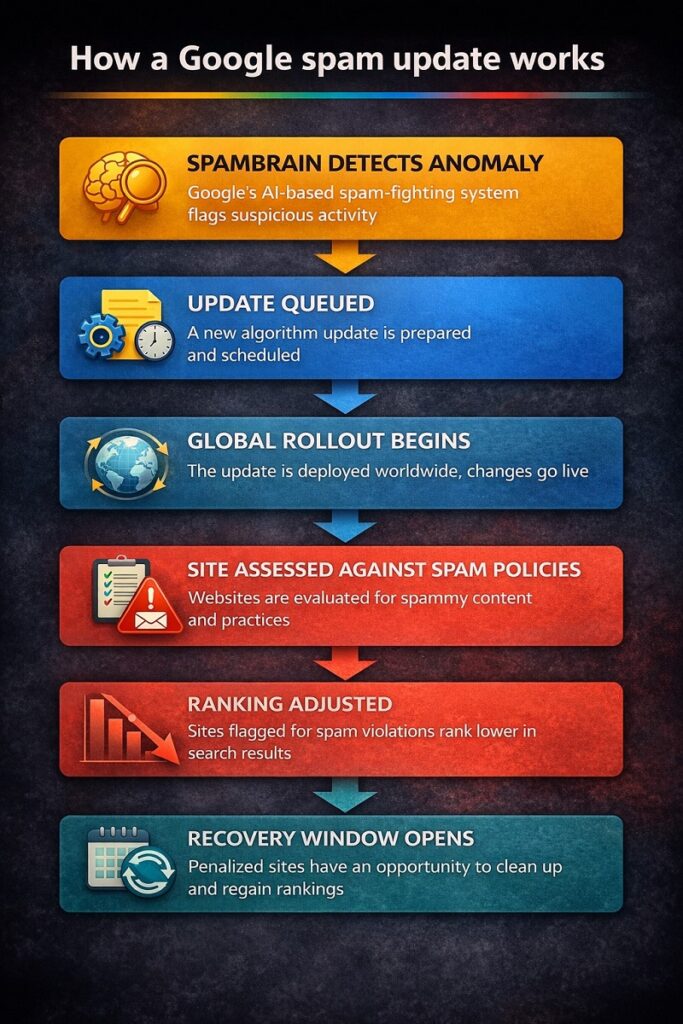
SpamBrain is Google’s AI-powered spam prevention system. It uses machine learning to automatically detect and neutralise search spam at scale including link schemes, thin content, and cloaking across all of Google Search.
Unlike a manual action (where a human reviewer flags your site), SpamBrain operates automatically. It runs continuously in the background. When Google makes a significant improvement to the system, it announces the change as a spam update.
SpamBrain was first publicly detailed in Google’s 2021 Webspam Report. Since then, it has been updated multiple times each iteration improving its ability to catch both existing spam patterns and new manipulation tactics.
What types of spam does SpamBrain target?
SpamBrain is not a single filter. It covers multiple spam categories:
- Link spam — Purchased links, link exchanges, private blog networks (PBNs), and other artificial link schemes
- Content spam — Thin content, auto-generated text, scraped content, and AI-spun articles with no original value
- Cloaking — Showing different content to Google crawlers than to human users
- Doorway pages — Pages created purely to rank for specific queries, with no genuine user value
- Sneaky redirects — Redirecting users to pages different from what was crawled
Not every spam update targets all of these simultaneously. Google has not specified which spam type(s) the March 2026 update primarily addresses.
Spam update vs. core update vs. manual action – what’s the difference?
These three terms are frequently conflated. They are fundamentally different:
| Spam update | Core update | Manual action | |
|---|---|---|---|
| Triggered by | Improvement to automated spam systems | Broad quality assessment changes | Human review of a specific site |
| Who is affected | Sites violating spam policies | Any site — good or bad content may shift | Only the flagged site |
| Google notifies you? | No (only a public announcement) | No (only a public announcement) | Yes — via Search Console |
| Recovery possible? | Yes, over months (with exceptions — see below) | Yes, at the next core update | Yes, via reconsideration request |
| Disavow helps? | Only for link spam — and only partially | Not applicable | Sometimes |
What Does the March 2026 Spam Update Actually Target?
Google has not released a specific breakdown of this update’s focus. That is normal, they rarely do. What we know comes from the announcement language, the documentation Google linked to, and observable SERP patterns in the days following the rollout.
Which industries and site types are most exposed?
Historically, spam updates hit hardest in verticals where manipulation is most common:
- Affiliate-heavy content sites with thin reviews and heavy outbound linking
- Local business aggregators with doorway pages for individual cities
- Guest posting networks with unnatural anchor text patterns
- Programmatic content sites publishing high volumes of templated, low-value pages
- Niche sites that have bought links aggressively or used PBNs
If your site sits in any of these categories and you saw traffic move around March 24–28, that is your first signal.
Does the update affect all languages and countries equally?
Yes. Google was explicit: the rollout covers all languages and all geographic locations. This is not a US-only or English-first rollout. Spanish, Arabic, Japanese, Bangla, Hindi – every market is in scope simultaneously.
This matters because some site owners assume non-English sites operate under different rules or face less scrutiny. They don’t.
Early SERP volatility signals
Within the first 48 hours of rollout, rank-tracking tools including Semrush Sensor and Sistrix recorded elevated SERP volatility in categories consistent with past spam updates: finance, health, and affiliate product reviews showed the highest movement.
Sites that recovered positions are those that had previously cleaned up spam signals. Sites that dropped further had typically accumulated new violations since the last major spam update.
Did the March 2026 Spam Update Affect Your Site? How to Diagnose a Ranking Drop
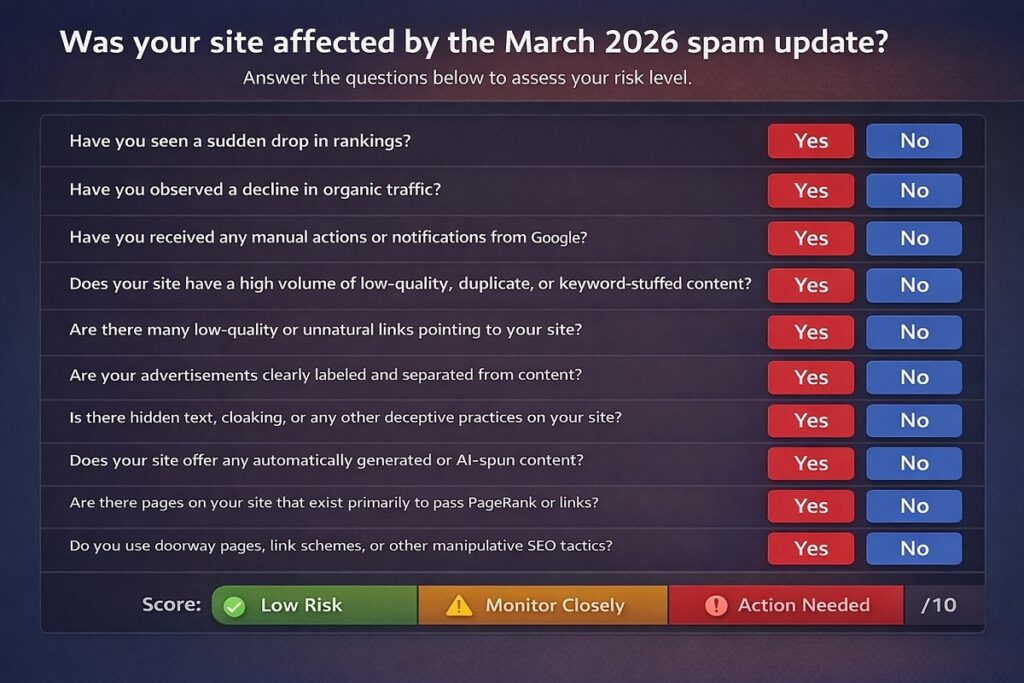
Before you change anything, you need to confirm: was it this update? Traffic drops have many causes. Misdiagnosing a technical issue as a spam penalty or vice versa wastes months.
Check your traffic: the key date window
Open Google Search Console. Pull your Performance data. Look for a drop that began on or after March 24, 2026.
A spam update signature looks like this:
- A sudden drop — not a gradual slide
- The drop correlates with March 24 (not earlier, not a week later)
- Specific pages or site sections fall, not the whole site uniformly
- The affected pages are your lower-quality or more aggressively optimised pages
If your whole site dropped uniformly before March 24, look at technical issues first — not this update.
How to use Google Search Console to confirm
- Go to Search Console → Performance → Search results
- Set the date comparison: March 17–23 vs March 24–30
- Filter by Pages — sort by biggest traffic decline
- Note which pages dropped. Cross-reference those pages with your most link-heavy or thin-content areas.
If the pages that dropped are also the pages you know have the most questionable backlinks or the thinnest content, you have your answer.
Third-party rank trackers vs. Search Console: which to trust?
During a rollout, third-party tools like Semrush, Ahrefs, and Sistrix update ranking data daily. Search Console data lags by 2–3 days. Use third-party tools to spot the pattern first, then confirm the extent in Search Console once data stabilises.
Never make site changes based on a single day of rank tracker data during an active rollout. Rankings fluctuate during the rollout window, wait until the update is confirmed complete before drawing conclusions.
How to Recover from the Google March 2026 Spam Update: A Step-by-Step Action Plan
To recover after a Google spam update: audit your content against spam policies, remove or fix violations, clean up toxic backlinks, and then wait. Google reassesses compliance over months, not days.
Here is the full action sequence:
Step 1 — Audit your content against Google’s spam policies
Read Google’s spam policies documentation in full. This is not optional and not something to skim. Map every policy to your own content.
The most commonly violated policies are:
- Thin content — Pages with little original value relative to existing search results
- Auto-generated content — Content created to rank, not to inform
- Scraped content — Material copied from other sources, even with minor modifications
- Hidden text — Text invisible to users but readable by crawlers
Step 2 — Identify and remove thin, duplicate, or AI-spun content
Use a crawl tool (Screaming Frog, Sitebulb, or similar) to pull all your indexed URLs. Sort by:
- Word count (flag pages under 300 words that serve no functional purpose)
- Duplicate content (run against Copyscape or use canonical analysis)
- Engagement metrics from GA4 (bounce rate, time on page — low engagement = low value signal)
For each flagged page: either improve it to genuine usefulness, consolidate it into a stronger page via 301 redirect, or remove it and allow it to deindex. Leaving thin pages indexed harms your site’s overall quality signal.
Step 3 — Conduct a backlink audit and disavow toxic links
Pull your full backlink profile from Ahrefs, Semrush, or Google Search Console’s Links report. Flag links from:
- Sites with domain ratings under 10 with no real traffic
- Pages with exact-match commercial anchor text pointing at money pages
- Obvious PBN footprints (same hosting blocks, identical site templates, identical ownership patterns)
- Bulk link drops from directories or comment spam
Submit a disavow file via Google Search Console. Be conservative, only disavow links you are confident are harmful.
Critical note: Read the next section before you disavow anything. Link spam penalties work differently from content spam penalties. Disavowing does not recover lost ranking in the same way and for some link penalties, recovery of the original benefit is not possible at all.
Step 4 — Submit a reconsideration request (only if you have a manual action)
If you received a Manual Action notice in Search Console, that is separate from the automated spam update. Manual actions require a reconsideration request after you have fixed the violations.
If you have no manual action notice, there is nothing to submit. The automated system will reassess your site on its own timeline.
Step 5 — Monitor and wait
Google’s own documentation is clear: “Making changes may help a site improve if our automated systems learn over a period of months that the site complies with our spam policies.”
Months. Not days. Not weeks.
Set a 90-day monitoring cadence. Track your target pages in Search Console weekly. Do not panic-change things every time you see a daily fluctuation that creates noise and delays your ability to assess what is actually working.
Link Spam Penalties Are Permanent – Here’s What That Actually Means
This is the section most SEO guides skip. It is also the most important nuance of any spam update.
Google’s own documentation states it plainly. For link spam updates specifically:
“Making changes might not generate an improvement. This is because when our systems remove the effects spammy links may have, any ranking benefit the links may have previously generated for your site is lost. Any potential ranking benefits generated by those links cannot be regained.”
Let that sink in. If your rankings improved because of spammy links, and Google’s systems have now removed the benefit of those links, you cannot get that ranking position back through disavow or cleanup alone. The benefit is gone. The only path forward is earning legitimate authority from scratch.
Content spam vs. link spam: two completely different recovery paths
| Content spam | Link spam | |
|---|---|---|
| Can rankings return? | Yes — if content is improved | Not to previous level |
| Primary fix | Improve or remove content | Disavow or remove links |
| Recovery timeframe | 3–6 months (next reassessment) | Partial — months to stabilise |
| Does disavow help? | Not applicable | Stops further harm, does not restore past gains |
| Google reassessment? | Automatic, over months | Automatic, but prior benefit is permanently lost |
| Risk of over-correction? | Low | High — only disavow confirmed bad links |
Why link spam penalties are permanent – Google’s logic
When Google’s systems detect that a link is artificial, they do not just penalise the link, they retroactively remove the ranking benefit that link was providing. Your site’s ranking was partly built on a foundation that Google has now determined was fake. There is no restoration path for that foundation. You must build a new one.
How to use the Disavow Tool and when it’s already too late
The Disavow Tool tells Google: “Don’t count these links when assessing my site.”
It is still worth using. It stops future harm from those links. It prevents a bad link profile from continuing to suppress your rankings.
What it cannot do is give you back the rankings you held because of those links. That distinction matters enormously for setting client expectations and internal recovery goals.
Use the tool. But budget 6–12 months, not 6–12 weeks, for meaningful recovery after heavy link spam involvement.
How Long Does the March 2026 Spam Update Take and What Happens Next?
Google stated the March 2026 spam update may take “a few days” to complete. In practice, that means the active ranking adjustment window is typically 3–7 days, after which the SERP stabilises.
“A few days” does not mean your rankings return to normal within a few days. It means the update’s rollout – the period during which Google is applying its revised spam signals is complete within that window. Rankings then settle at their new positions.
How to track when the update finishes
Watch these signals:
- Semrush Sensor / Sistrix — Volatility scores drop back to baseline levels
- Google Search Status Dashboard — The update entry is marked as complete
- Your own Search Console data — Daily click patterns stabilise with no major day-on-day swings
When all three align, the rollout is done. Now your actual ranking position, post-update is what you are working with.
7-day monitoring checklist after the March 2026 spam update
Use this as your reference for the week following the update announcement:
Day 1 (March 24)
- Note your current rankings for top 20 pages using a rank tracker
- Pull a Search Console baseline: clicks, impressions, average position
Day 2 (March 25)
- Compare rank tracker data to Day 1 — flag any pages that moved more than 5 positions
- Check Semrush Sensor volatility score for your niche
Days 3–4 (March 26–27)
- Run the spam update self-assessment checklist (above)
- Begin backlink audit if significant pages have dropped
Days 5–6 (March 28–29)
- Check if Google’s dashboard marks the update as complete
- Pull Search Console data for the March 24–28 window — compare to the prior week
Day 7 (March 30)
- Assess trend direction: is traffic stabilising, continuing to drop, or recovering?
- If dropping: begin the Step 5 recovery process above
- If stable: document your post-update baseline and set a 90-day monitoring calendar
Frequently Asked Questions
What is the Google March 2026 spam update?
The Google March 2026 spam update is a global algorithm change released on March 24, 2026, designed to demote sites that violate Google’s spam policies. It covers all languages and locations and is the first spam update of 2026.
It is not a core update and does not affect all sites equally. Sites with clean content, natural backlink profiles, and no spam policy violations are unlikely to see significant movement. Sites that have accumulated spam signal artificial links, thin content, cloaking are the primary targets.
How long does the Google March 2026 spam update take to roll out?
Google confirmed the rollout may take “a few days to complete.” This means the active adjustment window is approximately 3–7 days from March 24, 2026.
After the rollout completes, rankings reflect the update’s new assessment. Recovery from that new position if your site was impacted takes considerably longer: typically 3–6 months for content-related violations, and potentially much longer (with no full recovery possible) for link-related violations.
How can I recover my site after being hit by a Google spam update?
Review Google’s spam policies, remove or improve violating content, audit and disavow toxic backlinks, and then allow months for Google’s systems to reassess your site.
The key steps are:
- Audit content against Google’s spam policies
- Remove, improve, or consolidate thin or duplicate pages
- Identify and disavow toxic backlinks
- Submit a reconsideration request if – and only if – you received a manual action notice
- Monitor over a 90-day window and document any changes
There is no shortcut. Google’s reassessment is automated and operates on a months-long timeline.
What is SpamBrain and how does Google use it?
SpamBrain is Google’s AI-based spam prevention system. It automatically detects and neutralises search spam including link schemes, thin content, and cloaking across all Google Search results, operating continuously without human review.
SpamBrain is updated periodically to catch new spam patterns. When Google makes a meaningful improvement to SpamBrain, it typically announces a spam update. The March 2026 update is one such improvement. Because SpamBrain operates automatically, affected sites do not receive individual notifications – ranking changes are the primary signal.
Does the Google spam update affect all websites and languages?
Yes. Google confirmed the March 2026 spam update rolls out across all languages and all geographic locations simultaneously. No region or language is excluded.
This is a key point for international site owners. The assumption that non-English or non-US sites face less scrutiny is incorrect. SpamBrain operates at the same standard globally. If your site has spam signals regardless of what language it publishes in the March 2026 update is in scope.
Last updated: March 25, 2026. Information in this post reflects what is publicly known as of this date. As the rollout completes and SERP data stabilises, updates will be made to reflect observed patterns and community analysis.

AI Search Specialist (AEO, GEO) | Helping brands get found, answered, and cited | Win on Google & ChatGPT.
I help businesses show up where their customers are actually looking.
For a long time, that just meant chasing rankings on Google. Today, it means something entirely different: people are asking AI for answers.
My job is simple. I bridge the gap between traditional SEO and the new world of AI search. I make sure that when someone asks ChatGPT, Google’s AI, or any other engine a question in your industry, your brand is the definitive answer they get.
No magic tricks or complicated buzzwords – just clean, modern search strategies that get you visibility and highly qualified leads.
Want to see how we can make your brand the trusted answer?
👉 Let’s connect, or check out my exact strategies at khalidseo.com.