Your brand can be invisible in one AI search engine and front and center in another, for the exact same question. Most teams don’t know which one they’re losing.
That gap isn’t random. Google AI Overviews mention brands about 2.5 times more often than ChatGPT does, according to BrightEdge data. If you’ve built your whole strategy around one platform, you’re probably winning on it and losing badly on the other.
Here’s the fix: stop treating “AI search” as one thing. It’s three different systems with three different rules. Once you see how each one picks brands, you can stop guessing and start optimizing for the right signals on each.
What the BrightEdge Data Actually Found
BrightEdge ran tens of thousands of identical prompts through three platforms using its AI Catalyst tool. The question was simple: how often does each one name a brand in its answer?
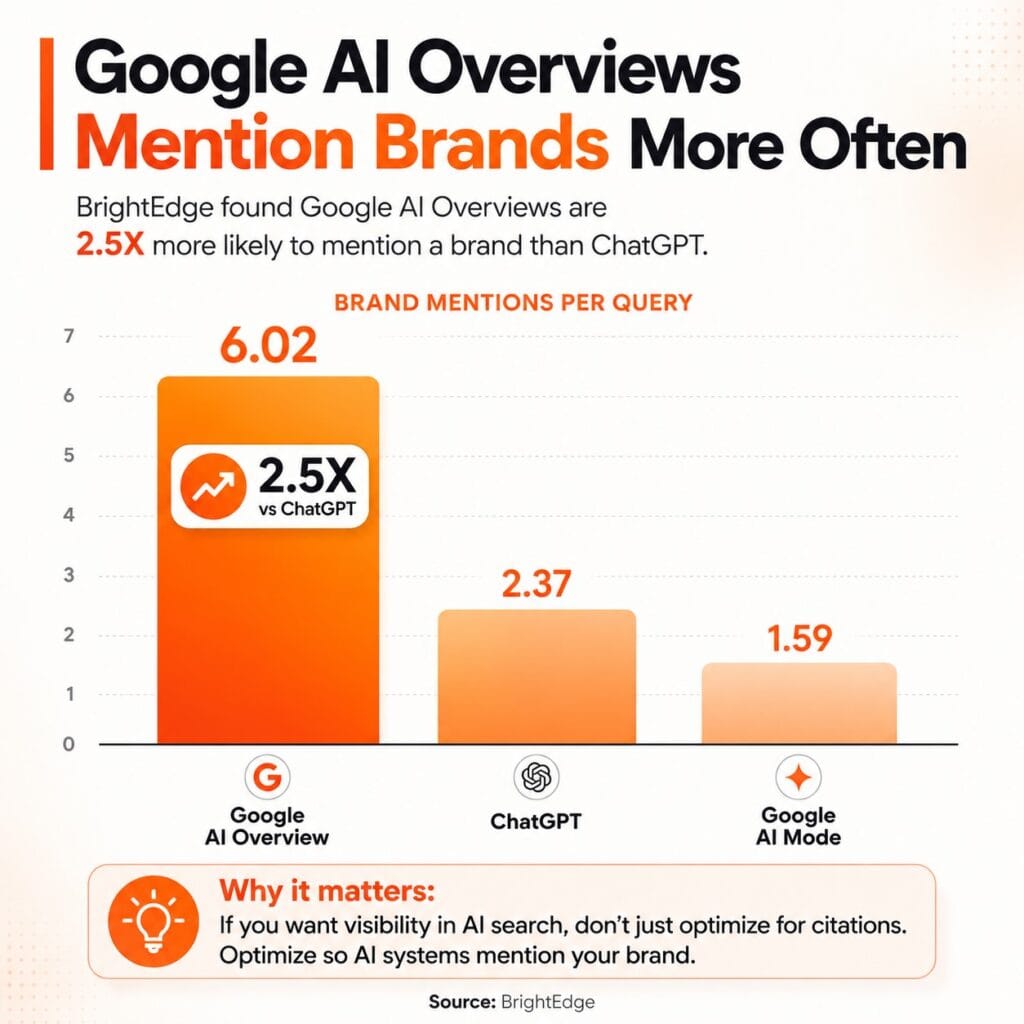
The averages came out like this.
| Platform | Brand Mentions Per Query |
|---|---|
| Google AI Overviews | 6.02 |
| ChatGPT | 2.37 |
| Google AI Mode | 1.59 |
So AI Overviews name roughly six brands per answer. ChatGPT names a little over two. AI Mode names fewer than two.
That’s where the headline “2.5x” comes from. AI Overviews mention 6.02 brands to ChatGPT’s 2.37, which is about two and a half times more.
The platforms also disagreed with each other a lot. BrightEdge found different brand recommendations on 61.9% of queries. Only 17% of queries returned the same brands across all three.
Read that again. Almost two out of three times, these systems named different brands for the same question.
Why the 2.5x Gap Exists (Live Web vs Training Data)
Google AI Overviews mention more brands than ChatGPT because they pull from live web sources and favor broad coverage. ChatGPT leans on its training data and surfaces fewer, more established names. The difference is breadth versus selectivity in how each one sources its answer.
That one distinction explains almost everything else.
How AI Overviews pull breadth from live sources
AI Overviews are wired into Google’s live index. When you ask a question, the system pulls from current web pages and tends to surface several brands at once.
More sources in means more brands out. If you can get into those source citations, you have a real shot at being named.
Why ChatGPT leans on what it already knows
ChatGPT works differently. A lot of its answers come from patterns in its training data, not a live crawl of today’s web.
That makes it cautious. It tends to name brands it already “trusts” from that training, which skews toward established, historically prominent companies. BrightEdge calls this an authority dividend, and it’s easier for big names to collect than for newcomers to earn.
The Finding Everyone Misses: Mentions Are Not Citations
Here’s the part most write-ups skip. Getting mentioned and getting cited are two different wins, and the platforms reward them in opposite directions.
A mention is when the AI names your brand in its answer text. A citation is when it links to your page as a source. They don’t always travel together.
Look at what happens when you put mentions next to citations.
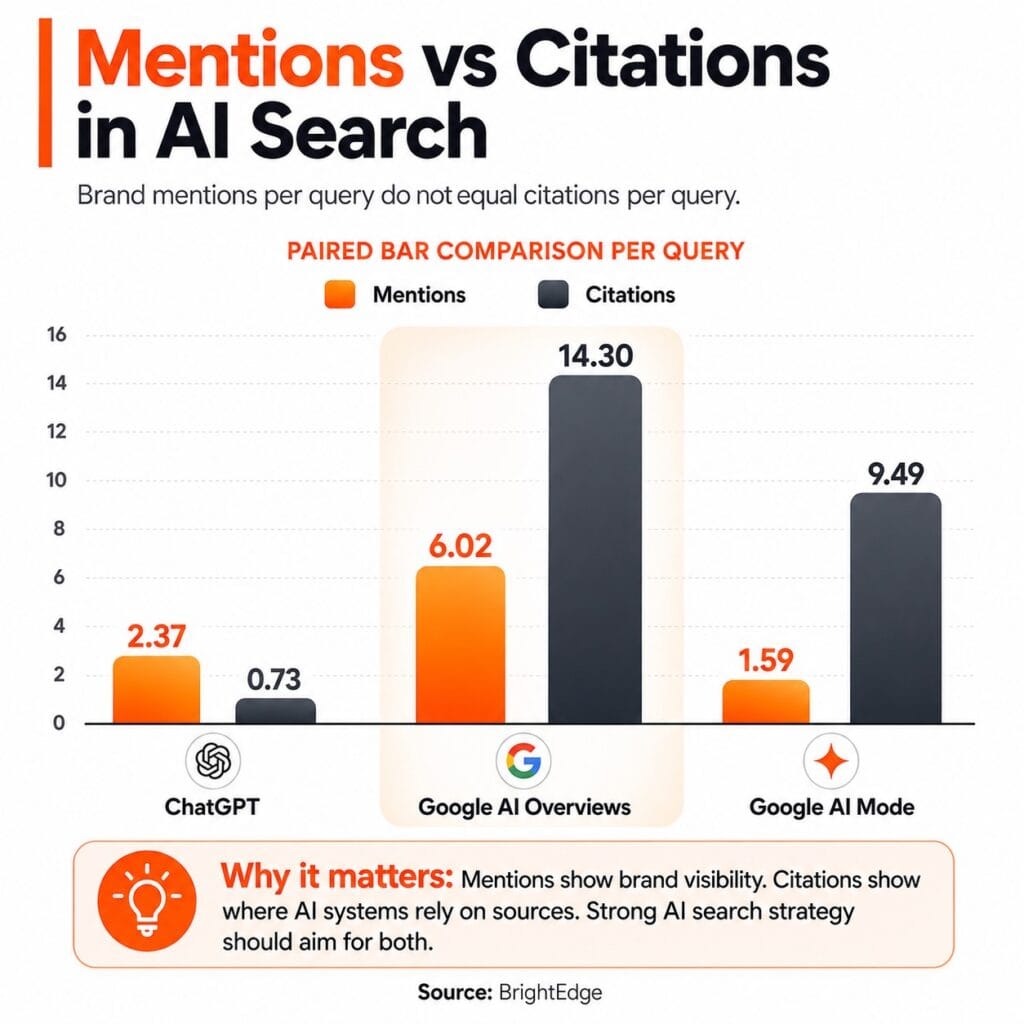
ChatGPT mentions about 2.37 brands but cites only 0.73 sources per query. It recommends more than it sources.
AI Overviews flip that. They mention 6.02 brands but cite 14.30 sources. They source far more than they name.
So the two systems reward different things. ChatGPT rewards being a known, recommended name. AI Overviews reward being a source worth linking to. A strategy that only chases mentions misses half the game.
The Three Platforms Have Three Personalities
The cleanest way to hold all of this in your head is to treat each platform as a personality with its own habits. ChatGPT, AI Overviews, and AI Mode disagree on brands most of the time because they were built and trained differently.
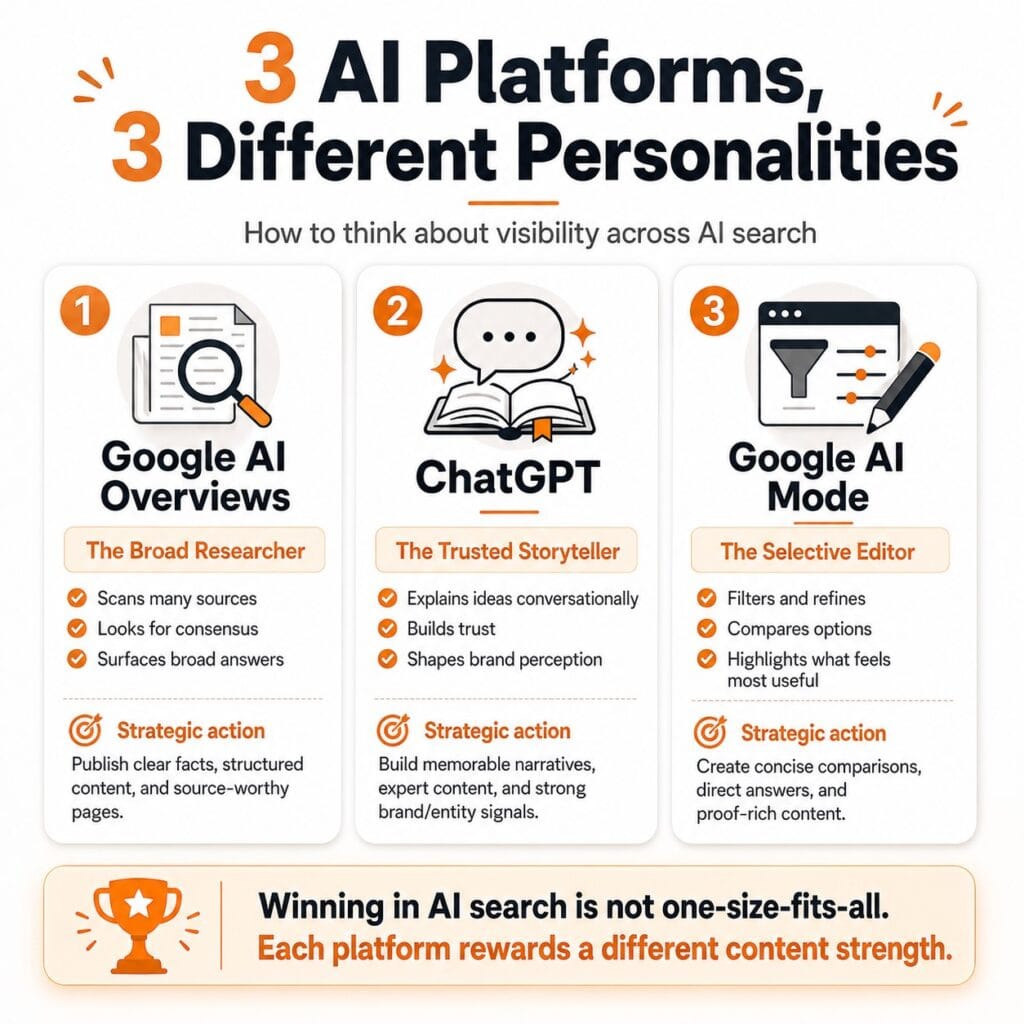
AI Overviews, the broad researcher
AI Overviews want coverage. Six brands per query, pulled from live sources, with heavy citation.
Your job here: become a source worth quoting. Get into the citations and you get named.
ChatGPT, the trusted storyteller
ChatGPT recommends fewer brands and trusts the ones it already knows. It favors established names and sources lightly.
Your job here: build authority over time. You can’t shortcut your way into its training the way you can earn a fresh citation.
AI Mode, the selective editor
AI Mode is the strictest. It names fewer than two brands per query but cites heavily behind the scenes (9.49 sources to 1.59 mentions).
Being one of the few names it picks carries real weight. The barrier is high, but so is the payoff.
What This Means for Your Content Strategy
You can’t run one playbook across all three. The signals that win AI Overviews are not the signals that win ChatGPT. Here’s how to split your effort.
Getting cited by AI Overviews
This is the most controllable of the three. AI Overviews reward source-worthy content, so the work looks a lot like strong classic SEO with a citation focus.
Write clear, well-structured pages that answer real questions directly. Cover topics with enough depth to build topical authority. The goal is to be the page the system wants to pull from.
Earning ChatGPT recommendations
This one is slower and less direct. ChatGPT favors brands with established authority, and that comes from sustained presence, not a single optimized page.
Focus on the authority signals that show up across the web: consistent mentions, reputable coverage, a track record that a model trained on the open web would absorb. There’s no quick lever here, which is exactly why it’s defensible once you have it.
Why one strategy can’t win both
Chasing the 6.02 mention number is a trap if it makes you ignore citations and authority. AI Overviews want a great source. ChatGPT wants a trusted name. AI Mode wants both, at a higher bar.
Split your effort on purpose. Technical and content quality for Overview citations. Long-game brand authority for ChatGPT. Don’t pretend a single fix covers all three.
Use this checklist to see where you stand right now.
How to Measure Whether It’s Working
Pick a set of queries that matter to your business and check what each platform actually says. Run the same prompts across AI Overviews, ChatGPT, and AI Mode, and log whether you’re mentioned, cited, both, or neither.
Track that over time as a rough share of voice. Tools like BrightEdge’s AI Catalyst do this at scale, but a manual spreadsheet works to start.
The number to watch isn’t a single ranking. It’s how often you show up, on which platform, and as a mention or a citation. That tells you where your strategy is landing and where it isn’t.
The Caveats Worth Knowing Before You Act
One thing to keep in mind: this is one vendor’s data. BrightEdge sells SEO and AI search tools, and these findings come from its own AI Catalyst product.
That doesn’t make the numbers wrong. But it’s worth treating them as a strong signal from a single source, not settled fact.
Worth noting too: Google publicly disputed a separate BrightEdge study, calling its methodology flawed. AI answers also change fast, so a 2.5x gap today may look different in six months.
The directional takeaway holds up regardless. These platforms surface brands differently, and one strategy won’t win all three. Test against your own queries before you move budget on anyone’s averages, including these.
FAQ
Why do Google AI Overviews mention more brands than ChatGPT?
AI Overviews pull from live web sources and favor broad coverage, while ChatGPT leans on training data and names fewer, more established brands.
The difference comes down to breadth versus selectivity. AI Overviews surface around 2.5x more brands per query because they’re built to gather many live sources at once.
How many brands does Google AI Overviews mention per query?
BrightEdge found Google AI Overviews mention 6.02 brands per query, versus 2.37 for ChatGPT and 1.59 for Google AI Mode.
AI Overviews cast the widest net of the three. That gives more brands a chance to appear in a single AI-generated answer.
What is the difference between a brand mention and a citation in AI search?
A mention is when the AI names your brand in its answer. A citation is when it links to your page as a source.
They don’t always overlap. ChatGPT mentions more than it cites, while AI Overviews cite far more sources than they name brands.
How do I get my brand mentioned in Google AI Overviews?
Focus on becoming a cited source through clear, well-structured content, strong topical authority, and pages that directly answer common questions.
AI Overviews pull breadth from live web sources. Getting into those citations raises your odds of being named in the answer itself.
Does ChatGPT recommend the same brands as Google?
Often not. BrightEdge found the platforms disagree on brand recommendations about 62% of the time, with only 17% of queries returning the same brands.
ChatGPT favors established names from its training data. Google leans on live sources, which produces very different results for the same query.
Google AI Overviews vs ChatGPT Brand Mentions: The Simple Truth
For competitive queries, originality, expertise, and editorial judgment remain your unfair advantages. This topic might seem complex, but it is actually very simple when you break it down. Think of it like a puzzle where all the pieces finally fit together.
The Real Numbers
- 6.02 vs 2.37 brand mentions per query: Google AI Overviews name about 2.5x more brands than ChatGPT, so the same question can make you visible on one platform and invisible on the other.
- 61.9% disagreement rate: The three platforms named different brands on nearly two out of three queries, which means there’s no single “win AI search” button to press.
A Wise Word
“The first thing we saw that was different from classic search versus AI is that it has an opinion. It fundamentally changes marketing.” — Jim Yu, CEO of BrightEdge
This means that instead of worrying about the hard parts, we should focus on the simple truth: AI doesn’t just list your brand, it forms a view of it, so being present isn’t the same as being chosen.
Key Information at a Glance
| Feature | Why it Matters | How it Helps You |
|---|---|---|
| AI Overviews cite sources | Live web, broad coverage | Strong content gets you named |
| ChatGPT trusts known names | Training data, fewer brands | Long-term authority pays off |
| Mentions differ from citations | Two separate visibility wins | Optimize for the right one |
A Surprising Fact
Did you know that ChatGPT names more brands than it actually links to, while AI Overviews link to more than twice as many sources as the brands they name? Most people think the opposite is true, but experts have found that this little secret is actually the key to success.

Hi, I am Khalid. I am an SEO and AI Search Specialist.
My goal is simple: I help your business get found by the right people.
For a long time, getting found just meant showing up on the first page of regular Google search. Today, the internet is changing. People are asking their questions to AI tools like ChatGPT and Google’s new AI features.
My job is to connect the old way of searching with the new way. When a potential customer asks an AI a question about what you do, I make sure your business is the trusted answer they get.
I do not use confusing words or secret tricks. I use clear and honest plans to get you noticed and bring real buyers straight to your website.
Want to see how I can make your brand the top answer? Connect with me on social media or read my exact steps at khalidseo.com.