You optimized your content. It shows up in ChatGPT. So why is it invisible in Perplexity and Google AI Overviews?
Here’s the uncomfortable part. The thing you built your whole SEO process around now reaches maybe a third less of the search landscape than it did a year ago.
Search didn’t just change. It split. In roughly 24 months it went from a one-engine market, to a one-AI-engine market, to a fragmented set of surfaces that each retrieve and cite content their own way.
A strategy built for one engine is a strategy built for a market that no longer exists.
The fix isn’t more content. It’s understanding that each engine has a different brain, and learning to speak to all of them. That’s what this post does.
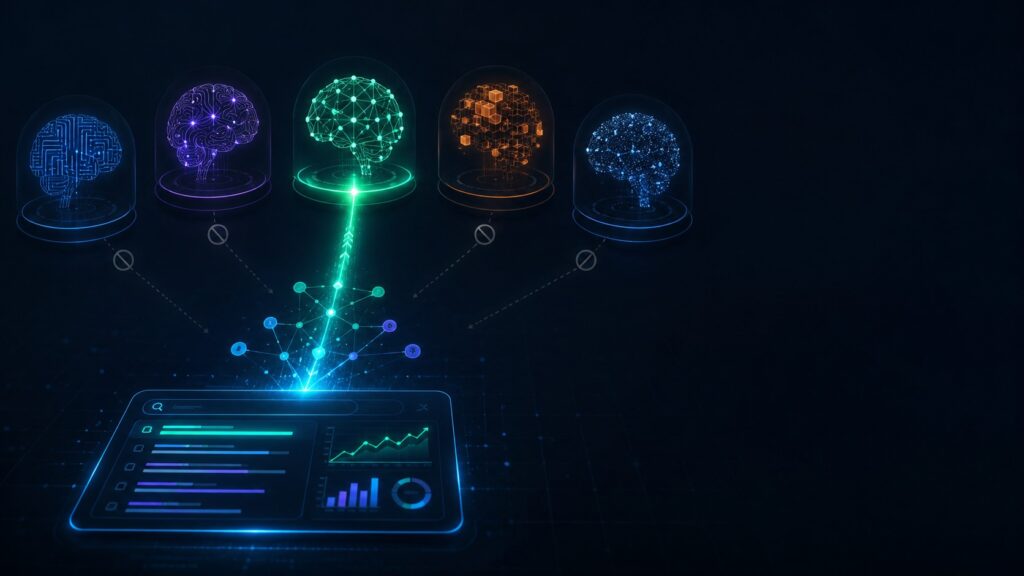
[VISUAL: Featured Image — four brain silhouettes wired to different sources]
Each AI Engine Has a Different Brain (And Why That Breaks Single-Channel SEO)
Each AI engine retrieves and cites content differently because they pull from different sources, weigh different trust signals, and update on different cycles. Optimizing for one engine’s logic does not carry over to the others.
That last sentence is the whole problem.
Marketers assume a citation is a citation. It isn’t. ChatGPT and Perplexity can both cite the same brand for the same query and do it for completely different reasons, on completely different evidence.
So a citation in one engine tells you almost nothing about whether you’re visible in the next.
The signals that drive a citation in one place and a recommendation in another aren’t the same signals. Win one engine’s logic and you’ve won exactly that engine. Nothing more.
Open-World vs Closed-World Models
RAG, or Retrieval-Augmented Generation, means an engine pulls live web pages at the moment you ask, then builds its answer from them. This separates open-world engines, which retrieve in real time, from closed-world engines, which answer from a fixed training snapshot.
The practical difference is timing.
Open-world engines like Perplexity and Google AI Overviews pull live data via RAG. Change your page today and it can show up in weeks.
Closed-world models tied to a training cutoff work on much slower cycles. Your update has to wait for the next training run to even be eligible.
Most guides skip this. It’s the difference between an edit that pays off this month and one that pays off next year.
Why the Same Brand Gets Cited for Different Reasons
A brand can earn a citation in ChatGPT and a citation in Perplexity for reasons that barely overlap.
ChatGPT leans on encyclopedic authority. Perplexity leans on freshness and clean retrievability.
So the same page can win one on its reputation and lose the other on its publish date.
The signals that drive citation are not the signals that drive recommendation. That gap is why your “we’re getting cited” win doesn’t translate across engines.
How Each Engine Decides Who Gets Cited
Every engine moves a query through the same four stages:
- Source input — what pool it draws from.
- Retrieval method — live RAG or static training data.
- Ranking signal — what it trusts most.
- Citation output — who it names in the answer.
The stages are shared. What happens inside each one is not. That’s where your content quietly fails on three engines while passing on one.
[VISUAL: Infographic #1 — How Each AI Engine Decides Who Gets Cited, swimlane comparison]
| ChatGPT | Perplexity | Google AI Overviews / Gemini | |
|---|---|---|---|
| Retrieval method | Mostly training data | Live RAG at query time | Live retrieval from Google’s index |
| Dominant trust signal | Encyclopedic authority (Wikipedia, strong profiles) | Freshness, clear structure, retrievability | Existing top-10 ranking, E-E-A-T |
| Update lag | Slow (training cycles) | Fast (weeks) | Fast (tied to your SEO) |
| Best lever | Earned third-party authority | Frequently updated, scoped content | Strong traditional SEO |
ChatGPT — Authority and Encyclopedic Sources
ChatGPT rewards reputation. Wikipedia shows up in nearly half of its top responses, which tells you what kind of source it trusts.
For most brands, the lever is earned authority. Strong profiles, high-authority third-party citations, established mentions.
Because it leans on training data, recency helps less here than almost anywhere else. The win is being known before the model trains, not being freshly updated.
Perplexity — Freshness and Retrievability
Perplexity runs its own crawler and retrieves live when you ask. That changes what matters.
Frequently updated content beats stale content. Clearly scoped pages beat sprawling ones. Direct answers beat buried ones.
If your page is hard to crawl or last touched two years ago, Perplexity has little reason to reach for it.
Google AI Overviews and Gemini — Riding Your Existing SEO
This is the good news for anyone who already does SEO well.
AI Overviews synthesize their answers from pages that already rank. A top-10 position gives you strong odds of being cited in the Overview above the results.
Gemini ties into Google’s index too, so the traditional SEO work you’ve already done translates into Gemini visibility almost directly.
SEO, GEO, and AEO — What Each One Actually Means
These three get blurred constantly. They aren’t the same job.
- SEO optimizes your content to rank in Google’s list of links.
- GEO, Generative Engine Optimization, structures your content so AI engines cite and recommend your brand inside their answers.
- AEO, Answer Engine Optimization, targets direct-answer formats like featured snippets and voice results.
They share a foundation: accurate, well-structured, genuinely useful content. But they reward different signals, and you need more than one of them now.
Building Content AI Engines Can Actually Read
Here’s what to change on the page itself:
- Lead sections with a short, standalone direct answer.
- Mark up content with the right schema for its job.
- Keep pages clearly scoped to one question or topic.
- Update high-value pages on a regular cadence.
- Earn third-party citations that corroborate your claims.
That last point is the shared upstream input across every engine. AI engines tend to cite brands that humans already cite, so independently corroborated coverage feeds all four surfaces at once.
Which Schema AI Engines Reward
Schema isn’t about marking up everything. It’s about matching the type to the content.
- FAQ schema for clusters of related questions.
- HowTo schema for step-by-step processes.
- Definition schema for concept and term explanations.
The right type raises your extraction probability, which is what gets you pulled into an answer. Complete markup on the wrong type does little.
Score Your Content Across All Four Engines
You don’t need another generic checklist. You need to know where your actual pages stand.
Run a page through the checker below. It scores your readiness for ChatGPT, Perplexity, Gemini, and Google AI Overviews, then names the single highest-impact fix for whichever engine you’re weakest on.
[VISUAL: Interactive Element — Multi-Engine Visibility Gap Checker]
Why Single-Channel Optimization Costs More Than It Saves
Optimizing for one engine now covers roughly a third less of the AI search landscape than it did a year ago. ChatGPT’s share of measurable AI referrals has fallen to about 62.6%, and the displaced share moved to engines with different retrieval logic.
So this isn’t a tactical miss. It’s structural.
A team built entirely around Google SEO, or a ChatGPT-first process, is built for a market that already broke apart. The displaced traffic didn’t disappear. It went to surfaces your current process can’t reach.
[VISUAL: Infographic #2 — share of AI referral traffic by engine plus shared upstream input]
The right operating model is multi-surface by default. You stop asking “are we in ChatGPT” and start asking “are we in all four.”
What to Measure Instead of Rank
Traditional rank tracking doesn’t work for AI search. There’s no clean position to track when the answer is synthesized from several sources.
Track citation frequency and AI referral sessions instead. Those reflect whether engines are actually pulling and naming you, which is the thing rank used to stand in for.
The One Move That Matters Next
You can’t optimize four brains with one strategy. The engines retrieve differently, trust different signals, and update on different clocks.
The window on this is closing. The brands building citation history now will compound that lead as AI search grows, the same way early SEO movers did in 2010.
Start by finding out where you actually stand. Run your top pages through the visibility checker, fix the weakest engine first, and build from there.
FAQ
Why does my content show up in ChatGPT but not in Perplexity?
Because the two engines retrieve differently. Perplexity uses live retrieval and rewards freshness and structure, while ChatGPT leans on training data and authoritative sources.
Content built for one engine’s logic often misses the other’s ranking signals entirely. A page that wins on reputation in ChatGPT can lose in Perplexity simply because it hasn’t been updated recently.
What is the difference between SEO, GEO, and AEO?
SEO optimizes for ranked links on Google. GEO structures content so AI engines cite your brand. AEO targets direct-answer formats like snippets and voice.
They overlap on the same foundation of accurate, well-structured content. But each rewards different signals, so doing one well does not automatically cover the other two.
Do I need a different SEO strategy for each AI search engine?
Partly. The foundation is shared, but priorities differ. Perplexity and AI Overviews respond within weeks, while ChatGPT and Gemini update on slower cycles.
So timing and emphasis shift per engine. The same content effort can pay off this month on one surface and next year on another.
How do I optimize my website for Google AI Overviews?
Earn a top-10 ranking, add clear direct-answer sections, mark up content with FAQ or HowTo schema, and strengthen E-E-A-T through author expertise and citations.
AI Overviews pull from pages that already rank, so your existing SEO is the foundation. The direct-answer structure makes your content easy to synthesize into the summary box.
Which AI search engine sends the most traffic in 2026?
ChatGPT still leads with roughly 62.6% of measurable AI referrals, followed by Claude near 18.5%, Gemini at 10.6%, and Perplexity at 7.3%.
ChatGPT’s share has fallen sharply, though. Optimizing for it alone now covers far less of the landscape than it did a year ago.
What does RAG mean in AI search?
RAG stands for Retrieval-Augmented Generation. The engine pulls live web pages at query time, then builds and cites its answer from them.
Perplexity and Google AI Overviews use RAG. That’s why fresh, crawlable content can appear in their results within weeks rather than waiting for a training cycle.

Hi, I am Khalid. I am an SEO and AI Search Specialist.
My goal is simple: I help your business get found by the right people.
For a long time, getting found just meant showing up on the first page of regular Google search. Today, the internet is changing. People are asking their questions to AI tools like ChatGPT and Google’s new AI features.
My job is to connect the old way of searching with the new way. When a potential customer asks an AI a question about what you do, I make sure your business is the trusted answer they get.
I do not use confusing words or secret tricks. I use clear and honest plans to get you noticed and bring real buyers straight to your website.
Want to see how I can make your brand the top answer? Connect with me on social media or read my exact steps at khalidseo.com.