Every few months, the same claim resurfaces: SEO is dead. AI search killed it. Nobody clicks blue links anymore.
And every few months, the businesses who believed that headline lose more traffic to the ones who didn’t.
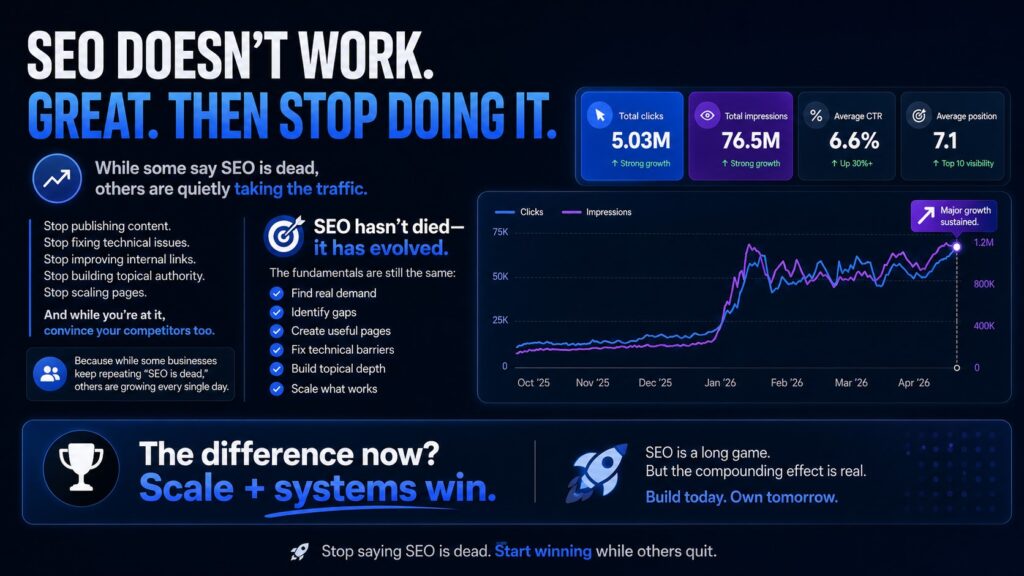
Here’s the problem with “SEO doesn’t work” – it’s rarely about SEO itself. It’s about effort. Most businesses that say SEO failed them stopped publishing, stopped fixing technical issues, and stopped building authority months before they declared it dead. Then they’re surprised when nothing happens.
Meanwhile, sites that kept showing up – fixing crawl errors, building topical depth, scaling content that actually answers questions are watching their organic traffic compound. Not overnight. Not from one viral post. From doing the fundamentals consistently while everyone else waited for proof it would work.
This article breaks down why SEO still works in 2026, what’s actually changed, and how to build a strategy that grows instead of stalls.
The “SEO Is Dead” Myth — Where It Comes From
The “SEO is dead” narrative tends to come from a specific pattern: a business invests inconsistently, sees slow early results (because SEO is rarely instant), gets discouraged, and quits right before momentum builds. They publicly blame the channel instead of the execution.
There’s also a more legitimate concern fueling this myth – the rise of AI-powered search. Tools like ChatGPT, Gemini, Perplexity, and Google’s AI Overviews are changing how people find answers. That’s real, and it matters. But a changing search landscape isn’t the same as a dead one. It means the channel has new rules, not no rules.
What’s Actually Changed in SEO (Not Whether It Works)
SEO in 2026 isn’t broken – it’s stricter. The bar for what gets rewarded has gone up, and the channels where content gets discovered have multiplied.
AI Overviews and Generative Search
Google’s AI Overviews, along with answer engines like ChatGPT and Perplexity, now summarize information directly in search results. This means thin, generic content has less room to rank — but it also means well-structured, genuinely useful pages have a new opportunity: getting cited as the source behind the AI-generated answer.
Shifting User Search Behavior
Searchers are asking longer, more specific, more conversational questions. They’re comparing options across multiple platforms before clicking through. Content that directly answers a specific question, in a specific context, performs better than broad, surface-level posts.
Higher Content Quality Bar
Google’s helpful content systems and years of algorithm updates have made it harder for low-effort, AI-spun, or duplicated content to rank. Quality, originality, and demonstrated expertise carry more weight than they used to.
None of this means SEO stopped working. It means SEO stopped rewarding shortcuts.
The SEO Fundamentals That Still Work in 2026
Strip away the trends, and SEO success still comes down to the same core moves it always has.
Finding Real Demand
Before creating anything, identify what people are actually searching for — not what sounds good internally. Keyword research, search intent analysis, and looking at what’s already ranking tell you where the real demand is.
Identifying Content Gaps
Look at what’s ranking for your target topics and ask: what’s missing? What’s outdated, incomplete, or poorly explained? Gaps in existing content are opportunities to create something genuinely better.
Creating Genuinely Useful Pages
This is the non-negotiable. Pages need to fully answer the searcher’s question, in a format that’s easy to scan and easy to trust. No filler. No padding to hit a word count.
Fixing Technical Barriers
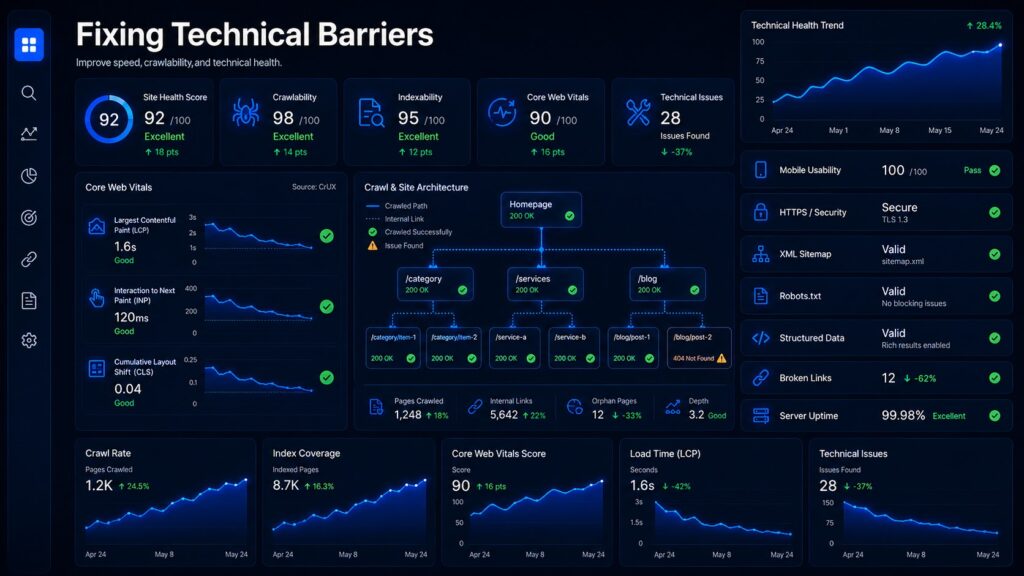
Site speed, mobile usability, crawlability, broken links, and indexing issues still quietly sabotage SEO efforts. A great page that Google can’t crawl or a slow page that users abandon will never perform, no matter how well it’s written.
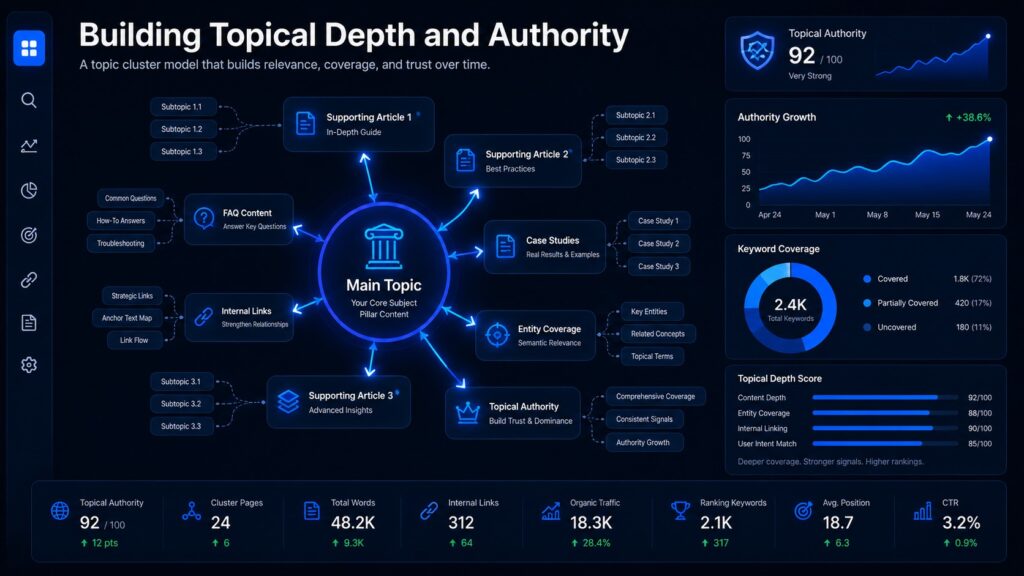
Building Topical Depth and Authority
Ranking for one page rarely moves the needle anymore. Building a cluster of interconnected, in-depth content around a topic signals real expertise — to both search engines and AI search tools pulling from authoritative sources.
Scaling What Works
Once a content format, topic cluster, or page structure proves it drives traffic, the winners scale it. Not by spamming more pages, but by systematically applying what’s already working to adjacent topics and gaps.
Real Results: What Modern SEO Growth Looks Like
SEO growth in 2026 rarely looks like a straight line. It typically looks flat for weeks or months – small, steady gains that feel unremarkable — followed by a compounding curve once enough pages, links, and topical authority accumulate.
It’s common to see sites move from a few hundred daily clicks to several thousand over a handful of months, not because of one big change, but because dozens of small, consistent fixes and content pieces started reinforcing each other. That’s the nature of compounding organic growth: unglamorous at first, then hard to ignore.
Common Mistakes That Make People Think “SEO Doesn’t Work”
- Expecting instant results. SEO is a medium-to-long-term channel. Judging it after four weeks is judging it too early.
- Publishing without a strategy. Random topics with no connection to search intent or topical clusters rarely rank well.
- Ignoring technical SEO. Even excellent content underperforms on a slow, poorly structured, or unindexed site.
- Stopping right before momentum builds. Many businesses quit during the flat phase, right before compounding growth would have kicked in.
- Copying competitors instead of solving gaps. Matching what already exists rarely outranks it. Improving on it does.
How to Build an SEO Strategy That Works in 2026
- Audit where you stand. Identify technical issues, content gaps, and current rankings before creating anything new.
- Map real search demand. Use keyword and intent research to prioritize topics people are actually searching for.
- Build topic clusters, not isolated posts. Group related content around core themes to build topical authority.
- Fix the technical foundation first. Site speed, mobile experience, and crawlability should be solid before scaling content.
- Write for the searcher, not the algorithm. Direct, clear answers earn both rankings and AI citations.
- Track, then scale what works. Double down on formats and topics already showing traction instead of starting from scratch each time.
This is the kind of strategy the team at Khalid SEO builds for clients — not chasing trends, but compounding fundamentals into sustained growth. You can see how this approach is applied in more detail on the Khalid SEO services page and through real case studies on khalidseo.com.
FAQs About SEO in 2026
Does SEO still work in 2026? Yes. SEO still works in 2026, but it rewards genuine expertise, technical soundness, and consistency more than it used to. Low-effort or outdated tactics no longer perform, but well-executed SEO continues to drive significant organic traffic.
Is SEO dead because of AI search tools like ChatGPT and AI Overviews? No. AI search tools have changed how answers are surfaced, but they still pull from indexed, authoritative web content. Strong SEO increases the chances of being the source cited in AI-generated answers.
How long does SEO take to work in 2026? Most businesses start seeing meaningful movement within 3 to 6 months of consistent effort, with stronger compounding growth typically appearing after 6 to 12 months, depending on competition and starting point.
What’s the biggest SEO mistake businesses make? Quitting too early. Many businesses stop investing in SEO right before the compounding effect of their efforts would have started showing results.
Do I need to keep publishing content for SEO to work? Consistent, high-quality content is one of the strongest signals of topical authority. It doesn’t need to be constant, but it does need to be sustained and strategic rather than one-off.
Final Thoughts: SEO Is a Long Game Worth Playing
SEO in 2026 isn’t dead — it’s just no longer forgiving of shortcuts. The businesses calling it dead are usually the ones who stopped too early. The ones quietly growing are the ones who treated it as a long-term system, not a quick campaign.
If you’re ready to build an SEO strategy based on what actually works now — not what worked five years ago — Khalid SEO can help you audit your current position and build a plan designed to compound. Get in touch with Khalid SEO to get started.
Suggested external authority links: