


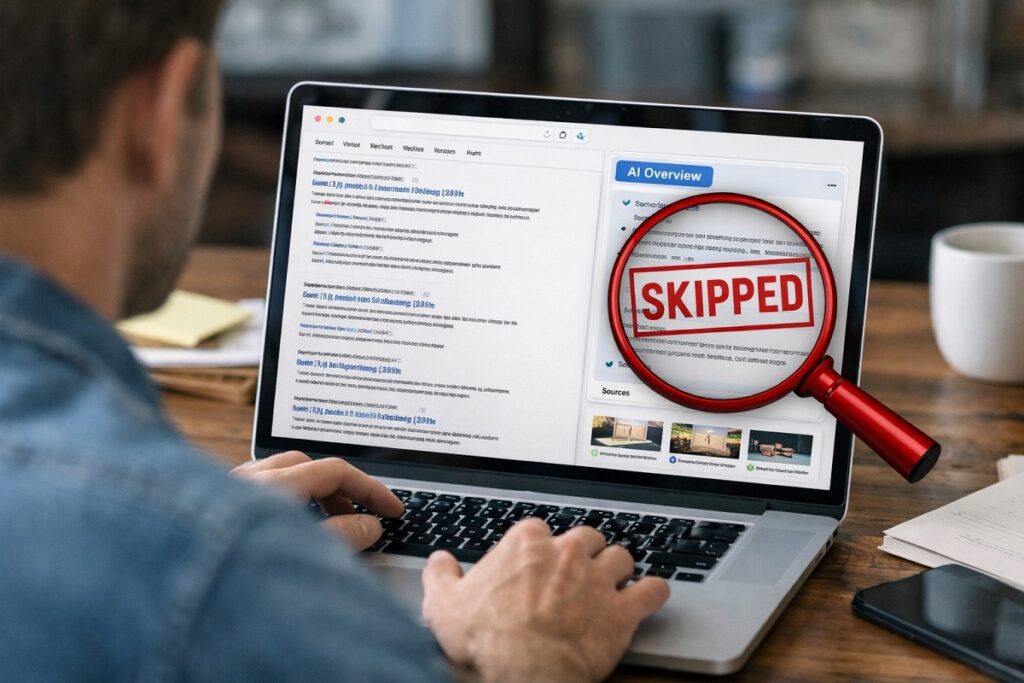
You open Google Search Console. You see your main target page sitting comfortably at position two. But your organic traffic is tanking.
Why? Because a massive Google AI Overview is pushing your organic link below the fold. The worst part is the AI is citing a competitor ranking at position twelve. Your top-tier content is being completely ignored by the answer engine.
Ranking high is no longer a guarantee of being cited. Large Language Models process text differently than traditional ranking algorithms. At Khalid SEO, we help brands bridge this exact gap. Here is the exact reason your pages are failing the extraction test, and how to fix them today.
Watch the video here 👇

The Growing Gap Between Ranking and Retrieval
There is a massive organic ranking gap right now. Being number one does not mean the AI will use your text.
Traditional ranking algorithms look at backlinks, domain age, and keyword density. They rank pages based on overall authority.
Large Language Models (LLMs) do not rank. They retrieve. They scan the web for the cleanest, most extractable answer to a specific question. If your answer is buried in fluff, Google AI Overviews will skip you entirely.
How AI Search Engines Actually Read Your Content
Google retrieval systems use a process called information extraction. They look for specific text nodes to satisfy a query.
| Traditional Search (Ranking) | Answer Engine Optimization (Retrieval) |
| Focuses on entire document relevance. | Focuses on self-contained text nodes. |
| Prioritizes domain authority and backlinks. | Prioritizes on-page trust signals and clarity. |
| Scans for keyword frequency and synonyms. | Extracts direct answers to specific entities. |
| User clicks a link to find the answer. | System serves the answer directly (zero-click). |
To succeed in AEO, you must build pages for machines to read quickly.
5 Reasons Your Top Content Gets Skipped by AI Overviews
You have great content. But it fails the AI extraction test. Here is why.
1. You are answering commercial intent queries with informational formats.
Not every query triggers an AI Overview. Google skips them for highly transactional or localized searches. If you try to force informational content into a commercial query, the AI ignores it.
2. Your introductions bury the actual answer.
Stop writing long stories. If your heading asks a question, the sentence immediately below it must answer that question. Do not warm up the reader. Give the facts instantly.
3. Your paragraphs rely too much on surrounding context.
AI models want self-contained answers. If paragraph three only makes sense because of paragraph two, the AI struggles. It cannot easily pull paragraph three out to use as a standalone citation.
4. You lack content level trust signals.
High domain authority is great. But AI looks for page-level trust. It wants author credentials, original data, and clear citations directly inside the text it extracts.
5. Your headings are not phrased as questions or claims.
Headings like “The Basics” give zero context to an LLM. Change that to “What is Answer Engine Optimization?” Make your heading hierarchy a map of clear questions.
How to Restructure Your Pages for Clean AI Extraction
You must build a flawless heading hierarchy. Treat your subheadings as the main queries your audience searches.
Below every heading, place a bold, direct answer. Keep this under 50 words. This provides a clean text node for the AI to grab.
After that direct answer, you can expand. Provide lists, tables, and deeper context for human readers.
Building On-Page E-E-A-T the AI Can Actually See
Google’s Knowledge Graph needs entities it can trust. Those E-E-A-T signals must live inside the content itself.
Use first-person language to prove personal experience. Link to your author bio from within the text. Cite original data whenever possible.
We constantly remind our clients at Khalid SEO: if your expertise isn’t visible on the page, the AI assumes it doesn’t exist.
The Khalid SEO AI Visibility Audit
Stop guessing if your pages are ready. Use this framework to audit your top pages.
Check your headings. Check your paragraph structure. Ensure your answers are self-contained.
Small structural tweaks lead to massive visibility gains. Start testing your layouts today.
Frequently Asked Questions
Why is my top-ranking page not showing in AI Overviews?
AI Overviews prioritize information retrieval over traditional ranking signals like backlinks. If your content buries the direct answer, uses complex structures, or lacks clear trust signals, Google skips it.
Google needs text that is easy to extract cleanly. A lower-ranking competitor will beat you if their answer is formatted perfectly for a machine to read.
What types of search queries trigger AI Overviews?
AI Overviews appear most often for conversational, long-tail, and strictly informational queries. Google generally bypasses AI generation for highly transactional, commercial, or localized searches.
Instead of an AI summary, commercial intent usually triggers traditional shopping links or map packs. Focus your AI optimization efforts on informational keywords.
How do I structure my blog posts for AI search?
Structure your posts with clear, question-based headings. Place a direct, concise answer immediately below each heading without any introductory fluff. Treat every section as a self-contained unit.
This allows the AI to extract the exact information it needs without pulling in irrelevant surrounding context.
Do backlinks matter for Google AI Overviews?
While backlinks build overall domain authority, they act as a secondary signal for AI Overviews. Google’s AI cares far more about content clarity, extractable structure, and entity positioning.
A highly structured page with zero backlinks can easily beat a massive, authoritative site in AI summaries. Format matters more than link juice here.
How can I improve my E-E-A-T signals for AI search?
E-E-A-T must live directly on the page itself. Include a clear author byline, use first-person language to show direct experience, and cite original data to prove expertise.
The AI looks for absolute proof of expertise within the text. It does not just rely on your overall domain profile to verify trust.


AI Search Specialist (AEO, GEO) | Helping brands get found, answered, and cited | Win on Google & ChatGPT.
I help businesses show up where their customers are actually looking.
For a long time, that just meant chasing rankings on Google. Today, it means something entirely different: people are asking AI for answers.
My job is simple. I bridge the gap between traditional SEO and the new world of AI search. I make sure that when someone asks ChatGPT, Google’s AI, or any other engine a question in your industry, your brand is the definitive answer they get.
No magic tricks or complicated buzzwords – just clean, modern search strategies that get you visibility and highly qualified leads.
Want to see how we can make your brand the trusted answer?
👉 Let’s connect, or check out my exact strategies at khalidseo.com.