Traffic is dropping. You see it in your analytics. It isn’t because you lost rankings; it’s because the rankings themselves are disappearing.
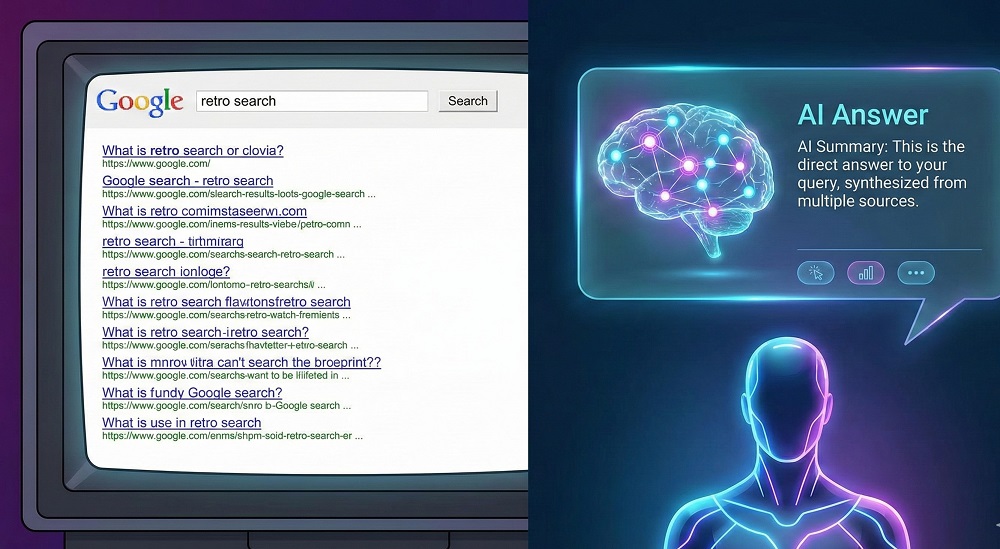
For two decades, the “10 blue links” were the gatekeepers of the internet. If you ranked #1, you won. But now, Google SGE (Search Generative Experience), ChatGPT, and Perplexity are rewriting the rules.
They don’t just list websites, they answer questions directly. If your site isn’t the source of that answer, you remain invisible.
You don’t need to fight the machines. You need to feed them.
This is AIO SEO. Here is how to evolve your strategy at Khalid SEO to survive the zero-click era.
What is AIO SEO? (The Definitive Answer)
AIO (Artificial Intelligence Optimization) is the process of optimizing content so it can be understood, cited, and synthesized by generative AI models like ChatGPT, Google Gemini, and Claude.
Unlike traditional SEO, which focuses on ranking a URL on a page, AIO focuses on Answer Engine Optimization (AEO). The goal is to become the “primary source” that an AI references when it generates an answer for a user.
Think of it this way: SEO is for humans clicking links. AIO is for machines seeking facts.
AIO vs. SEO vs. GEO: Clearing the Confusion
Marketing loves buzzwords. It is vital to distinguish between the three core disciplines dominating 2026.
Here is the breakdown:
| Feature | SEO (Traditional) | AIO (AI Optimization) | GEO (Generative Engine Opt.) |
| Primary Goal | Rank URLs in SERPs | Be cited in AI answers | Optimize specifically for SGE |
| Target Audience | Humans searching | LLMs & Algorithms | Hybrid (AI + Human) |
| Key Metric | Clicks / Traffic | Mentions / Citations | Visibility / Impressions |
| Content Style | Long-form, skimmable | Direct, factual, dense | Visual, structured, concise |
| Success Factor | Backlinks & Keywords | Entity Authority & Trust | Multimodal content (Images/Video) |
Why Traditional Keyword Stuffing Fails
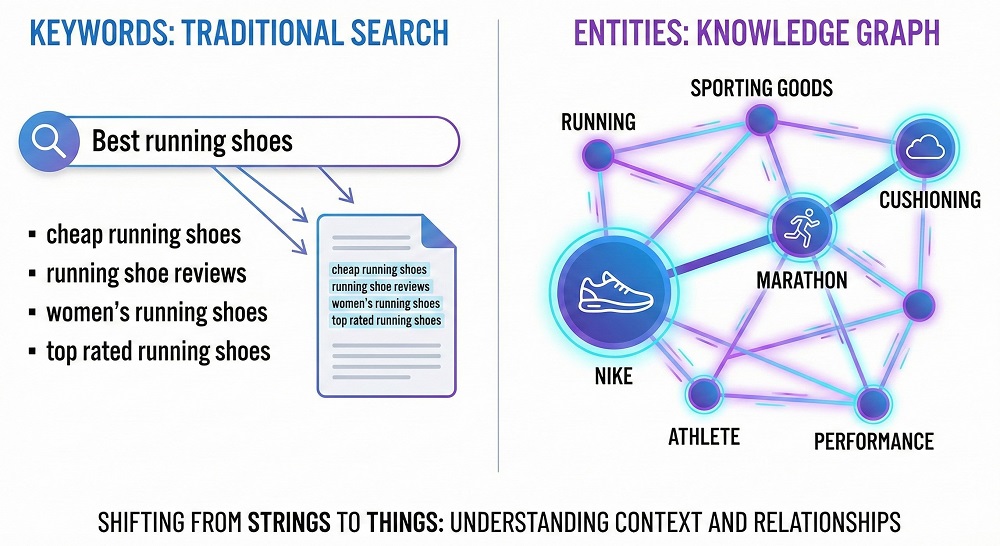
Old SEO relied on repetition. You wrote “best running shoes” five times, and Google understood the relevance.
AI models do not count keywords. They map meanings. If you stuff keywords without context, modern LLMs view your content as low-quality noise. They ignore it.
The Shift to Brand Visibility
In the AIO era, traffic might decrease, but qualified visibility increases. If ChatGPT answers a user’s question and cites khalidseo.com as the expert source, that user is far more likely to convert than a random visitor from a Google search.
How LLMs “Read” Your Website (The Technical Side)
To win at AIO, you must understand Vector Space.
LLMs don’t read text left-to-right like humans. They convert words into numbers (tokens) and place them in a 3D mathematical space. Words that are semantically related sit close together in this space.
- Classic SEO: Matches the word “Apple” to the word “Apple.”
- AIO / Vector Search: Understands that “Apple” is close to “iPhone,” “Tech,” and “Cupertino,” but far away from “Fruit” or “Pie” depending on the context.
Why We Prioritize Structured Data
At https://khalidseo.com/, we emphasize Schema Markup (JSON-LD) because it speaks the robot’s language. Structured data explicitly tells the AI: “This is a Price,” “This is an Author,” and “This is a Fact.”
Without Schema, the AI has to guess. With Schema, you give it certainty. Certainty leads to citations.
The Core Pillars of an AIO Strategy
Stop writing for word count. Start writing for Information Gain.
1. Entity Density: Beyond Keywords
An “Entity” is a distinct thing a person, place, or concept known to the Knowledge Graph (like “Neil Patel” or “Ahrefs”).
To rank in AI overviews, your content must connect your main topic to relevant entities. If you write about “Link Building,” you must also mention entities like “PageRank,” “Domain Authority,” and “Anchor Text” to prove to the AI that you cover the topic depth.
2. “Token Efficiency”: Writing Concise Code
LLMs have processing limits. Bloated code confuses them. Keep your HTML clean. Ensure your main content is near the top of the DOM (Document Object Model).
3. The Power of Original Data
AI models are trained on existing data. They crave new information.
- Do not just rewrite what is on Page 1.
- Run a survey.
- Publish a case study with unique numbers.
- Interview an expert.
When you provide fresh data, you become the origin node of that information. The AI must cite you because you are the only source.
Top Tools for AIO Analysis in 2026
You cannot track AIO success with Google Search Console alone. You need next-gen tools.
- Otterly AI: Great for tracking how often your brand is mentioned in ChatGPT conversations.
- Perplexity: Use this to research your topic. Ask it a question and see which sources it cites. mimic their structure.
- Semrush AI Toolkit: Excellent for analyzing NLP patterns and keyword intent.
Is Your Site Ready for the AI Takeover?
If your traffic is dipping, your site might be invisible to LLMs.
Do you have FAQ Schema? Is your content reading level below 8th grade (preferred by AI for clarity)?
If you aren’t sure, check the guides at https://khalidseo.com/. We specialize in auditing “Entity Graphs” to ensure your brand is machine-readable.
Frequently Asked Questions (FAQs)
This section is structured for Voice Search and Featured Snippets.
What is the main difference between SEO and AIO?
AIO focuses on citations in generative AI answers, while SEO focuses on ranking links. Traditional SEO drives clicks from search engines; AIO drives authority and brand mentions from chatbots and zero-click results.
How do I optimize my content for AI Overviews?
Focus on Information Gain and conversational structure. Use question-based headings (H2s), provide direct 40-word answers immediately after, and implement robust FAQ Schema to help machines parse your data.
Is keyword research dead in AIO?
No, but it has evolved into Entity Research. Instead of counting keyword density, you must identify “parent” topics and semantically related concepts (entities) to establish your page’s context in the Knowledge Graph.
What tools are best for AIO SEO?
Top tools include Otterly AI, Perplexity, and Semrush. These platforms help you track brand mentions in Large Language Models and analyze the “vector context” of your competitors.
Why is brand authority important for AIO?
AI models prioritize “trusted sources” to minimize hallucinations. High brand authority—signaled by consistent mentions, author credentials (E-E-A-T), and quality backlinks—increases the probability of an LLM citing your brand as a fact.
Conclusion
AIO is not a trend. It is the standard. The “10 blue links” are fading, but the need for high-quality, authoritative answers is higher than ever. Build your brand, structure your data, and let the AI do the work of finding you.