
AI agents are transforming how people shop. Traditional e-commerce architectures are breaking under this shift. Shoppers are abandoning manual carts when AI assistants cannot complete purchases for them.
If your infrastructure cannot communicate directly with these AI models, you are invisible to high-intent buyers. Worse, relying on third-party AI marketplaces threatens your status as the Merchant of Record, risking your first-party data.
The Universal Commerce Protocol (UCP) solves this. Co-developed by Google and Shopify, this open-source standard bridges the gap. It allows AI agents to negotiate and execute secure purchases directly on your backend. Here is exactly how to integrate it.

The Dawn of Agentic Commerce: What is the Universal Commerce Protocol (UCP)?
The Universal Commerce Protocol (UCP) is an open-source standard developed by Google and Shopify that enables agentic commerce. It allows AI agents to securely negotiate, build dynamic carts, and execute transactions on behalf of users while the retailer maintains their Merchant of Record status.
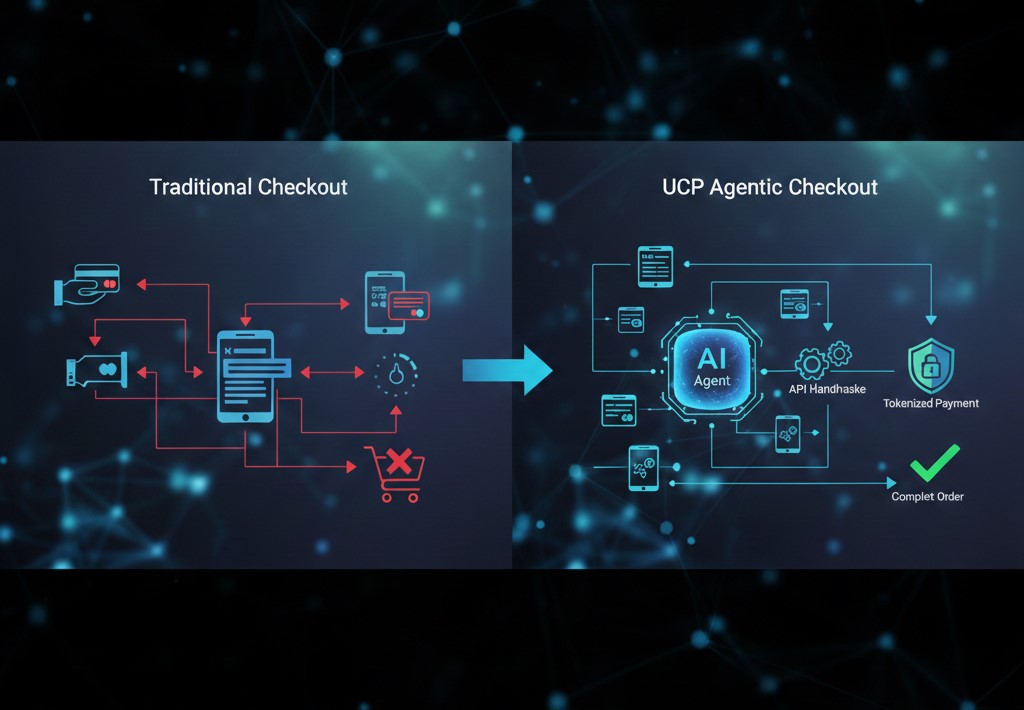
This protocol shifts e-commerce from passive catalogs to programmable interactions. UCP defines the discovery and negotiation mechanisms between an AI agent and a merchant. It replaces rigid checkout forms with dynamic API handshakes.
How UCP Works: The Architecture of AI Checkout
Traditional checkouts force human buyers through friction-heavy steps. UCP eliminates this via dynamic capability discovery. Merchants publish a machine-readable JSON manifest at /.well-known/ucp.
AI agents read this manifest to understand your exact commerce capabilities. They learn how to build a cart, apply discounts, and process fulfillments instantly.
Integrating UCP via MCP and APIs
UCP is intentionally transport-agnostic. It does not force you into a single technology stack. You can connect your backend to AI surfaces using standard REST APIs.
For deeper AI integration, UCP natively supports the Model Context Protocol (MCP). This allows large language models to execute tool calls directly against your commerce logic. It also supports Agent2Agent (A2A) messaging for complex negotiations.
UCP Payments & Security: AP2 and Decoupled Architecture
Handling financial data autonomously requires a zero-trust architecture. UCP achieves this by structurally decoupling the payment process. It separates what the consumer uses to pay from who processes the transaction.
| Component | Definition | Real-World Example |
| Payment Instruments | What the consumer uses to fund the purchase. | Google Pay, saved credit cards, digital wallets. |
| Payment Handlers | The backend processor that executes the transaction. | Stripe, Adyen, Shopify Payments. |
This decoupled model integrates perfectly with the Agent Payments Protocol (AP2). AI agents use tokenized payments and verifiable credentials. They never access raw credit card numbers.
The Merchant Perspective: Data Control and “Merchant of Record”
A massive fear surrounding agentic commerce is the loss of customer ownership. UCP was built specifically to protect retailers. You never cede control to a centralized AI marketplace.
With UCP, you remain the Merchant of Record. You maintain total control over taxes, compliance, and fulfillment. You also retain all first-party customer data. Identity linking is handled securely via OAuth 2.0.
Core Capabilities and the UCP Rollout
UCP is not a theoretical concept. It is live and actively rolling out across AI Mode in Google Search and the Gemini app. The initial launch focuses on three actionable primitives.
- Checkout: Manage complex cart logic, taxes, and dynamic pricing.
- Identity Linking: Authenticate users for loyalty programs and saved preferences.
- Order Management: Utilize real-time webhooks for fulfillment, tracking, and returns.
Your UCP Integration Readiness Roadblock Report
Upgrading legacy architecture to support UCP requires strategic planning. You must evaluate your current tech stack against the protocol’s requirements.
Assess your payment service provider’s compatibility with UCP handlers. Audit your catalog data for MCP ingestion. Determine if your checkout flow requires human-in-the-loop escalation or can be fully automated.
Agentic Commerce FAQ
What is the Universal Commerce Protocol (UCP)?
The Universal Commerce Protocol (UCP) is an open-source standard that enables seamless agentic commerce between AI agents and business systems while the retailer remains the Merchant of Record.
It acts as a universal abstraction layer. Google and Shopify co-developed it to prevent the fragmentation of AI-driven shopping experiences.
How does UCP handle payments securely?
UCP secures transactions by separating consumer payment instruments from merchant payment handlers, utilizing the Agent Payments Protocol (AP2) to process tokenized payments without exposing raw data.
This modular design ensures interoperability. Shoppers can use their preferred wallets while merchants route transactions through their existing processors like Stripe or Adyen.
Is UCP compatible with the Model Context Protocol (MCP)?
Yes. UCP is transport-agnostic and natively supports the Model Context Protocol (MCP), alongside REST APIs and Agent2Agent (A2A) messaging for seamless AI integration.
This flexibility allows developers to choose the integration path that best fits their existing backend infrastructure.
Do merchants lose control of customer data with UCP?
No. A foundational principle of UCP is that the retailer retains full ownership of the customer relationship, post-purchase data, and Merchant of Record status.
UCP is merely a communication protocol. It is not an intermediary marketplace that intercepts or hoards your transactional data.
What are the core capabilities of UCP?
The initial launch of UCP focuses on three core capabilities: dynamic Checkout, secure Identity Linking via OAuth 2.0, and real-time Order Management using webhooks.
Merchants can declare these capabilities in their public manifest. AI agents then dynamically discover and interact with them based on user intent.