Most websites unintentionally block millions of users every day. They also block search engines.
You might spend thousands on content creation and link building. Yet, a poor technical foundation will kill your crawlability. Competitors with cleaner, faster sites are simply stealing your organic traffic.
The fix isn’t another keyword tool. It is web accessibility. When you build a site that people with disabilities can use, Googlebot indexes it faster. Here at Khalid SEO, I specialize in bridging this gap. Let’s explore how fixing your site’s access directly drives organic growth and revenue.
The Hidden Overlap: Why SEO and Web Accessibility Are the Same Discipline
What is SEO accessibility? SEO accessibility is the practice of designing websites so they are easily understood by search engine crawlers and fully usable by people with disabilities. It focuses on the technical overlap between inclusive user experience and search visibility, utilizing semantic tags and logical architecture.
Search engines and screen readers operate similarly. They both crawl your Document Object Model (DOM) linearly. They do not “see” your visual CSS styling. They read your raw code top-down.
If your code is messy, both bots and users get lost. If it is structured, your search visibility increases.
The Technical Foundation: How Bots and Assistive Tech “See” Your Site
Semantic HTML vs. Div Soup
Search crawlers need structure to rank pages accurately. A website built entirely with generic <div> tags offers zero context.
Semantic HTML solves this. It uses specific tags like <article>, <nav>, and <header>. This tells Googlebot exactly what matters most. It also allows screen readers to jump directly to your primary content.
| Feature | The “Div Soup” Approach | The Semantic HTML Approach |
| Code Structure | <div class="header">, <div class="menu"> | <header>, <nav> |
| Screen Reader Experience | Reads every element sequentially. High friction. | Can skip to main content immediately. |
| Googlebot Interpretation | Struggles to find the main topic cluster. | Instantly understands topical relevance. |
| Core Web Vitals Impact | Slower parsing, larger DOM size. | Faster rendering, improved LCP. |
The Role (and Risks) of ARIA Attributes
Accessible Rich Internet Applications (ARIA) attributes help explain dynamic content. They bridge the gap when standard HTML falls short.
Use tags like aria-label to give context to icon-only buttons. But proceed with caution. Bad ARIA implementation is worse than no ARIA. Overusing these attributes confuses both assistive tech and search algorithms.
Mastering the POUR Principles for Better Search Rankings
The Web Content Accessibility Guidelines (WCAG) rely on four core rules. Known as the POUR principles, they are a literal blueprint for technical SEO.
Perceivable (Alt Text & Media Optimization)
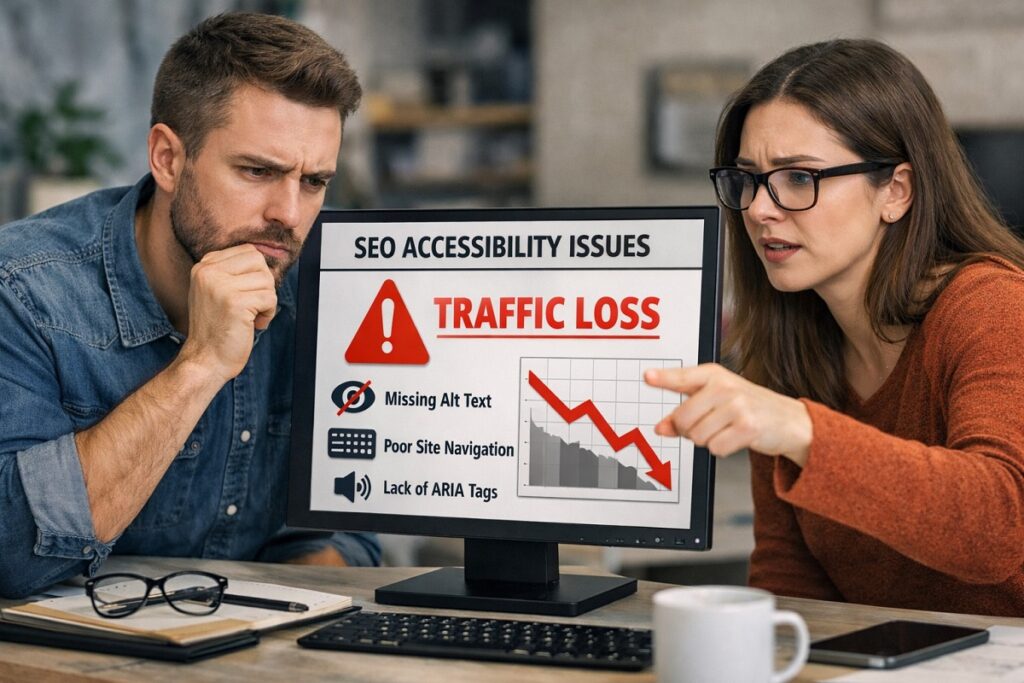
Content must be available to all senses. Alt text optimization is critical here. It describes images clearly for visually impaired users. Simultaneously, it gives Google Image Search vital context to rank your visuals.
Operable (Keyboard Navigation & Site Architecture)
Your navigation must work without a mouse. Keyboard navigation requires a clean, highly logical site architecture. If a human can tab through your site easily, crawlers can index your pages efficiently.
Understandable (Predictable UX & Content Hierarchies)
Predictable user experience (UX) keeps visitors reading. You must use clear heading hierarchies. Move from H1 to H2 to H3. Never skip heading levels. This plain structure directly supports Google’s Helpful Content system.
Robust (Clean Code for Future-Proofing)
Robust sites work perfectly across all devices and browsers. Valid HTML and responsive design are non-negotiable. This aligns perfectly with Google’s mobile-first indexing standards.
The ROI of Inclusive Design: Core Web Vitals and Conversions
Inclusive design improves your Core Web Vitals automatically. Semantic HTML loads much faster than heavy JavaScript frameworks.
This speed reduces your bounce rate. Faster load times (LCP) and stable layouts (CLS) keep users on the page. High dwell time sends incredibly strong ranking signals to search engines.
Accessible sites also see massive conversion rate optimization (CRO) boosts. Clearer forms, high visual contrast, and readable text remove friction. When you remove friction, users buy more.
ADA Compliance: Protecting Your Traffic and Your Brand
Digital accessibility is no longer optional. The Department of Justice actively enforces ADA website compliance.
Following the WCAG 2.2 guidelines protects your business from expensive lawsuits. More importantly, it secures your search visibility. As an AI SEO, GEO, and AEO Specialist, I consistently see how strict compliance correlates with algorithmic trust.
Stop treating accessibility as an afterthought. Build it into your technical foundation today.
Frequently Asked Questions
Does web accessibility affect SEO?
Yes, web accessibility directly affects SEO. Both search engines and assistive technologies rely on clean, semantic HTML and logical site structure to parse content efficiently. Implementing accessibility best practices like proper heading hierarchy and descriptive alt text improves crawlability. It boosts Core Web Vitals and enhances overall user experience signals, which Google rewards.
How do screen readers and search engines read websites?
Screen readers and search engine bots read websites in a linear, top-down fashion by crawling the Document Object Model (DOM). They rely heavily on semantic HTML and heading tags (H1-H6) to understand the content’s hierarchy, context, and primary topics. They ignore visual CSS completely.
What are the POUR principles in web accessibility?
The POUR principles form the foundation of the WCAG. They mandate that digital content must be Perceivable, Operable, Understandable, and Robust.
Content must be available to all senses, navigable via multiple inputs, clear to read, and compatible with various modern assistive technologies.
How does accessibility improve Core Web Vitals?
Accessibility improves Core Web Vitals by prioritizing clean, highly efficient code over bloated frameworks. Semantic HTML loads faster than JavaScript-heavy layouts, which improves Largest Contentful Paint (LCP). Keyboard-friendly elements simplify event handling, improving First Input Delay (FID). Structured content prevents unexpected visual shifts, improving Cumulative Layout Shift (CLS).

AI Search Specialist (AEO, GEO) | Helping brands get found, answered, and cited | Win on Google & ChatGPT.
I help businesses show up where their customers are actually looking.
For a long time, that just meant chasing rankings on Google. Today, it means something entirely different: people are asking AI for answers.
My job is simple. I bridge the gap between traditional SEO and the new world of AI search. I make sure that when someone asks ChatGPT, Google’s AI, or any other engine a question in your industry, your brand is the definitive answer they get.
No magic tricks or complicated buzzwords – just clean, modern search strategies that get you visibility and highly qualified leads.
Want to see how we can make your brand the trusted answer?
👉 Let’s connect, or check out my exact strategies at khalidseo.com.