
Traffic from traditional search engines is dropping. Users now demand instant answers, not a list of ten blue links.
This shift leaves publishers in a dangerous position. AI search engines often scrape your hard work without sending valuable clicks back to your site, directly threatening your ad revenue.
There is a solution to this traffic cannibalization. The Perplexity Publisher Program offers a lifeline for media companies. As an AI Search Specialist, I built this guide to help you capture this new revenue and master Generative Engine Optimization (GEO).
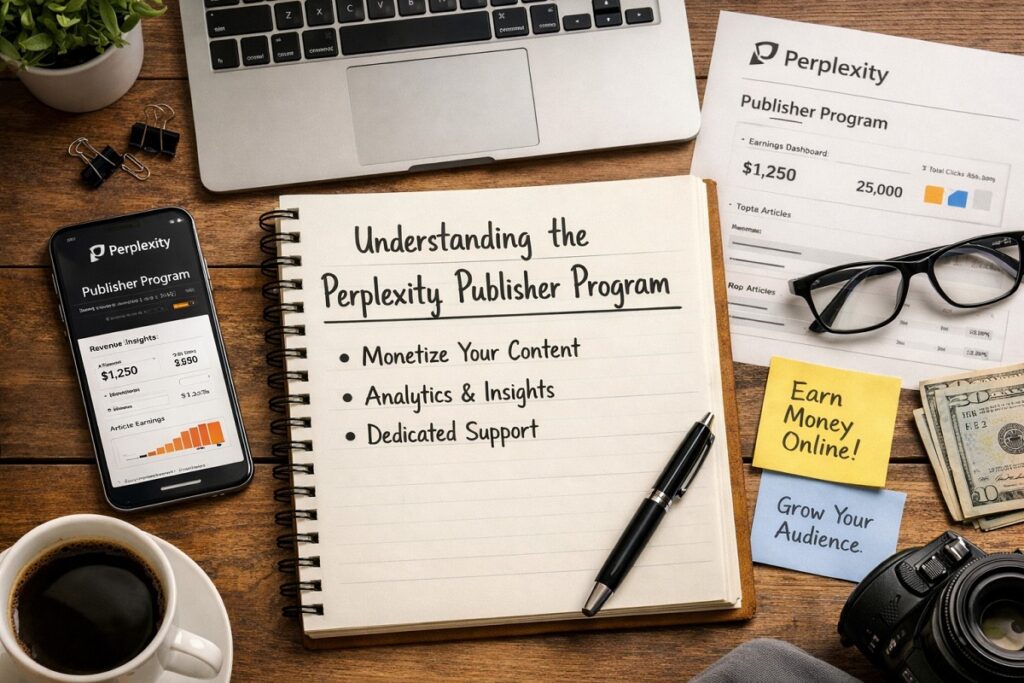
The Evolution of AI Monetization: What is the Perplexity Publisher Program?
The Perplexity Publisher Program is a dual-revenue initiative that compensates media companies when their content is cited in AI-generated answers or viewed through the Comet browser. It aims to share advertising and subscription revenue directly with original content creators.
Perplexity AI, led by CEO Aravind Srinivas, realizes that AI needs high-quality journalism to survive. Without publishers, their models hallucinate.
This program creates a financial bridge. It shifts the focus from purely driving clicks to rewarding accurate, citable information. It relies heavily on generative engine optimization to ensure the right content surfaces for Sponsored Follow-Up Questions.
The Economics of Citation: How Publishers Actually Get Paid
You need to understand how the money flows. The program operates on two primary financial tracks.
The Ad-Revenue Share Model (Sponsored Questions)
Brands buy ads in the form of Sponsored Follow-Up Questions. When a user clicks these prompts, Perplexity generates a new answer.
If your article is cited in that sponsored response, you earn a flat percentage of that ad revenue. It creates a direct financial incentive for high-quality, authoritative reporting.
The Comet Plus Subscription Pool (Pay-Per-Usage)
The second track involves the Comet Plus subscription. This is a pay-per-usage model powered by a shared revenue pool.
When paying subscribers use AI agent traffic to research topics, Perplexity tracks the citations. The revenue split heavily favors publishers whose content successfully completes the user’s task. It monetizes the walled garden rather than fighting it.
| Feature | Traditional Search SEO | Perplexity Publisher GEO |
| Primary Goal | Drive clicks to website | Secure citations in AI answers |
| Revenue Source | Display ads on your site | Revenue split from subscriptions & sponsored queries |
| Key Metric | Organic Traffic (Sessions) | AI Citation Frequency |
| Technical Focus | Backlinks & Keyword Density | Structured Data & Entity Relevance |
Generative Engine Optimization (GEO): The Technical Blueprint for Inclusion
Joining the program is only step one. You must optimize your site so Perplexity’s bots actually choose your content over your competitors.
Structuring Data for Answer Engines
AI models do not read websites like humans do. They process entities and relationships.
You must implement flawless structured data. Use Article, FAQ, and Authorship schema. This clearly defines your entities and ensures precise citation tracking.
Adopting the LLMs.txt Protocol
You need to control how AI crawls your site. The traditional robots.txt is no longer enough.
Implement the LLMs.txt protocol. This provides a clean, markdown-based directory specifically for AI crawlers like those from Perplexity and OpenAI. It highlights your most important, factual content for API access and ingestion.
The Strategic Dilemma: Traffic Cannibalization vs. New Revenue Streams
Many C-Suite executives fear AI search. They worry it will destroy their direct traffic.
Why Major Brands Like Gannett and TIME Are Opting In
Major publishers are not waiting around. Brands like Gannett, TIME, and Der Spiegel have already partnered with Perplexity.
They understand that AI search is inevitable. Platforms like ScalePost.ai are also emerging to facilitate AI content licensing. These publishers prefer a guaranteed revenue split now rather than fighting a losing battle for traditional clicks later.
Protecting Your Direct Reader Relationships
You must balance AI optimization with audience retention. Do not put your best, unique journalism entirely behind an AI’s walled garden.
Use AI search for top-of-funnel discovery. Drive those users back to your site with exclusive newsletters, deep-dive investigations, and strong direct reader relationships.
AI Revenue Impact Calculator
Estimate your potential revenue risk as organic traffic shifts to AI Answer Engines.
Don’t lose this revenue to the walled garden.
I am an AI Search Specialist. Let’s optimize your site for GEO today.
How to Prepare Your Website for the AI Search Era
The era of ten blue links is ending. You must adapt your strategy for AI search monetization.
Start by auditing your current entity structure. Focus on building topical authority and answering complex questions directly. At Khalid SEO, I help publishers transition seamlessly into this new ecosystem by mastering AEO and optimizing for LLMs.
Frequently Asked Questions (FAQ)
What is the Perplexity Publisher Program?
The Perplexity Publisher Program is a revenue-sharing initiative compensating media companies when their content is cited in AI answers. It shares advertising and subscription revenue with original creators.
It attempts to solve the traffic cannibalization problem caused by AI search engines, creating a sustainable financial model for high-quality journalism.
How does Perplexity pay publishers?
Perplexity pays via a usage-based revenue-sharing model. Publishers earn a percentage when cited in sponsored follow-up questions or accessed through the pooled Comet Plus subscription tier.
This means your financial return is directly tied to how often the AI relies on your specific facts and reporting to satisfy a user’s query.
How do I join the Perplexity Publisher Program?
The program currently operates through direct partnerships with major media brands. However, independent publishers can prepare by implementing Generative Engine Optimization (GEO) to ensure citable content.
While smaller sites cannot sign a direct contract today, structuring your data now ensures you capture citations and are ready when the program expands.
What are the technical benefits of the Perplexity Publisher Program?
Beyond revenue, the program offers publishers free developer API access, infrastructure for custom answer engines, and Enterprise Pro accounts for editorial staff to accelerate research.
These tools allow media companies to build their own internal AI products and improve their reporting workflows at no additional cost.
How can publishers optimize for Perplexity AI?
Publishers must implement Generative Engine Optimization (GEO). This requires comprehensive structured data, direct answers, clear authorship, and adopting the LLMs.txt protocol to guide AI crawlers.
This shifts your technical strategy from traditional keyword stuffing to building a robust, easily digestible entity graph for answer engines.