You dominate the search results. You hold “Position 1” for your highest-value commercial keywords. Your traffic logs look healthy.
But when a potential customer asks ChatGPT, “Who is the best provider for X?”, your brand is nowhere to be found.
Instead, the AI recommends a competitor who ranks on Page 2 of Google.
This is the “Silent Crisis” of 2026. Traditional SEO metrics, rankings, clicks, and domain authority are failing to capture the new reality of search. Google trusts links; Large Language Models (LLMs) trust patterns.
If your brand’s data isn’t corroborated across the digital ecosystem, you are statistically insignificant to an AI. To win in this new era, you must pivot from optimization to Consensus.
The “Consensus Engine”: Why LLMs Ignore Your Rankings
Traditional search engines are indexers. They fetch documents and rank them based on relevance and authority signals (backlinks). If you have the best links, you win the island.
LLMs are not indexers; they are Consensus Engines.
When an AI like ChatGPT or Gemini constructs an answer, it uses Retrieval-Augmented Generation (RAG). It scans multiple sources simultaneously to synthesize a response. Its primary directive is to avoid “hallucination.”
Here is the brutal truth: Unique information is often treated as a hallucination risk.
If your website claims you are the “market leader,” but no industry journals, Reddit threads, or third-party reviews corroborate that claim, the AI treats your data point as an outlier. It discards it. It chooses the “safer” answer—your competitor, whose claims are echoed across ten different sources.
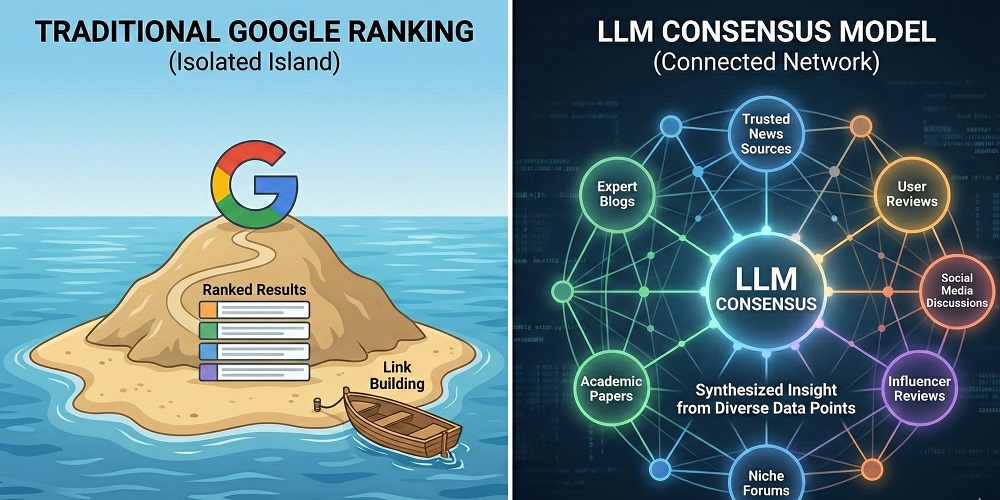
The Shift: Link Juice vs. Semantic Proximity
| Feature | Traditional SEO (Google) | Generative Engine Optimization (GEO) |
| Primary Goal | Rank #1 on a list of blue links. | Be cited as the “Answer” in chat. |
| Trust Signal | Backlinks from high-DA sites. | Corroboration across diverse sources. |
| Content Strategy | Keywords and length. | Data density and entity connections. |
| Failure Mode | Low traffic / Page 2 ranking. | Invisibility (Zero citations). |
Decoding the “Fan-Out” Pattern (How AI Checks Facts)
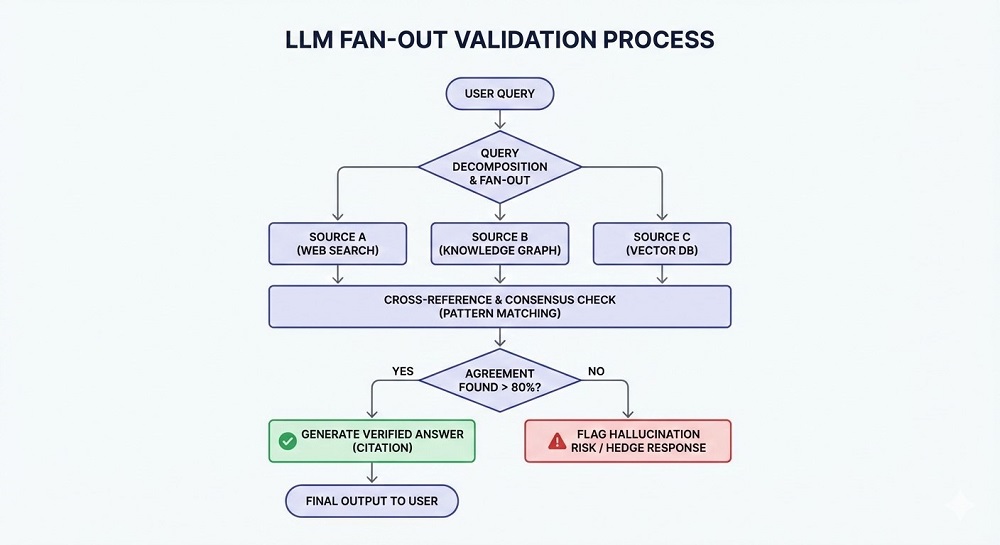
To optimize for AI, you must understand how it “thinks.” It doesn’t read one page linearly. It uses a Fan-Out pattern.
- Query Decomposition: The AI breaks the user’s complex question into smaller sub-queries.
- Parallel Retrieval: It sends agents to fetch data from diverse nodes—Wikis, News, Forums (Reddit), and Reviews.
- Pattern Matching: It looks for the “majority vote.”
If four out of five sources agree on a fact, that fact becomes the Consensus Truth. If your website is the only source claiming something, you fail the validation check.
This mechanism is why “Brand Authority” is no longer enough. You need Cross-Domain Agreement.
The Strategic Model: Building the “Triangle of Truth”
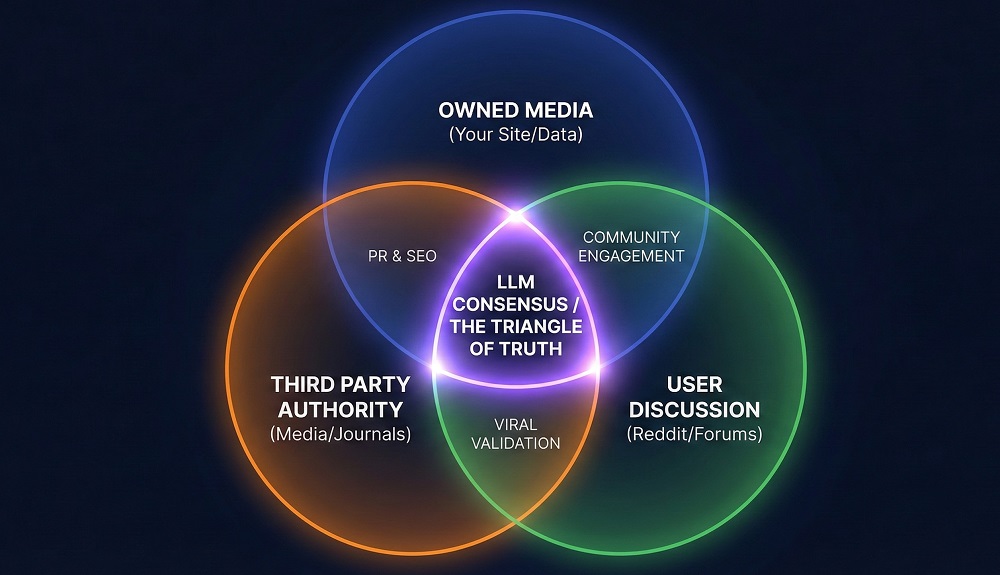
You cannot force an AI to cite you. You must make it statistically impossible for the AI not to cite you. You do this by occupying the Triangle of Truth.
To trigger a citation, your brand entity must exist at the intersection of three datasets:
- Owned Media (Your Site): The source of the claim (Structured Data).
- Third-Party Authority (Media/Journals): The validation of the claim.
- User Consensus (Reddit/Forums): The “human” proof that the claim is real.
If you miss one angle for example, you have great PR but zero Reddit presence, the AI may flag your brand as “marketing noise” rather than an organic entity.
From SEO to GEO: 4 Steps to Engineer Consensus
Generative Engine Optimization (GEO) is the practice of aligning your content with these consensus algorithms. Here is your execution plan.
1. Increase Data Density
Fluff is fatal. AI agents strip away adjectives and look for hard data (entities, numbers, dates).
- Bad: “We offer fast shipping.”
- GEO: “We process 98% of orders within 4 hours (Source: 2025 Logistics Audit).”Give the AI specific, cite-able statistics.
2. The “Reddit Factor”
Google has heavily weighted Reddit in its recent updates, and LLMs use it as a proxy for human trust.
- Strategy: You cannot spam. You must foster genuine discussion. Monitor brand mentions and ensure your specific value propositions (e.g., “best pricing,” “reliable API”) are repeated by actual users in relevant threads.
3. Co-Occurrence Strategy
An AI learns by association (Vector Embeddings). If your brand is never mentioned in the same sentence as the industry leaders, you are not in the “neighborhood” of the answer.
- Tactic: Get featured in “Best X Tools” listicles alongside your top competitors. The goal isn’t just the link; it’s the semantic proximity of your brand name next to the category winners.
4. Schema for Machines
Use SameAs markup on your “About” page. Explicitly tell the Knowledge Graph: “This entity (My Brand) is the same entity discussed on this Wikipedia page, this Crunchbase profile, and this G2 review page.” Connect the dots so the AI doesn’t have to guess.
Measuring the Unmeasurable: Citation Share of Voice
Forget rank tracking. You need to measure Citation Share of Voice (C-SOV).
This metric tracks how often your brand is cited in AI-generated answers for your core topics.
- Zero Visibility: The AI answers but doesn’t mention you.
- Brand Mention: The AI lists you as an option.
- The Answer: The AI recommends you as the primary solution.
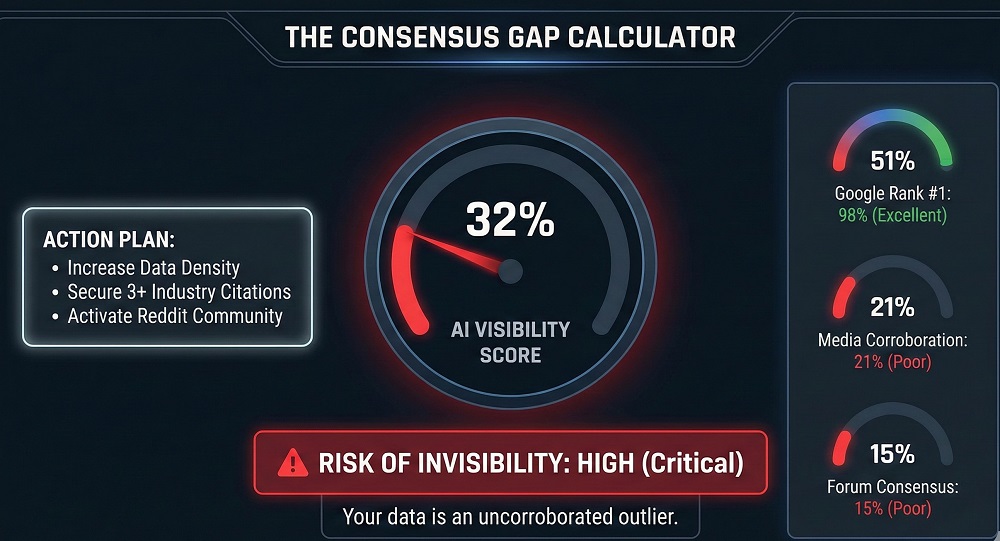
📉 Consensus Gap Calculator
Calculate your risk of being invisible to AI answers.
Conclusion: The End of the “Single Source of Truth”
For twenty years, we played a game of “King of the Hill.” We fought for the top spot on Google.
That game is ending. The new game is “Consensus.” It is not about being the loudest voice in the room; it is about being the most corroborated.
If your data points are agreed upon by the crowd, the media, and your own site, you become the truth. If not, you remain #1 on Google, but invisible to the future.
FAQ: Optimizing for Answer Engines
Why does ChatGPT ignore my website even if I rank #1 on Google?
ChatGPT prioritizes Consensus over rank.
While Google ranks based on backlinks, LLMs use Retrieval-Augmented Generation (RAG) to scan for factual agreement across multiple sources. If your website’s claims are not corroborated by other nodes (journals, forums), the LLM treats your content as an “outlier” to avoid hallucination.
What is Generative Engine Optimization (GEO)?
GEO is the practice of optimizing content for AI citation.
Unlike SEO, which focuses on clicks, GEO focuses on Citation Share of Voice. Key strategies include increasing “Data Density” (unique stats), building forum consensus, and ensuring your brand appears alongside competitors (Co-occurrence) to enter the AI’s consideration set.
How do I improve my Citation Share of Voice (C-SOV)?
Increase your brand’s semantic proximity to the topic.
You must establish a “Triangle of Truth”: 1. Ensure high Data Density on your site. 2. Secure mentions in “Best of” lists alongside competitors. 3. Manage discussions on Reddit/Quora, as LLMs weigh human consensus heavily.
Is “Consensus” a real ranking factor for AI?
Yes, it is the primary filter for accuracy.
Research on “Multi-Model Consensus” confirms that AI agents trust information that appears consistently across diverse, unconnected sources. Cross-verification reduces the probability of false information, making “consensus” the effective ranking signal for inclusion in an answer.
What is the “LLM Fan-Out” pattern in search?
It is the parallel retrieval process used by AI agents.
The AI breaks a query into sub-parts, searches multiple sources simultaneously, and aggregates the results. It looks for overlapping patterns in the data. Content that matches the “majority view” of these diverse sources is cited; outliers are discarded.