The traffic you rely on is vanishing.
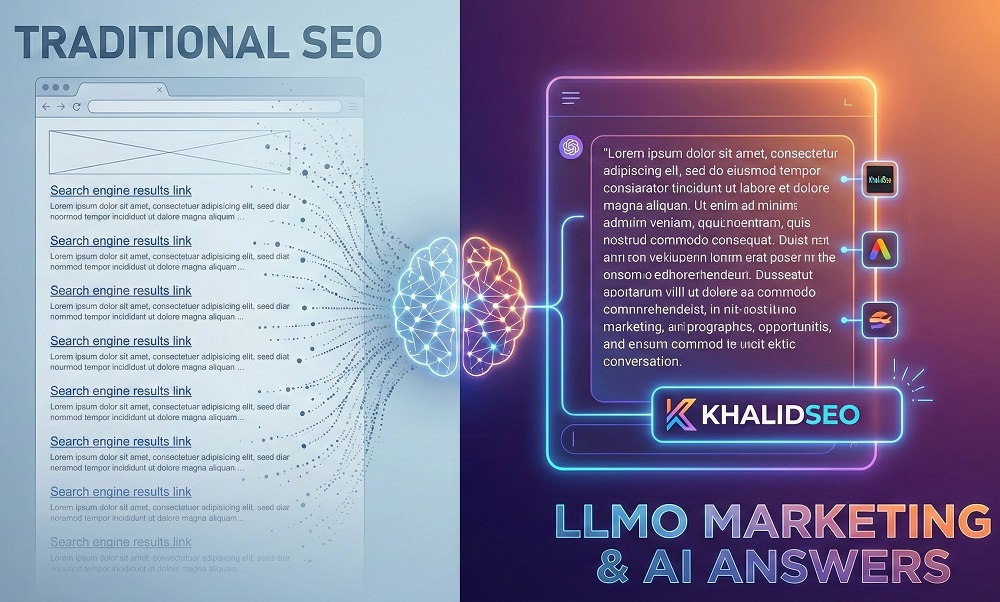
For two decades, the formula was simple: rank high, get clicks, make money. But search is changing. Users aren’t just “Googling” anymore; they are asking ChatGPT, Gemini, and Perplexity for direct answers. When an AI answers a user’s question perfectly, they don’t click your link. They stay in the chat.
This is the “Zero-Click” reality. If your brand isn’t part of the AI’s answer, you are invisible.
LLMO Marketing (Large Language Model Optimization) is the solution. It isn’t about tricking an algorithm with keywords. It is about training the AI to recognize your brand as a trusted entity.
At KhalidSEO, we have shifted our entire strategy from “chasing clicks” to “building authority,” ensuring our clients are the source the AI cites, not the link it ignores.
Beyond SEO: What is LLMO Marketing?
Search Engine Optimization (SEO) focuses on retrieving documents. LLMO Marketing focuses on generating answers.
In traditional SEO, you optimize a webpage to rank for a specific keyword. In LLMO, you optimize your brand’s entities (people, products, concepts) to be included in the AI’s training data. You are essentially “teaching” the model facts about your business.
When a user asks, “What is the best CRM for small business?”, you don’t want to just appear on a list. You want the AI to reply: “According to top industry sources, [Your Brand] is the recommended choice because…”
This shift requires a new mindset. We are moving from Generative Engine Optimization (GEO) to complete brand integration within the Knowledge Graph.
The Mechanics of Visibility: How LLMs “Read” Your Brand
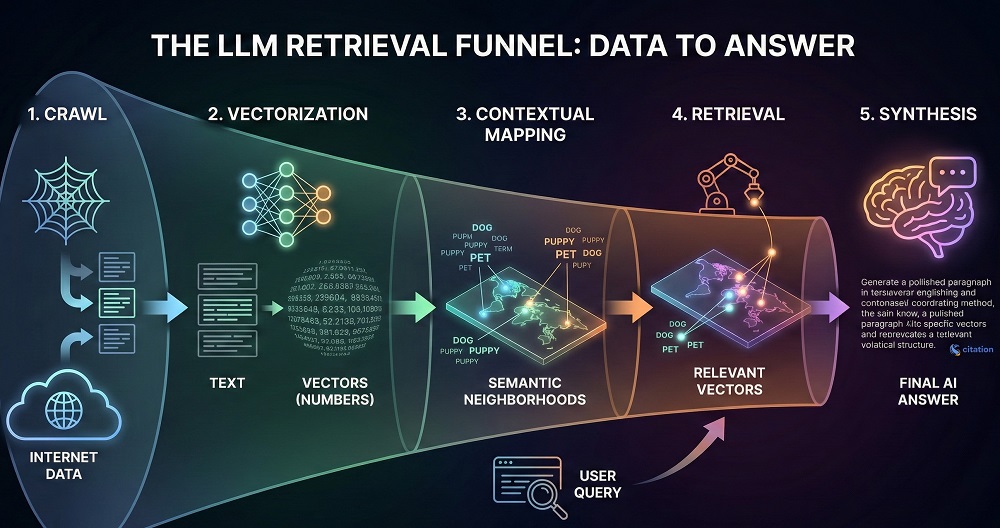
AI models do not read text like humans. They convert words into numbers called vectors.
Imagine a massive 3D map. Every word and concept has a specific coordinate. Words with similar meanings (like “dog” and “puppy”) are located close together. This is Semantic Proximity.
If your brand is consistently mentioned alongside authoritative terms in your industry, the AI places your brand’s “vector” in that same neighborhood. When a user queries that topic, the AI grabs the closest, most trusted entities to construct its answer.
If your content is thin or generic, your vector is weak. You are floating in the middle of nowhere on the map. To fix this, you need Entity Salience – clear, repeated associations between your brand and your core topics.
The Trust Protocol: Building Entity Authority
You cannot rank in an AI answer without trust. LLMs rely heavily on the Knowledge Graph to verify facts.
If Google’s Knowledge Graph doesn’t know you exist, ChatGPT likely won’t either.
- The “Wikipedia Effect”: AI models weigh third-party validation heavily. A mention on Wikipedia, Wikidata, or a major industry publication is worth 100 blog posts on your own site.
- Consistent N-A-P: Ensure your Name, Address, and Phone number are identical across every platform. This helps the AI understand that “Brand X” on Twitter is the same as “Brand X” on LinkedIn.
- Digital PR: You need citations from authoritative sources. This confirms to the “Machine Reader” that you are a legitimate entity, not a fly-by-night website.
At KhalidSEO, we prioritize Entity Establishment. We don’t just build links; we build a digital footprint that screams “authority” to the algorithms.
Optimizing Content for the “Machine Reader”
Writing for AI is different from writing for humans. AI loves structure, facts, and Information Gain.
If your article repeats what is already on the top 10 results, the AI ignores it. It adds no new value to the model. You must provide unique data, a contrarian viewpoint, or a proprietary framework.
Structure is King. Use clear H2s and H3s. Use bullet points. Use tables. These formatting choices act as “handles” for the AI to grab onto when parsing your content.
SEO vs. LLMO: The Shift
| Feature | Traditional SEO | LLMO Marketing |
| Primary Goal | Ranking #1 on Google | Being the “Direct Answer” |
| Key Metric | Organic Traffic / Clicks | Share of Model / Mentions |
| Optimization Focus | Keywords & Backlinks | Entities & Context |
| Content Style | Long-form, “Skyscraper” | Fact-dense, Structured Data |
| Technical Base | HTML / Meta Tags | Schema / JSON-LD / Vectors |
Technical LLMO: Speaking the Robot’s Language
Code is the clearest way to communicate with an LLM. You must use Schema Markup (Structured Data) to explicitly tell the AI what your content means.
- Organization Schema: Tell the AI who you are, your logo, and your social profiles.
- SameAs Properties: Link your website to your other verified profiles (Crunchbase, LinkedIn, Wikipedia).
- Mentions Property: Use the
mentionstag in your schema to link your content to recognized entities (e.g., linking your “Marketing Guide” to the Wikidata entry for “Digital Marketing”).
This reduces ambiguity. You aren’t hoping the AI understands you; you are handing it a digital business card.
Measuring the Unmeasurable: KPIs for the AI Era
How do you track success when there are no clicks? You stop counting visits and start counting mentions.
- Share of Model: How often does ChatGPT mention your brand when asked about your industry?
- Sentiment Analysis: Is the AI describing your brand positively or negatively?
- Relative Visibility: Are you appearing in the “Related Questions” or follow-up prompts?
We are moving from a “Traffic Economy” to an “Attention Economy.” The goal is brand recall. If the user reads the AI answer and sees KhalidSEO cited as the expert, that impression is often more valuable than a blind click.
FAQ: Mastering LLMO
What is the difference between SEO and LLMO?
SEO focuses on ranking links; LLMO focuses on influencing answers.
While SEO targets search engine result pages (SERPs) to drive clicks, LLMO (Large Language Model Optimization) targets the training data and retrieval layers of AI models to ensure your brand is cited in direct answers.
How do I optimize my content for AI overviews?
Focus on high Information Gain and strict formatting.
AI Overviews prioritize content that offers unique data or perspectives not found elsewhere. Format this content with clear headings, bullet points, and immediate direct answers to facilitate easy parsing by the model.
Does keyword density matter for LLMO?
No, keyword density is irrelevant for LLMO.
LLMs use vector embeddings to understand the semantic meaning behind words. Instead of repeating exact keywords, focus on “Semantic Proximity”—using a diverse vocabulary of related concepts that reinforce your topical authority.
How does a brand get into the Knowledge Graph?
Establish corroboration across authoritative third-party sources.
You must be cited by trusted entities like Wikipedia, Wikidata, and major industry news sites. Consistent business details (NAP) and robust Organization Schema on your website are also critical for entry.
What tools can I use for LLMO marketing?
Use entity-focused tools like InLinks, Schema App, and Google’s API.
Tools that analyze Knowledge Graph presence and structured data are essential. Additionally, use platforms like Perplexity AI to manually test your brand’s visibility in conversational search results.