
Google’s May 2024 update wasn’t a warning shot. It was an execution.
For years, the “Parasite SEO” playbook was simple: lease a subdomain from a high-authority news site, pump it full of affiliate coupons or “Best X” listicles, and watch the cash roll in. You didn’t need expertise; you just needed a host with a high Domain Authority (DA).
That era is dead.
With the rollout of the Site Reputation Abuse policy, Google has fundamentally changed how it evaluates third-party content. But the crackdown has evolved beyond just “rented” subdomains. In 2025, the algorithm is now targeting a much wider net, including SaaS brands that rank themselves #1 without evidence and affiliate sites that lack “close oversight.”
If your traffic has flatlined, or if you’re terrified it might, this isn’t a time for panic. It’s time for a pivot. Here is your operational framework for auditing, fixing, and future-proofing your content strategy.
Defining “Site Reputation Abuse”: It’s Not Just About Parasite SEO
Many SEOs wrongly assume this policy only targets the egregious offenders like a payday loan directory hosted on a reputable university domain. While those were the first to fall, the definition is far more nuanced.
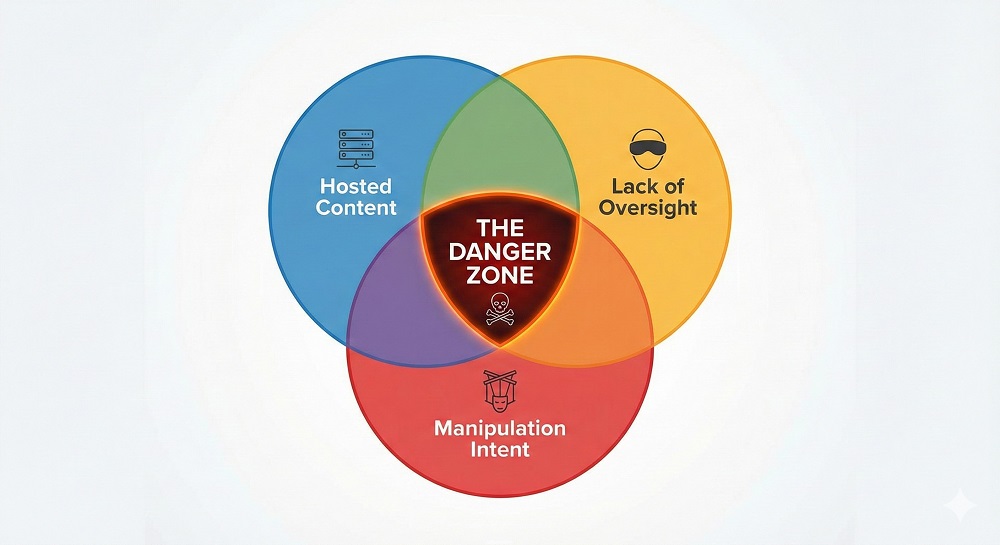
Site Reputation Abuse occurs when third-party content is published with little to no first-party oversight, specifically to manipulate search rankings by exploiting the host’s authority.
It’s a signal confusion issue. Google wants to know: Does the host site actually vouch for this content, or are they just selling their reputation?
The Danger Zone: Where Google Draws the Line
To clarify the risk, consider this comparison of compliant partnerships vs. policy violations.
| Feature | Legitimate Partnership (Safe) | Site Reputation Abuse (Risk) |
| Topic Alignment | Tightly aligned with host’s core niche (e.g., TechRadar reviewing laptops). | Completely unrelated (e.g., A local news site hosting a “Best Keto Gummies” list). |
| Editorial Oversight | Host editor reviews, edits, and approves every piece. | Content is published directly by the third party via FTP or CMS access. |
| Authorship | Clear bylines from the host’s staff or vetted contributors. | “Staff Writer” or generic aliases with no digital footprint. |
| Monetization | Value-first; affiliate links are secondary to user utility. | Monetization-first; content exists only to house the links. |
The New Ranking Signal: E-E-A-T and “Evidence of Experience”
Why are even some “legitimate” affiliate sites getting caught in the crossfire? Because they lack Experience, the newest member of the E-E-A-T family.
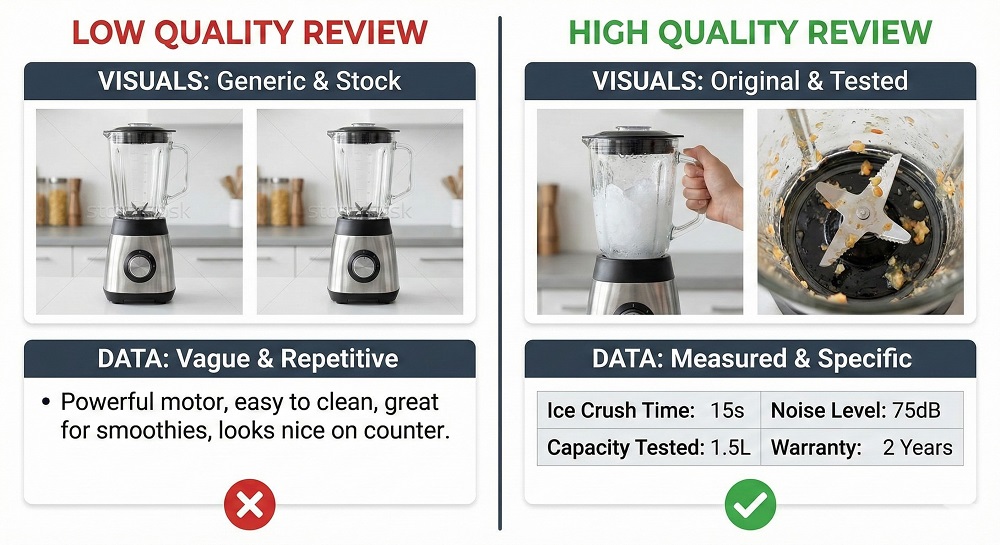
In 2025, Google’s SpamBrain AI can distinguish between a review written by someone who summarized Amazon specs and someone who actually touched the product.
If your “Best Robot Vacuums” article relies on stock photos and rehashed manufacturer descriptions, you are vulnerable. To survive, you must provide Information Gain unique value that doesn’t exist elsewhere on the SERP.
The “Trust Signals” Checklist:
- Original Assets: Do you have photos or videos of your team holding/using the product?
- Negative Reviews: Do you mention flaws? (A 100% positive review is a spam signal).
- Unique Data: did you measure the noise level of the vacuum? Did you time the battery life yourself?
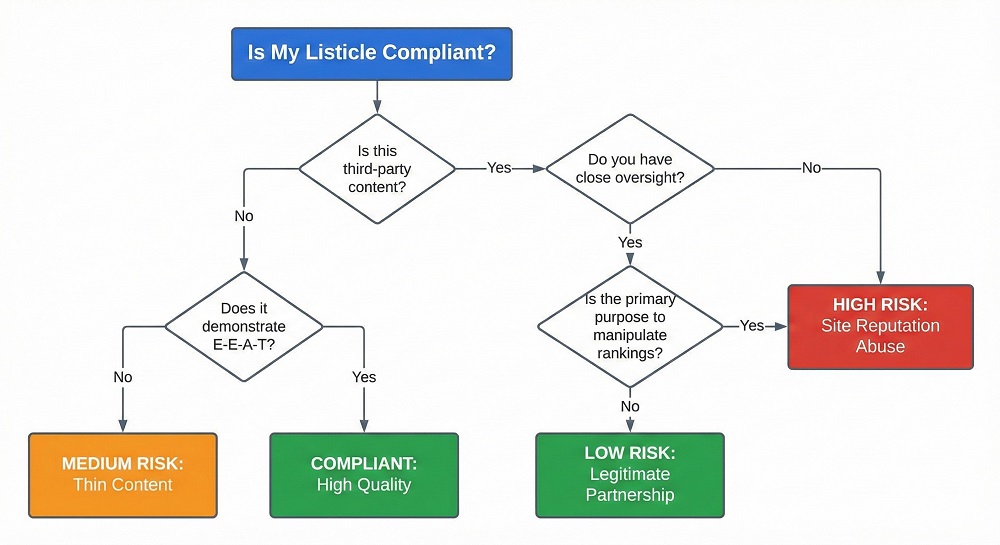
The Compliance Audit: Is Your Content Safe? (Step-by-Step)
Don’t wait for a manual action. Perform this audit immediately on your “Best Of” folders and subdomains.
1. The “Oversight” Test
For every page hosted on a third-party or partner section, ask: Can I produce an email thread or Slack log showing the host site’s editor giving feedback on this specific URL? If the answer is no, the content is toxic.
2. The “Topic” Test
Does the content make sense for the host domain’s audience?
- Pass: A cooking blog hosting a “Best Chef Knives” guide.
- Fail: A cooking blog hosting a “Best Crypto Wallets” guide.
3. The “Indexation” Decision
If you identify risky pages, you have two choices:
- Delete (410 Gone): If the content offers zero unique value.
- No-Index: If you must keep the page for contractual reasons but want to remove it from Google’s view.
Case Study: Why SaaS Brands Ranking Themselves #1 Is a Trap
A silent killer in the 2025 updates has been the demotion of SaaS blogs that rank their own tool as the #1 solution in a “Best [Category] Tools” list.
The Flaw: It violates the core principle of E-E-A-T Trustworthiness. You cannot be an objective reviewer of your own product.
The Fix:
- Be Honest: If you rank yourself #1, disclose the bias in the introduction.
- Rank Objectively: Place yourself #3 or #4 if competitors truly offer features you lack.
- Comparison methodology: Explain why you chose the order. “We ranked Tool X #1 because it has a free tier, which our tool lacks.”
Recovery Roadmap: What to Do If You’ve Been Hit
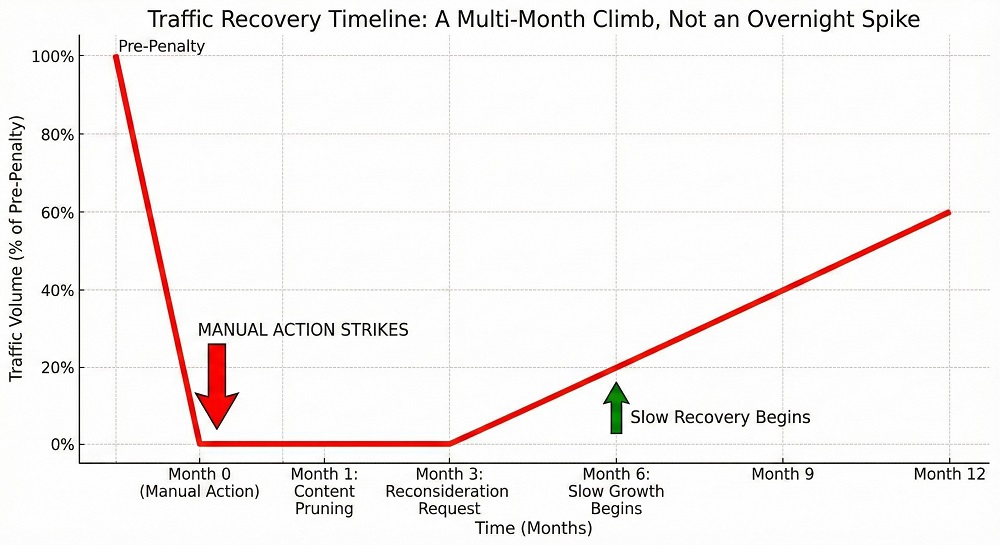
If you wake up to a manual action notification in Google Search Console, the clock is ticking.
- Stop the Bleeding: Immediately
noindexthe offending sections. Do not just edit them; remove them from search. - The Process Audit: Google doesn’t just want the bad pages gone; they want proof you’ve fixed the process that allowed them. You need to document new editorial guidelines.
- The Reconsideration Request: This is your plea. Be specific.
- Bad: “We fixed the links.”
- Good: “We identified 45 pages created by Partner X without oversight. We have deleted these pages (URLs attached), terminated the contract with Partner X, and implemented a new 3-stage editorial review process for all future content.”
Future-Proofing: Building a “Comparison Engine” Strategy
The “listicle” format is a relic. The future belongs to Comparison Engines.
Users don’t want a static list of 10 items; they want to filter. Look at how sites like RTINGS.com or NerdWallet operate. They build dynamic tools where users can input their needs (“Budget under $200,” “Good for pets”) and get a personalized result.
This is the ultimate E-E-A-T signal. It proves you have a database of structured data, not just a writer with a keyword tool.
Next Steps:
- Audit your “Best Of” content today.
- Invest in original photography/videography for your top 10 money pages.
- Stop renting reputation; start building your own.
Frequently Asked Questions (FAQ)
Q: What is Google’s Site Reputation Abuse policy?
A spam policy targeting third-party content published without oversight. It penalizes pages that exploit a host site’s authority (like news domains) to rank for unrelated keywords, often called “Parasite SEO.”
Q: Can I still rank “Best of” listicles in 2025?
Yes, but only with “Evidence of Experience.” You must prove you physically tested the products using original photos, unique data, and a transparent methodology. Summarizing Amazon reviews is no longer sufficient.
Q: Why did my affiliate site traffic drop recently?
You likely triggered the “SpamBrain” or “Helpful Content” systems. Common causes include thin content, lack of first-hand experience signals, or aggressive monetization that disrupts the user experience.
Q: How do I recover from a “Site Reputation Abuse” manual action?
Remove the content and reform your editorial process. You must noindex or delete the violating pages, terminate low-quality partnerships, and submit a Reconsideration Request documenting your new oversight protocols.
Q: What is “Parasite SEO” and why is Google banning it?
Hosting marketing content on high-authority sites to game rankings. Google bans it because it confuses users and allows unverified content to rank unfairly, bypassing the trust signals required for independent sites.