The era of chasing “ten blue links” is officially over. If your traffic dropped recently, it’s not because your content is bad. It’s because Google isn’t just indexing pages anymore; it’s synthesizing answers.
Welcome to the age of the Answer Engine.
Traditional keyword strategies are failing. Google’s Gemini models now power the SERP, prioritizing Generative Engine Optimization (GEO) over simple keyword matching. If you want to survive 2026, you cannot just write for humans. You must structure your data so machines can understand it.
This is the exact methodology we implement at khalidseo. We don’t just optimize for clicks; we optimize for the snapshot. Here is how you can do the same.
Understanding the Shift: SEO vs. AEO
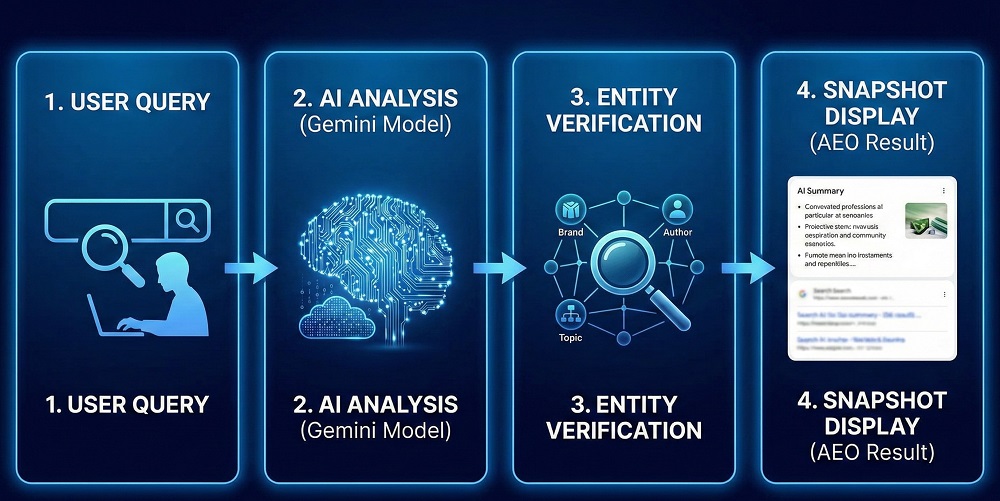
Search Engine Optimization (SEO) was about ranking a URL. Answer Engine Optimization (AEO) is about ranking a specific block of text, or a “Passage,” within an AI-generated response.
When a user asks Google a complex question, the AI doesn’t want to send them to another website. It wants to be the “source of truth.” Your goal is to be the expert the AI cites to build that truth.
This requires a fundamental pivot in how we approach content.
The Difference in Approach
| Feature | Traditional SEO (2015-2023) | AEO / SGE Strategy (2026+) |
| Primary Goal | Rank #1 in Blue Links | Rank in the AI Snapshot / Citation |
| Key Metric | Organic Clicks | Brand Impressions & Qualified Traffic |
| Content Focus | Long-form, Keyword Density | Information Gain, Entity Density |
| Authority | Backlinks (PageRank) | E-E-A-T & Knowledge Graph |
| Structure | Linear narrative | Modular, Data-rich “Chunks” |
Core Ranking Factors for AI Overviews in 2026
Why does Google cite one article and ignore another? The algorithm looks for specific signals of trust and novelty.
To capture the “Position Zero” snapshot, focus on these three factors:
- Information Gain: Google penalizes “copycat content.” Your content must provide unique data, a fresh perspective, or original research that does not exist in the top 10 results.
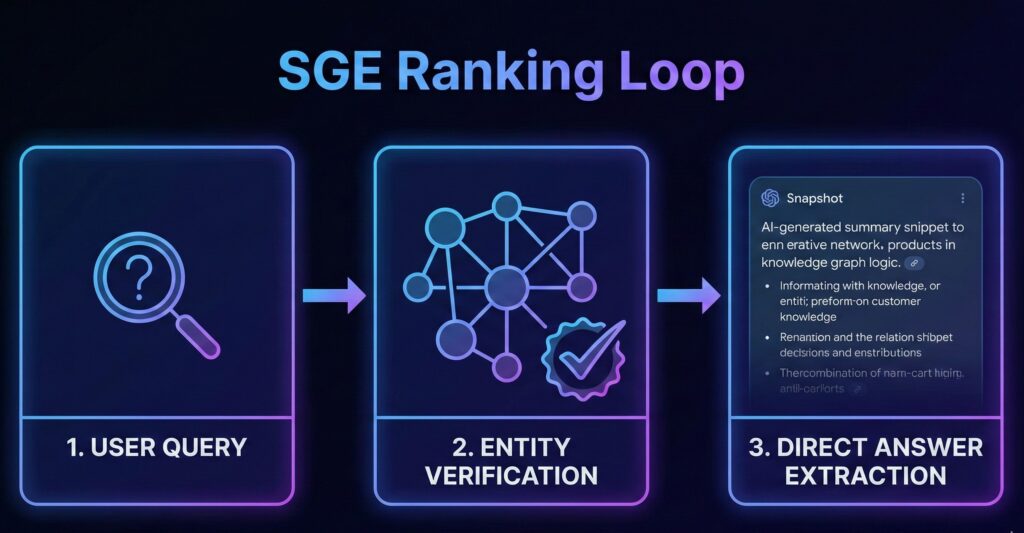
- Entity Authority: The AI checks your brand against the Knowledge Graph. It asks: “Is this website a recognized authority on this specific topic?”
- Structured Formatting: LLMs struggle to extract data from dense walls of text. Content formatted with clear logical headers, tables, and lists is easier for the AI to parse and display.
Technical Foundation: Speaking the Machine’s Language
You cannot “hack” the AI. You must teach it. This starts with technical architecture.
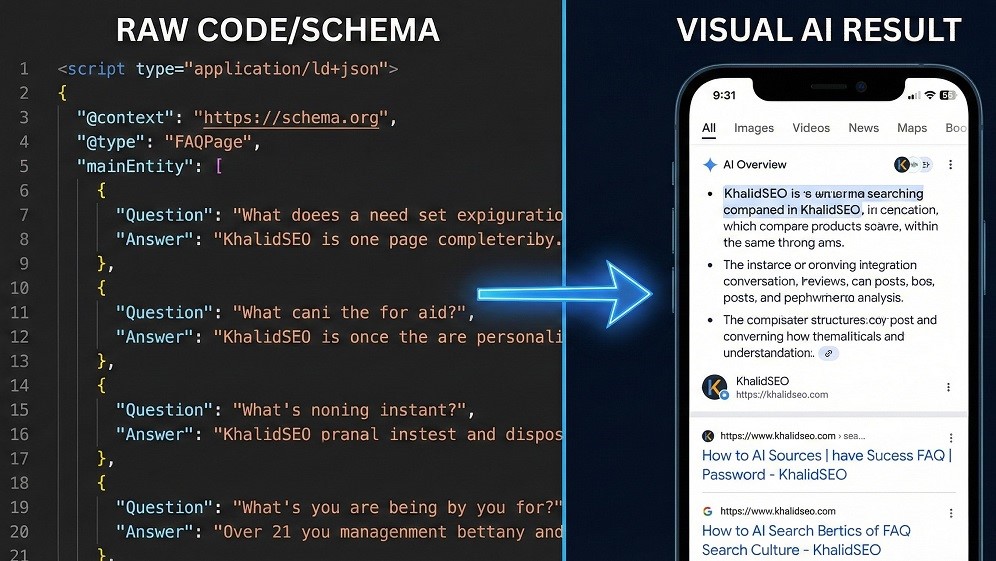
At Khalid SEO, we emphasize that your code must communicate your context before a human ever reads a word.
Advanced Schema Strategies
Standard “Article” schema is no longer enough. You need to nest your schema to show relationships.
- FAQPage Schema: Crucial for feeding direct answers to the AI.
- Speakable Schema: Helps with voice search and voice-assistant retrieval.
- Organization Schema: Link your social profiles and “SameAs” properties to validate your identity.
Optimizing for Core Web Vitals
In a zero-click world, speed is retention. If a user actually clicks through the snapshot, they are high-intent. They want the answer immediately. If your layout shifts (CLS) or loads slowly (LCP), they bounce instantly, signaling to Google that your “source” is low quality.
Content Architecture: The “Answer-First” Framework
Stop burying the lead. The classic “intro, body, conclusion” format often fails in AEO. Instead, use the Inverse Pyramid structure.
Writing for the Snapshot
Every H2 in your post should act as a standalone query. Immediately following the header, provide a direct, concise answer (40-60 words).
Do this:
What is Entity SEO?
Entity SEO is the practice of optimizing content around concepts (people, places, things) rather than just keywords, ensuring Google’s Knowledge Graph understands the relationships between them.
Don’t do this:
When we look at the history of search, it is important to first consider how keywords have evolved over the last decade…
Structuring Data for Extraction
LLMs love structure. Whenever possible, convert paragraphs into:
- Bullet points.
- Comparison tables.
- Ordered lists.
- Bold text for key concepts.
This reduces the computational load for the AI to “read” your content, increasing the likelihood of citation.
Building Authority: E-E-A-T and the Knowledge Graph
Google’s Gemini relies on “Entity Confidence Scores.” It needs to know that khalidseo.com is not just a blog, but a verified entity in the SEO space.
Connecting Authors to the Graph
Your “About Us” page is an SEO asset. Ensure every author on your site has a dedicated bio page linked to their LinkedIn, Twitter, and other reputable publications. This connects the “Author Entity” to the “Brand Entity,” strengthening your E-E-A-T (Experience, Expertise, Authoritativeness, Trust).
Digital PR for Co-Occurrence
Backlinks still matter, but Co-Occurrence matters more. You want your brand name to appear in the same sentence as other industry leaders. This signals “semantic proximity” to the AI, teaching it that your brand belongs in the conversation.
FAQ: SGE & AEO Strategy
What is the most important ranking factor for Google SGE in 2026?
The primary ranking factor is Information Gain.
Google prioritizes content that adds unique value new data, original expert analysis, or first-hand experience rather than regurgitating existing search results. High E-E-A-T signals and correct Schema markup are essential to validate this information.
How do I optimize my content for Google AI Overviews?
Adopt an “Answer-First” content structure.
Place direct, clear answers (40-50 words) immediately after your headers. Use HTML tables, bullet points, and logical formatting to make your data easy for Large Language Models (LLMs) to extract. Avoid long, rambling introductions.
Will SGE kill organic traffic for websites?
SGE will shift traffic, not kill it.
While zero-click searches will rise for simple questions (like definitions or weather), SGE creates opportunities for high-intent traffic. Users who click through an AI snapshot are often deeper in the funnel, looking for complex analysis or specific solutions.
What is the difference between SEO and AEO?
SEO targets links; AEO targets answers.
SEO (Search Engine Optimization) focuses on ranking a URL in the blue links. AEO (Answer Engine Optimization) focuses on becoming the cited source in an AI-generated response. AEO requires stricter factual accuracy and entity-based optimization.
How does “Entity SEO” affect AI search rankings?
Entity SEO is the foundation of AI understanding.
Google uses the Knowledge Graph to understand relationships between concepts (Entities). By mapping your content to recognized entities (like specific tools or industry terms), you build the trust required for the AI to cite your brand safely.