Search isn’t dying. It’s learning to think.
For over a decade, the goal of SEO was simple: rank in the “ten blue links” or capture position zero. But if you’ve checked your analytics lately, you’ve noticed the shift. Traffic for basic definitions is drying up. The click-through rates (CTR) you relied on are volatile.
The reason? Google has moved from Information Retrieval to Information Synthesis.
This transition scares many marketers. It shouldn’t. At Khalid SEO, we see this not as a traffic loss, but as a quality filter. The users who click through now are deeper in the funnel, more educated, and ready to buy.
This post explains exactly how to pivot. We will break down the mechanics of the new SERP and provide a Dual-Optimization Playbook to help you rank for both the traditional Featured Snippet and the emerging AI Snapshot.
Featured Snippets vs. AI Snapshots: What’s the Real Difference?
To dominate the search results, you must understand the machine reading your content. While they look similar a block of text at the top of Google, their “brain” is completely different.
The Mechanics: Extraction vs. Synthesis
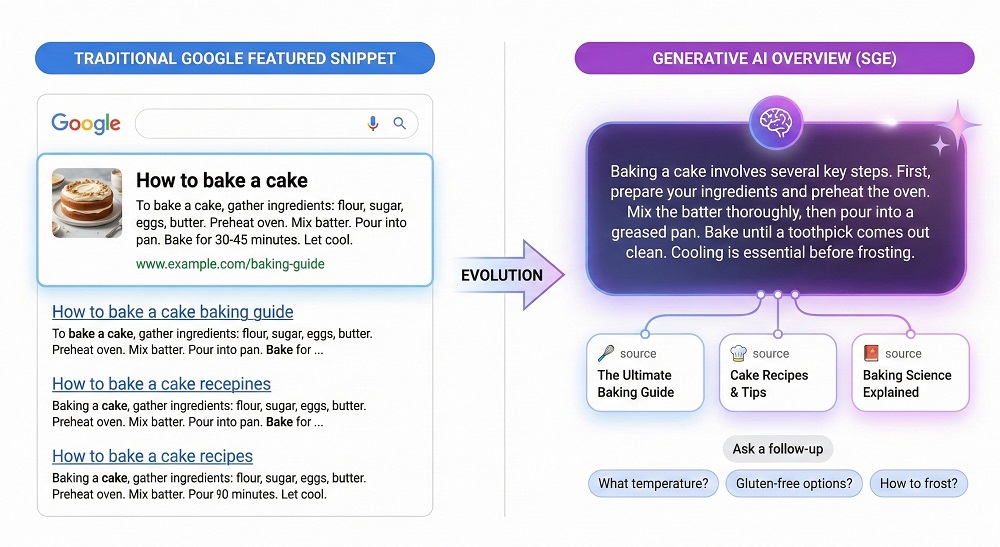
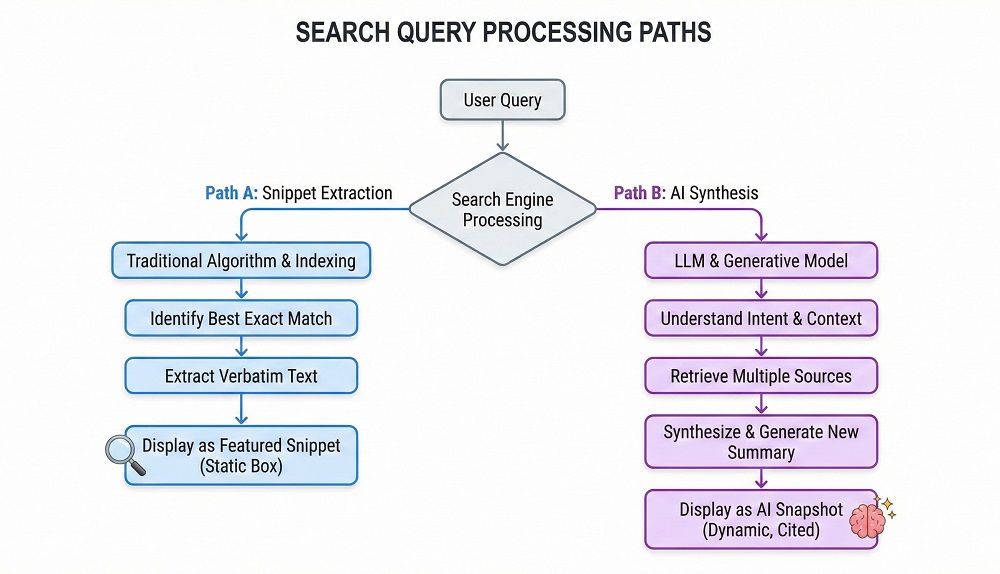
A Featured Snippet is a copy-paste job. Google’s algorithm scans a page, finds a concise paragraph or list that answers the query, and extracts it verbatim. It relies on keyword matching and clear HTML structure.
An AI Snapshot (AI Overview) is a creative writer. It uses Large Language Models (LLMs) and Retrieval-Augmented Generation (RAG). It reads ten different sources, understands the concepts (Entities), and writes a brand-new answer. It doesn’t copy your text; it synthesizes your expertise.
The Visual Real Estate
Featured Snippets are rigid. They are usually a box containing a definition, a table, or an ordered list.
AI Snapshots are fluid. They expand, contract, and offer “chips” to refine the search. Crucially, they cite multiple sources via link cards, offering a new kind of visibility for brands that possess high Topical Authority.
At a Glance: The Technical Breakdown
| Feature | Featured Snippet | AI Snapshot (AIO) |
| Core Mechanism | Extraction: Pulls exact text from one URL. | Synthesis: Generates new text from multiple URLs. |
| Primary Technology | Keyword Matching & HTML Parsing. | LLMs (Gemini) & Semantic Understanding. |
| Ranking Factor | Concise formatting, exact-match keywords. | Entity Authority, consensus, information gain. |
| User Intent | Speed (Get the fact). | Exploration (Understand the topic). |
| Click Potential | High for the single winner. | Distributed across 3-5 source links. |
The “Zero-Click” Reality: Will AI Kill Your Traffic?
Let’s be honest about the data. Yes, Zero-Click Searches are increasing.
The “Simple Query” Casualty
If your traffic strategy relies on defining basic terms like “what is a meta tag” or “price of iPhone 15,” you are in trouble. AI Overviews satisfy these queries instantly. The user has no reason to click.
This traffic is likely gone forever. But ask yourself: did those visitors ever convert? probably not.
The “Complex Query” Opportunity
This is where Khalid SEO focuses. When users ask complex questions, “how to build a topical map for SaaS” an AI summary isn’t enough. It provides a primer, but the user needs the deep dive.
The links cited in AI Snapshots often see a higher conversion rate. The AI has already pre-qualified the user. If they click your link after reading the summary, they are looking for expert implementation, not just information.
The Dual-Optimization Playbook (How to Rank for Both)
You don’t have to choose. You can structure your content to win the Featured Snippet for traditional searchers and the AI Snapshot for the generative experience.
1. Structuring for Snippets: The “Definition” Approach
To win the traditional snippet, you must be concise.
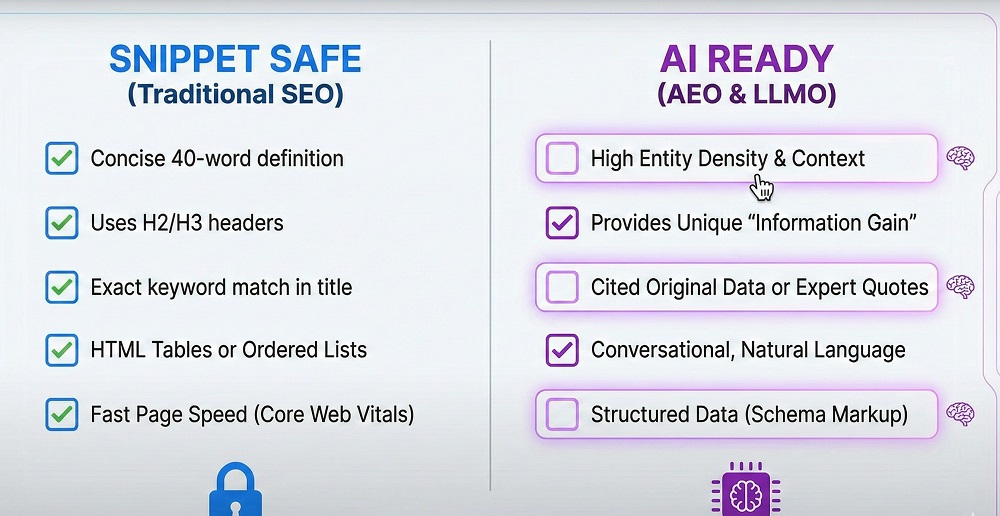
- The 40-Word Rule: Place a direct, bolded answer to the main query immediately after your H2.
- Use HTML Lists: For “how-to” or “best of” queries, use standard
<ol>or<ul>tags. - Clean Formatting: Avoid complex sentence structures in your summary paragraphs.
2. Structuring for AI: The “Entity Authority” Approach
To win the AI citation, you must demonstrate depth.
- Entity Density: Use the specific nouns (tools, people, concepts) associated with your topic. This builds the Vector Context the LLM looks for.
- Information Gain: Add unique data or a contrarian viewpoint. If your content repeats what everyone else says, the AI will ignore it. It seeks “consensus,” but it cites “novelty.”
- Schema Markup: Use aggressive Schema (Article, FAQ, Person) to help the machine parse your content’s hierarchy.
Future-Proofing Your SEO Strategy for 2026
The era of tricking the algorithm is over. The era of Answer Engine Optimization (AEO) is here.
Why “Brand as Entity” is the New Keyword
In a world of infinite AI content, trust is the only scarce resource. Google wants to know who is behind the content. You need to establish your brand as a recognized Entity in the Knowledge Graph. This means consistent messaging across social media, press releases, and your own domain.
Preparing for the Voice & Chatbot Era
People don’t type “best shoes running” into ChatGPT. They say, “I need running shoes that won’t hurt my knees on pavement.”
Your content must answer these conversational, specific needs. It requires a shift from keyword stuffing to natural language mastery.
Frequently Asked Questions (FAQs)
We’ve structured these answers for direct consumption by Voice Search and AI models.
What is the main difference between a Featured Snippet and an AI Snapshot?
The difference is extraction vs. synthesis. A Featured Snippet copies exact text from one webpage to answer a query. An AI Snapshot uses generative AI to create a new summary by combining information from multiple sources.
Will AI Overviews replace Featured Snippets?
Not entirely. While AI Overviews handle complex, exploratory topics, Featured Snippets remain the standard for specific, fact-based queries like definitions, math, or quick data points. Google currently displays both formats depending on intent.
How do I rank for Google AI Overviews?
Focus on Entity Authority and Consensus. You must cover the topic comprehensively (Topical Authority), use clear H2/H3 headings for parsing, and provide unique data or expert insights that LLMs identify as high-value “Information Gain.”
Do AI Snapshots steal website traffic?
Yes, for simple queries. They reduce clicks for basic facts (Zero-Click). However, for complex topics, being cited as a source in an AI Snapshot can drive higher-quality traffic from users seeking deep expertise.
Can I opt out of Google AI Overviews?
Yes, but it is not recommended. You can use “nosnippet” or “max-snippet” tags to block Google. However, this removes your brand from the most valuable screen real estate, effectively making you invisible to modern searchers.
Own the Answer, Win the Customer
The search landscape isn’t closing; it’s evolving. You can either mourn the loss of easy traffic or build a strategy that dominates the new Answer Engine.
Is your site speaking the language of AI?
Book a free consultation with Khalid SEO today. Let’s ensure your brand is the clear, confident authority on Google, ChatGPT, and the new era of search.