Your homepage is being evaluated right now by four different intelligence systems. Google’s crawler is reading it to build a brand identity record. LLM training pipelines are harvesting your copy to decide what they “know” about you. RAG retrieval engines are scoring it for citation worthiness. And real humans are forming a first impression they will rarely revise.
Most brands are satisfying one of those four audiences. Maybe two.
The problem is not bad design or slow load times. It is a category error. Brands treat their homepage as a page, a place to explain what they do. Search engines and AI systems treat it as something else entirely: the primary source document for your brand’s identity in their knowledge systems.
Fix the category error, and everything else becomes clearer. That is what this post does.
👉 PDF file: The Entity Home
What most brands get wrong about their homepage
There is a version of homepage optimization that most teams know well. Write a clear headline. Load fast. Include your primary keyword. Get some backlinks. It is not wrong advice. It is just incomplete, by about a decade.
The brands winning in search and AI-generated answers today are not just optimizing pages. They are managing entities.
The four audiences your homepage must satisfy simultaneously
Every time your homepage is crawled, four distinct systems form or update a judgment about your brand:
- Google’s Knowledge Graph engine extracting named entities, relationships, and factual claims to populate your brand’s knowledge record
- LLM pre-training pipelines harvesting brand copy that becomes what models “remember” about you when a user asks
- RAG retrieval systems (used by Perplexity, Bing Copilot, and others) scoring your page for citation quality in real-time answer generation
- Human visitors forming a trust and relevance judgment within seconds
Most homepages are built for the fourth audience only. The first three operate on entirely different logic and ignoring them is why brands with excellent websites still have invisible or inaccurate AI-generated profiles.
Why keyword-era homepage logic fails today
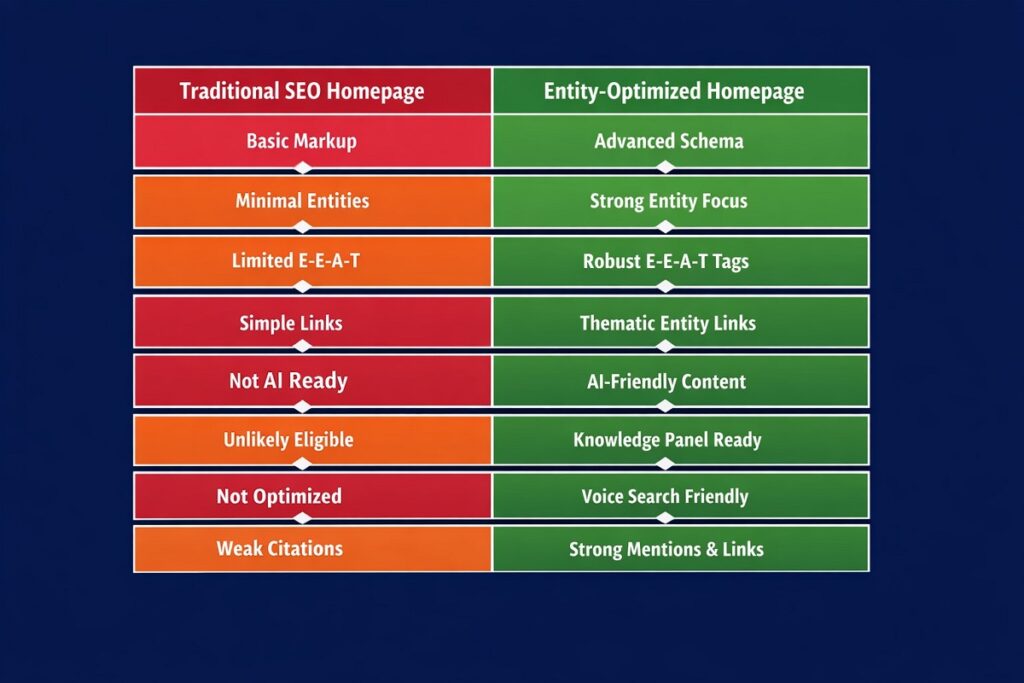
Traditional SEO treats your homepage as a page. Entity SEO treats it as a signal. The difference is not semantic, it changes what you write, how you structure it, and what markup you add.
A keyword-optimized homepage answers the question: what does this business do? An entity-optimized homepage answers a harder question: who, precisely, is this brand and how does it relate to other known entities in the world?
That second question is the one Google’s Knowledge Graph is asking. It is the one LLMs ask when they decide whether to cite you or confabulate something vague. Most homepages have no answer for it.
The invisible audit
Right now, you can run a basic version of the audit these systems run on you. Search for your brand name on Google. Does a Knowledge Panel appear? Ask ChatGPT “What does [your brand] do?” is the answer accurate, or is it a vague hallucination? Search your brand in Perplexity – are you cited, or absent?
If any of those checks fail, it is almost always a homepage problem.
What is a brand entity home page?
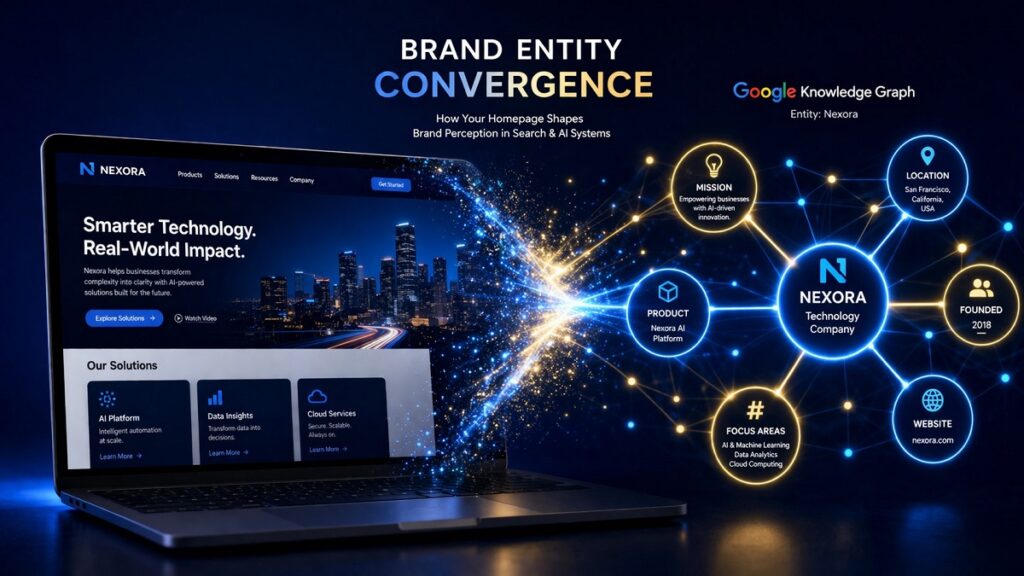
A brand entity home page is the primary URL that search engines, AI systems, and users treat as the authoritative source document for a brand’s identity establishing who the brand is, what it does, why it is trustworthy, and how it connects to other known entities in the Knowledge Graph.
That definition does a lot of work, so let’s pull it apart.
Entity vs. page: the conceptual shift
A page exists to deliver content to a human reader. An entity exists in a knowledge system – it has properties, relationships, and a persistent identity that survives across queries, models, and time.
Your homepage is both. But most brands only optimize it for one.
The entity layer is what Google reads before a user ever clicks. It is what populates your Knowledge Panel. It is what an LLM retrieves when a user asks about your category. Getting this layer right does not require replacing what you already have it requires adding a layer of structured, machine-readable identity signals on top of it.
How the Knowledge Graph forms your brand identity record
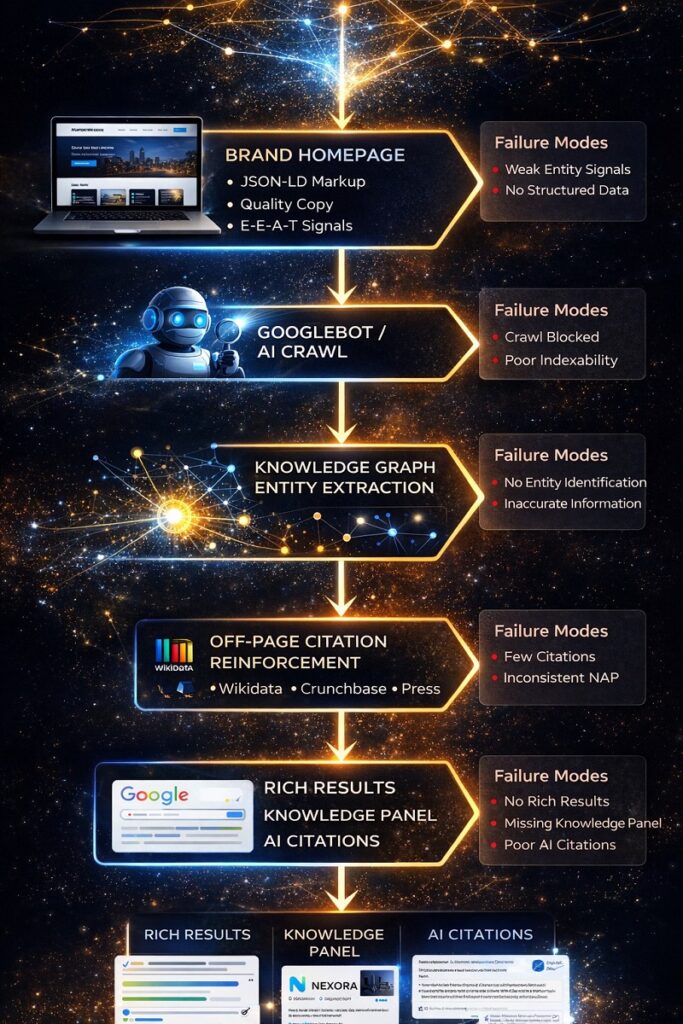
Google’s Knowledge Graph is not a database of pages. It is a database of entities real-world things with attributes and relationships. When Googlebot crawls your homepage, it is not just indexing words. It is asking:
- Is this a known organization?
- What is its legal name, founding date, and primary location?
- What other authoritative sources (Wikidata, Crunchbase, LinkedIn) confirm these facts?
- What topics is it authoritative on?
Your homepage is the primary source document for answering those questions. If it does not answer them clearly through both natural language and structured markup the Knowledge Graph fills in the blanks from less reliable sources. Sometimes it gets it right. Often it does not.
The three systems reading your homepage right now
Beyond Google, two other intelligence systems are actively forming a view of your brand from your homepage:
LLM pre-training pipelines crawl and index the public web. The language on your homepage – how you describe your brand, your category, your differentiation becomes training signal. Vague, marketing-speak copy produces vague, unreliable model knowledge.
RAG retrieval engines (the backbone of Perplexity, Bing Copilot, and AI Overviews) do not use training data alone. They retrieve live web content to answer queries. Your homepage is scored for citation authority in real time. Structured, factual, clearly attributed copy scores higher.
The entity signal stack: what these systems actually read
Entity optimization is not one thing. It is a layered system of signals – each layer legible to different parts of the search and AI infrastructure. Here is how the stack breaks down.
Layer 1 — Structured data signals
This is the most direct way to communicate your brand’s identity to machine readers. Every brand homepage should implement the following schema types, in this order of priority:
- Organization (or its subtype, e.g.,
LocalBusiness,Corporation) declares your brand’s name, URL, logo, founding date, legal name, andsameAslinks to authoritative third-party profiles - WebSite enables the Sitelinks Searchbox for branded queries and tells Google which URL is the canonical home of your brand
- BreadcrumbList communicates your site’s hierarchy to crawlers, distributing topical authority from the homepage outward
- FAQPage (where appropriate) places answer content directly in Google’s structured data graph, capturing PAA positions
Without Organization schema, you are asking Google to guess your brand’s legal name, founding date, and entity type from unstructured prose. It will try. It will sometimes be wrong.
Layer 2 — Natural language signals
This layer is where most brands are invisible and where the LLMO opportunity is largest.
LLMs learn what they know about your brand from your copy. If your homepage says “We help businesses grow,” the model learns nothing entity-specific. If it says “Acme Corp is a B2B SaaS company founded in 2017, headquartered in London, that provides supply chain analytics software to mid-market manufacturers,” the model has a factual anchor it can retrieve and repeat accurately.
Write your homepage copy the way you would write an encyclopedia entry about your brand. Specific, factual, attributed, and free of marketing language that obscures rather than defines.
Layer 3 — Trust and authority signals (E-E-A-T)
Google’s E-E-A-T framework (Experience, Expertise, Authoritativeness, Trustworthiness) is not just for content pages — it applies to brand homepages directly.
Key signals on the homepage level:
- Named individuals with explicit roles (CEO, founder) linked to author profiles or LinkedIn
- Press citations and third-party media coverage with source attribution
- Physical address and contact details consistent with every other mention across the web (NAP consistency)
- Customer proof logos, case studies, or review aggregates from named organizations
Off-page, your E-E-A-T is reinforced by Wikidata entries, Crunchbase profiles, Wikipedia references, and any publication that mentions your brand by its exact legal name.
Layer 4 — Technical signals
None of the above matters if the page cannot be crawled and indexed efficiently. Core Web Vitals directly affect how often Googlebot re-crawls and how confidently it trusts the content it finds. A homepage with poor LCP or high CLS is not just a bad user experience – it is a signal that the page is unstable and lower-priority.
Additionally:
- Ensure your homepage is the canonical URL not a redirect destination or a paginated variant
- Use a single, clean
<h1>that states your brand name and primary entity type - Internal links from the homepage should distribute authority to your topical cluster pages, reinforcing the subject-matter signals the Knowledge Graph uses to classify your brand
How your homepage shapes AI-generated answers: the LLMO imperative
Because LLMs extract brand facts during training runs, the specific language your homepage uses not the intent behind it, but the actual words and sentence structures becomes the source material for what AI systems say about you when asked.
This is not a future concern. It is happening now, on every crawl cycle.
How LLMs learn about brands
The pipeline works in two phases:
Phase 1 — Pre-training: Your homepage content is crawled, cleaned, and included in training data. The model learns associations: what category you are in, what you do, who you are compared to, what language surrounds your brand name. This is baked into the model’s weights.
Phase 2 — Retrieval (RAG): When a user queries ChatGPT or Perplexity about your brand, the system may also retrieve live web pages to supplement or verify training knowledge. Your homepage is the highest-authority live source for that retrieval. Pages with clear, factual, entity-dense copy score higher in retrieval ranking.
The implication: your homepage copy does double duty. It trains the model’s base knowledge and feeds its live retrieval layer.
Writing copy that AI systems extract and repeat accurately
The test for LLM-optimized copy is simple: can an AI extract a complete, accurate, standalone sentence about your brand from this text?
Good entity copy has these properties:
- Specificity over aspiration “Acme serves 400 mid-market logistics companies in the EU” beats “We help businesses achieve their goals”
- Factual anchors founding year, headquarters city, employee count range, named product categories
- Category clarity your brand’s type should be unambiguous: SaaS company, law firm, e-commerce retailer, professional services agency
- Relationship signals name your key integrations, partners, or industry memberships; these become Knowledge Graph edges
The LLMO audit: checking your brand in AI answers
Run this four-step check monthly:
- Ask ChatGPT: “What does [brand name] do and who do they serve?” – note accuracy, tone, and whether it cites your homepage
- Search your brand in Perplexity – note which sources it cites. Is your homepage one of them?
- Ask Google Gemini: “Tell me about [brand name]” – compare to your homepage’s own description
- Search Google for your brand name – does a Knowledge Panel appear? Is it accurate?
Any discrepancy between what these systems say and what your homepage says is a signal gap to close.
Building your entity home page: the implementation framework
This is the sequence. Do it in order — each step builds on the last.
Step 1: implement Organization + WebSite schema
Add the following JSON-LD to your homepage <head>. This is the minimum viable entity declaration:
json
{
  "@context": "https://schema.org",
  "@graph": [
    {
      "@type": "Organization",
      "@id": "https://yourdomain.com/#organization",
      "name": "Your Legal Brand Name",
      "url": "https://yourdomain.com",
      "logo": "https://yourdomain.com/logo.png",
      "foundingDate": "2017",
      "legalName": "Your Legal Entity Name Ltd",
      "description": "One factual sentence describing what your brand does, for whom, and where.",
      "sameAs": [
        "https://www.linkedin.com/company/yourbrand",
        "https://www.wikidata.org/wiki/Q_YOURITEMID",
        "https://www.crunchbase.com/organization/yourbrand",
        "https://en.wikipedia.org/wiki/Your_Brand"
      ]
    },
    {
      "@type": "WebSite",
      "@id": "https://yourdomain.com/#website",
      "url": "https://yourdomain.com",
      "name": "Your Brand Name",
      "publisher": {"@id": "https://yourdomain.com/#organization"}
    }
  ]
}
The sameAs array is not optional. It is the mechanism by which Google cross-references your homepage entity with external authoritative sources. Every link you add is a trust signal and a disambiguation signal that tells the Knowledge Graph your “Acme” is not some other “Acme.”
Step 2: build your sameAs network
Before you can link your schema to Wikidata or Wikipedia, those entries need to exist. Here is the priority sequence:
- LinkedIn Company Page already exists for most brands; ensure the company description matches your homepage copy exactly
- Crunchbase claim and complete your profile; Google treats Crunchbase as a high-authority business entity source
- Wikidata create an item for your organization using the
Qidentifier system; this is the closest equivalent to a “Knowledge Graph application form” - Google Business Profile mandatory for any brand with a physical location; inconsistent NAP here will undermine all other signals
- Wikipedia only if your brand meets notability criteria; do not create a promotional page that will be deleted
Step 3: write entity-defining brand copy
Every homepage needs seven types of factual sentence:
- What you are — entity type, category, and legal name
- When you were founded — year and city
- Who you serve — specific industry or customer segment, not “businesses of all sizes”
- What you make or do — primary product or service, named precisely
- How you are different — a factual differentiator, not a superlative
- Where you operate — geography of operations
- What your scale is — customers served, employees, or annual revenue range if public
These seven sentences can be woven naturally through your hero section, about blurb, and footer. They do not need to appear as a list on the page but they all need to be present.
Step 4: establish E-E-A-T signals on-page
Add or strengthen the following, in order of impact:
- Named founder or CEO with a linked bio, photo, and title in visible body copy, not just in metadata
- Press logos or media mentions with source name and ideally a date
- Physical address in the footer, consistently formatted, matching Google Business Profile exactly
- Customer logos named organizations, not “500+ happy customers”
- Third-party review links G2, Trustpilot, Google Reviews with a direct link to your profile
Step 5: validate and iterate
Use these three tools before and after every homepage update:
- Google Rich Results Test (search.google.com/test/rich-results) validates your JSON-LD and surfaces parsing errors
- Schema Markup Validator (validator.schema.org) checks structural correctness against schema.org specifications
- Google Search Console monitor the “Enhancements” section for structured data coverage and errors
The 90-day expectation: Knowledge Graph inclusion and Knowledge Panel generation are not immediate. Expect 4–12 weeks after a clean entity implementation before you see Knowledge Panel changes. LLMO effects take longer – LLM retraining cycles vary by model and provider.
How to get your brand a Google Knowledge Panel
To earn a Google Knowledge Panel for your brand:
- Add Organization schema with
sameAslinks to Wikidata, Crunchbase, and LinkedIn on your homepage - Create or claim a Wikidata entity for your organization and link it to your homepage URL
- Ensure NAP consistency your brand name, address, and phone number must match across all web mentions
- Build E-E-A-T signals press coverage, author authority pages, third-party review profiles
- Claim the panel once it appears in search results, use the “Claim this knowledge panel” link and verify via Google Search Console
Knowledge Panels are not awarded, they are inferred. Google generates one when it has sufficient, consistent, cross-referenced evidence that your brand is a real, stable entity worth surfacing.
What triggers Knowledge Panel generation
Three signal thresholds must be crossed simultaneously:
- Entity confirmation Google can match your homepage to a consistent entity record across multiple authoritative sources
- Topic authority your brand is associated with a recognizable industry, product category, or subject area
- Social proof named third parties (press, directories, review platforms) reference your brand by its exact legal name
Most brands meet one or two. Entity home page optimization closes the gap on all three.
Creating your Wikidata entity
Wikidata is the most direct path to Knowledge Graph inclusion outside of Wikipedia. To create an item:
- Create a Wikidata account at wikidata.org
- Click “Create a new item” and enter your organization’s official name
- Add core properties:
instance of(Q4830453 = business),official website,inception(founding date),headquarters location,industry - Add
official websitepointing to your homepage URL — this is the sameAs bridge Google uses - Reference each claim with a reliable source (your own homepage, a Crunchbase entry, or a press article)
Once the item exists, add its Q identifier to your homepage’s sameAs array.
After the panel: what to do next
Claiming the panel is not the finish line. It is the starting line for active entity management:
- Suggest edits to any inaccurate information using the “Suggest an edit” function
- Add your logo and social profiles if they are not already pulling through
- Monitor for changes third parties can suggest edits to your panel; check monthly
- Use the panel as a credibility signal in PR and sales materials “As seen in Google’s Knowledge Panel” is a trust signal a surprising number of buyers respond to
Measuring entity authority: the KPIs that tell you it is working
| Metric | Traditional SEO | Entity SEO |
|---|---|---|
| Primary success signal | Keyword ranking position | Knowledge Panel existence |
| Branded search quality | CTR on branded queries | Sitelinks appearance in branded SERP |
| AI visibility | Not measured | Brand citation rate in LLM answers |
| Third-party authority | Domain authority score | Wikidata / Crunchbase profile completeness |
| Content performance | Organic sessions | Passage indexing coverage |
| Trust measurement | Backlink count | E-E-A-T signal density (on + off-page) |
Traditional search signals to track
Start with what is measurable in Google Search Console today:
- Branded query CTR and impressions rising branded search volume indicates growing entity awareness; this is often the first measurable signal of Knowledge Graph inclusion
- Sitelinks appearance when Google shows sitelinks beneath your homepage in branded results, it is confirming your homepage as an established entity home
- Knowledge Panel presence check monthly by searching your brand name in an incognito window from your target market’s geography
LLMO signals: tracking AI citations
There is no single tool for this yet but the manual audit above (ChatGPT, Perplexity, Gemini) run monthly gives a qualitative baseline. Track:
- Citation accuracy — does the AI describe your brand correctly?
- Citation presence — does Perplexity link to your homepage when answering brand queries?
- Comparative positioning — when a user asks “compare [your brand] vs [competitor],” what does the AI say?
Document these monthly. Changes over 6–12 months will correlate with your entity optimization activities.
The 90-day entity authority review
Set a structured review at 30, 60, and 90 days post-implementation:
- Day 30: Validate all structured data is error-free in Google Search Console. Confirm Wikidata and Crunchbase profiles are live and linked.
- Day 60: Check for Knowledge Panel changes. Run the LLMO audit. Note any improvement in branded query Sitelinks.
- Day 90: Full audit — compare entity readiness score to baseline. Identify which signals have moved and which remain gaps.
The entity home page checklist: 30-point audit framework
Use this before every significant homepage update and as a quarterly health check.
Structured data (8 items)
Organizationschema present with@id,name,url,logo,foundingDate,legalNameWebSiteschema present and linked toOrganizationviapublishersameAsarray populated with at least 3 authoritative external profiles- Wikidata
Qidentifier included insameAs - No JSON-LD errors in Google Rich Results Test
- No warnings in Schema Markup Validator
BreadcrumbListschema on homepage (or confirmed not applicable)FAQPageschema added if FAQ content is present on page
Entity copy (7 items)
- Brand legal name stated in visible body copy (not just in logo alt text)
- Founding year and headquarters city mentioned
- Primary customer segment named specifically (not “businesses” or “enterprises”)
- Primary product or service named with its formal label
- Category language matches your Wikidata entity’s
industryproperty - Homepage description matches the
descriptionfield in your Organization schema exactly - No aspirational language replacing factual claims (e.g., “world-class” instead of named proof)
E-E-A-T and trust (8 items)
- Named founder or CEO in visible copy with role and linked bio
- At least one press mention with publication name and link
- Physical address in footer, matching Google Business Profile exactly
- Named customer logos or case study references (not anonymous)
- Link to third-party review platform (G2, Trustpilot, or equivalent)
- LinkedIn Company Page linked from footer
- Privacy policy and terms of service pages linked and live
- SSL certificate valid and HTTPS enforced site-wide
Technical and UX (7 items)
- LCP under 2.5 seconds (verify in Google Search Console > Core Web Vitals)
- CLS score under 0.1
- Homepage is the canonical URL (no redirect chain to homepage)
- Single
<h1>containing brand name and primary entity type - Internal links to minimum 3 topical cluster pages from homepage
- Homepage included in XML sitemap with correct
lastmoddate - Mobile rendering tested and confirmed in Google Search Console > Mobile Usability
FAQ
What is a brand entity home page in SEO?
A brand entity home page is the primary URL that search engines and AI systems use as the authoritative source for a brand’s digital identity – establishing who the brand is, what it does, and how it connects to the Knowledge Graph.
This is distinct from a standard homepage in one critical way: it is optimized not just for human readers but for machine knowledge systems. Google’s Knowledge Graph, LLM training pipelines, and RAG retrieval engines all extract identity facts from this page. An entity home page uses structured data (JSON-LD), entity-defining copy, and E-E-A-T signals to give those systems accurate, consistent, cross-referenceable information about the brand. Brands that treat their homepage only as a human-facing page leave their AI and Knowledge Graph presence to chance and chance usually produces inaccurate results.
How does your homepage affect your brand’s presence in AI-generated answers?
AI systems extract brand facts from your homepage during training and live retrieval. Vague, marketing-heavy copy produces unreliable AI brand profiles. Specific, factual, entity-dense copy produces accurate, citable AI answers.
When a user asks ChatGPT or Perplexity about your brand, the system draws from two sources: pre-trained knowledge (harvested from your homepage in past crawl cycles) and live retrieval (current homepage content scored for citation authority). Brands with homepage copy that includes specific facts – founding year, customer segment, product names, headquarters – produce more accurate and more frequently cited AI descriptions. Brands with aspirational, jargon-heavy copy produce hallucinated or absent profiles. The fix is not technical, it is editorial.
What structured data should every brand homepage have?
Every brand homepage needs four schema types: Organization (brand identity), WebSite (canonical site declaration), BreadcrumbList (hierarchy signals), and optionally FAQPage (answer engine eligibility).
Organization is the non-negotiable foundation – it is the machine-readable declaration of your brand’s legal name, URL, logo, founding date, and sameAs links to Wikidata, LinkedIn, and Crunchbase. WebSite unlocks the Sitelinks Searchbox for branded queries. BreadcrumbList communicates your site’s hierarchy to crawlers, helping the Knowledge Graph understand your topical scope. FAQPage places your answer content directly into Google’s structured data layer – capturing PAA positions and increasing AI citation probability. Validate all four using the Google Rich Results Test before and after every homepage update.
How do I get my brand a Google Knowledge Panel?
To earn a Knowledge Panel: (1) add Organization schema with sameAs links, (2) create a Wikidata entity, (3) ensure NAP consistency across the web, (4) build E-E-A-T signals, (5) claim the panel once it appears via Google Search Console.
Knowledge Panels are not applied for – they are generated when Google has sufficient, consistent, cross-referenced evidence that a brand is a stable real-world entity. The fastest path to that evidence threshold is a combination of clean structured data on your homepage and confirmed matching entries in Wikidata and Crunchbase. Press coverage helps. Wikipedia helps more. But the foundation is always the same: a homepage that clearly, consistently, and verifiably declares who you are. Claiming the panel once it appears is a separate step – done via the “Claim this knowledge panel” link in search results, verified through Google Search Console.
What is the difference between traditional SEO and entity SEO for a homepage?
Traditional SEO optimizes a homepage for keyword rankings. Entity SEO optimizes it for brand identity – ensuring search engines and AI systems understand who you are, not just what you say.
Traditional SEO success looks like: ranking for target keywords, high organic traffic, strong backlink profile. Entity SEO success looks like: Knowledge Panel presence, accurate AI-generated brand descriptions, Sitelinks in branded search results, and high citation rates in LLM-generated answers. Neither approach replaces the other – entity optimization is additive. But brands that pursue only keyword optimization are leaving their Knowledge Graph presence, their AI visibility, and their branded search experience entirely unmanaged. In a search environment where AI-generated answers increasingly intercept branded queries before a user ever clicks, that is a significant and growing risk.
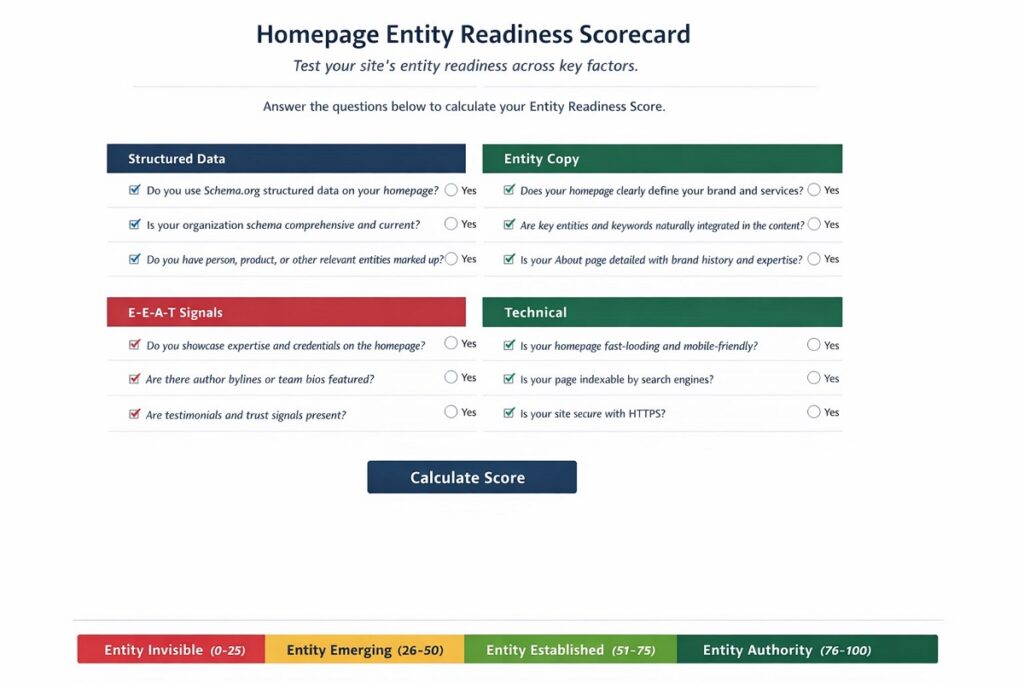
Ready to find out where your homepage stands? Use the Entity Readiness Scorecard above to get your score in under two minutes.

AI Search Specialist (AEO, GEO) | Helping brands get found, answered, and cited | Win on Google & ChatGPT.
I help businesses show up where their customers are actually looking.
For a long time, that just meant chasing rankings on Google. Today, it means something entirely different: people are asking AI for answers.
My job is simple. I bridge the gap between traditional SEO and the new world of AI search. I make sure that when someone asks ChatGPT, Google’s AI, or any other engine a question in your industry, your brand is the definitive answer they get.
No magic tricks or complicated buzzwords – just clean, modern search strategies that get you visibility and highly qualified leads.
Want to see how we can make your brand the trusted answer?
👉 Let’s connect, or check out my exact strategies at khalidseo.com.