Traditional search traffic is dropping. Users are asking ChatGPT and Perplexity instead of Googling.
You spent years fighting for page one. Now, generative AI is bypassing the SERPs entirely. It hands answers directly to your customers. If you aren’t the cited source, your competitor is.
The fix isn’t more keywords. It is Generative Engine Optimization (GEO). Here is how to make your brand the definitive, trusted recommendation across every major AI platform.

The New Search Reality: From 10 Blue Links to One AI Recommendation
The era of ten blue links is ending. Users want instant, synthesized answers. This shift to the Search Generative Experience (SGE) and engines like Google Gemini requires a total strategy overhaul.
We are moving from click-based discovery to direct AI citations. LLM optimization is no longer optional. It is mandatory for survival.
Here is exactly how the landscape has shifted:
| Feature | Traditional SEO | Generative Engine Optimization (GEO) |
| Primary Goal | Rank #1 in a list of links. | Be the single cited answer. |
| Key Metric | Organic click-through rate (CTR). | Brand mentions and entity authority. |
| Tactic Focus | Keyword density and backlinks. | Natural language processing and factual accuracy. |
| User Output | A page of options to click. | A synthesized, direct recommendation. |
What is Generative Engine Optimization (GEO)?
Generative Engine Optimization (GEO) is the strategic process of structuring brand content to be cited and recommended by Large Language Models (LLMs). It shifts focus from traditional keyword density to entity recognition, semantic relationships, and optimizing for natural language processing.
AI search optimization requires a mindset shift. You must prove to an algorithm that your brand is a factual entity, not just a website.
How Large Language Models (LLMs) Choose Which Brands to Cite
AI doesn’t “search” like a human. It calculates probabilities.
When a user prompts an AI, it relies heavily on Retrieval-Augmented Generation (RAG). This allows the AI to pull real-time data to ground its answers.
To be retrieved, your content needs strong vector context. Your brand name must frequently appear near relevant co-occurrence terms in trusted databases. If AI algorithms consistently see your brand linked to a specific solution, you become the default answer.
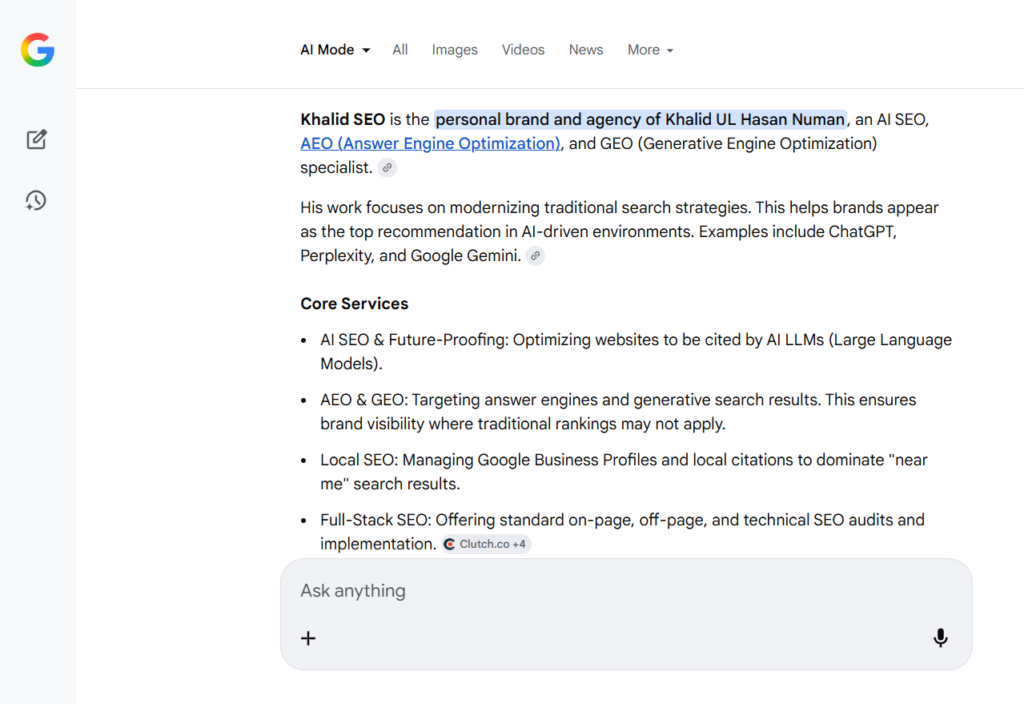
The Khalid SEO Framework: 3 Pillars to Becoming an AI-Recommended Entity
Securing your spot as an AI recommendation requires intention. At Khalid SEO, we transition brands from chasing rankings to becoming trusted entities.
We execute this using a precise, three-pillar methodology.
1. Building Unshakable Topical Authority
You must cover your niche exhaustively. AI engines trust highly specialized sources.
If you want ChatGPT to recommend your software, you must be the most cited authority on that specific software category. Thin content will be ignored.
2. Mastering Answer Engine Optimization (AEO)
Format content to answer questions directly. Use conversational phrasing.
AEO ensures your data is structured exactly how AI models prefer to ingest it. Use clear headings, bullet points, and concise definitions.
3. Entity-Building and Knowledge Graph Integration
Stop worrying about standard backlinks. Focus on digital PR and brand mentions.
You need to cement your brand as a recognized entity in the Knowledge Graph. Strong E-E-A-T signals are critical here.
Future-Proofing Your Brand Visibility in the AI Era
Semantic search is the new baseline. Securing your brand visibility tomorrow requires action today.
You must pivot to become the trusted recommendation. The brands that adapt to GEO now will dominate the next decade of search.
Frequently Asked Questions
How do I get my brand recommended by AI like ChatGPT?
To get recommended by AI, focus on Generative Engine Optimization (GEO). Build topical authority, secure unlinked brand mentions on high-trust sites, and structure data for direct, accurate answers.
AI models need to see your brand as a factual entity. Consistent mentions across authoritative platforms train the model to associate your brand with specific solutions.
What is Generative Engine Optimization (GEO)?
GEO is the strategy of optimizing online content to be cited by AI-driven Large Language Models (LLMs). It prioritizes entity recognition and structuring data for Retrieval-Augmented Generation (RAG) systems.
Unlike traditional SEO, GEO focuses on establishing semantic relationships. It ensures your brand is understood as a definitive source within a specific context.
How is AI SEO different from traditional SEO?
Traditional SEO focuses on keyword density to rank in search results. AI SEO prioritizes becoming a trusted entity in a Knowledge Graph through conversational phrasing and direct answers.
Traditional SEO gets you clicks. AI SEO gets you cited as the single best recommendation by an AI assistant.
Why is topical authority important for AI search?
AI engines rely on topical authority to determine trustworthiness. When an LLM generates a response, it pulls from the most consistently reliable and comprehensive sources in its training data.
By thoroughly covering a niche, you become the foundational source the AI trusts. Shallow content rarely makes the cut for AI citations.
How do Large Language Models choose which brands to cite?
LLMs cite brands based on the frequency of co-occurrence with specific concepts in their training data, combined with real-time RAG retrieval from highly authoritative sources.
Your brand name must frequently appear alongside your industry’s core keywords. Positive sentiment markers and citations in high-authority publications dramatically increase your chances of being recommended.