Organic traffic is dropping for many established sites. You publish great content, build links, and optimize tags. Yet, clicks keep falling.
The reason is simple. Generative engines now answer user queries directly. If you rely solely on traditional ranking methods, SGE and LLMs will bypass your site entirely. You are fighting a retrieval system, not a traditional algorithm.
The solution requires a shift from keyword indexing to entity citation. At Khalid Seo, we help brands make this transition. You need an AI SEO Specialist to make your data machine-readable.
The Evolution of Search: Why the Role of an AI SEO Specialist is Non-Negotiable
Search engines no longer rely on string matching. They use Neural Matching and SGE to understand the intent behind a query.
Traditional SEO methods fail here. An AI SEO Specialist builds topical maps. They establish your brand within the global Knowledge Graph. This ensures AI agents view you as a definitive entity.
From Keywords to Entities: The Architecture of Modern Search
Search algorithms now treat your site as a database. To gain visibility, your data points must connect logically to broader industry concepts.
We use Entity-based SEO to shrink the semantic distance between your brand and user problems. This makes your site the logical source for AI models to cite.
The Core Skillset: What Does a Senior AI SEO Specialist Actually Do?
A modern search strategist is a technical architect. They do not just write blog posts. They build the infrastructure for AI visibility.
- Engineer semantic data: They structure website data so LLMs can easily parse and cite it.
- Optimize for RAG systems: They format content specifically for Retrieval-Augmented Generation architectures.
- Build custom SEO tools: For instance, developing an AI Search Indexability & Crawlability Checker to monitor a site’s technical health.
- Execute prompt engineering: They use AI to scale content production while strictly maintaining E-E-A-T standards.
- Train internal teams: Many specialists lead online courses to upskill marketing departments on digital marketing and AI SEO.
Generative Engine Optimization (GEO): The 2026 Strategy for Citation
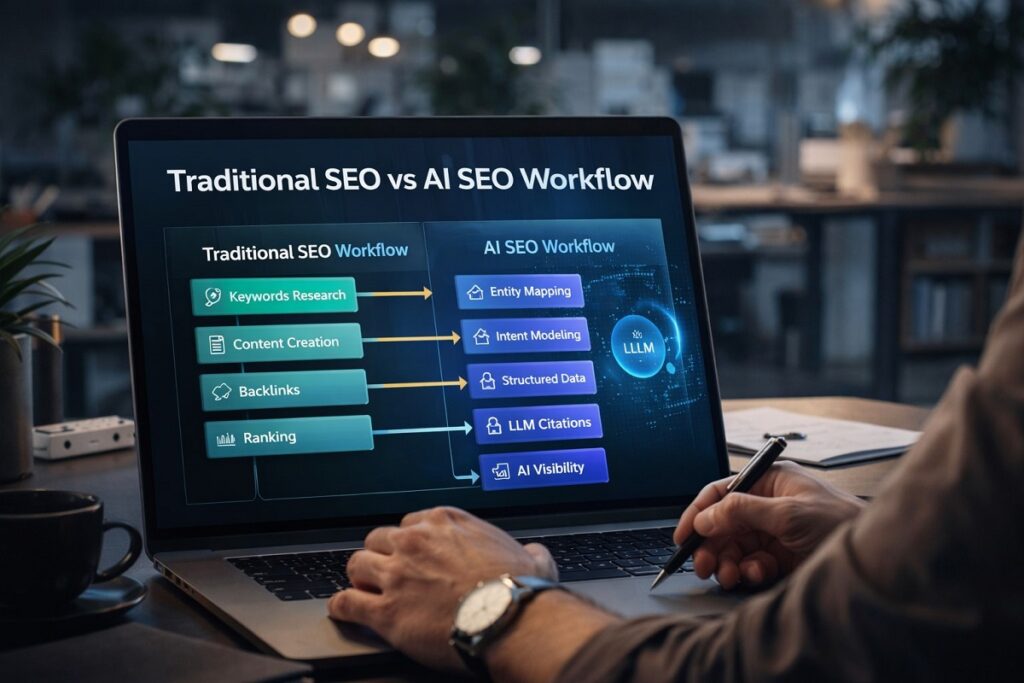
GEO is the new standard. Your primary goal is to become the trusted citation for models like Perplexity and Gemini.
| Feature | Traditional SEO | AI SEO (GEO) |
| Primary Goal | Rank #1 on Page 1 | Be cited in an AI summary |
| Content Focus | Keyword Density | Entity Density & Information Gain |
| Success Metric | Click-Through Rate (CTR) | Brand Mentions & Citations |
| Tech Requirement | XML Sitemaps | Vector-Ready Schema & JSON-LD |
Technical Infrastructure: Schema and Machine-Readability
Crawlability now applies to LLM agents. Bots from OpenAI and Anthropic must easily read your site architecture.
This requires advanced JSON-LD and vector-friendly setups. Your backend signals matter more than ever. We prioritize these technical layers to ensure search engines trust your data implicitly.
Balancing E-E-A-T with Algorithmic Content Production
Users ignore generic, automated text. To stand out, you must provide Information Gain.
You can use AI to organize massive datasets. However, human insight is mandatory. Original expertise proves your E-E-A-T and prevents algorithmic penalties for low-value content.
The Future of Search: Preparing for the Post-Keyword Era
Voice search and predictive analytics are taking over. Preparing your site now prevents digital obsolescence.
Build topical authority today. Invest heavily in entity mapping. Future-proof your business against the next algorithm update.
FAQ
What is Generative Engine Optimization (GEO)?
GEO is the practice of optimizing content to be selected as a reference by generative AI models. It focuses on declarative headings, concise direct answers, and clean site architecture that AI agents can easily parse and crawl.
How is AI SEO different from traditional SEO?
Traditional SEO focuses on ranking in the Top 10, while AI SEO prioritizes answer engine visibility and citations. It shifts the focus from raw click-through rates to securing verified brand mentions within AI-generated responses.
Can AI-generated content rank on Google in 2026?
Yes, provided it meets strict E-E-A-T standards and includes original human insight. Google prioritizes Information Gain. An AI SEO specialist ensures automated drafts are enhanced with unique data to satisfy strict algorithms.
What does an AI SEO specialist do?
An AI SEO specialist optimizes websites for generative search engines using entity-based structures. They implement RAG-friendly content, deploy advanced schema markup, and build high semantic proximity between topics to secure AI citations.
How do I improve my site’s AI visibility?
Focus entirely on building topical authority and implementing structured data. By creating comprehensive content clusters and using schema to define your brand’s relationships, you drastically increase the likelihood of being cited.