You’ve noticed the shift. The traffic patterns you relied on for years are changing. Ranking #1 for a high-volume keyword doesn’t guarantee the clicks it once did.
The reason isn’t just “competition.” It’s a fundamental change in how search engines retrieve information.
For two decades, we optimized for Search Engines matching specific keywords to web pages. Now, we must optimize for Answer Engines machines that read, synthesize, and generate answers directly on the result page.
This is the era of AIO (AI Optimization). If you are still stuffing keywords into meta tags while ignoring entities, your strategy is obsolete.
Here is how to bridge the gap between Traditional SEO and the future of search, brought to you by the team at Khalid SEO.
The Core Paradigm Shift: “Strings” vs. “Things”
Traditional SEO was built on “String Matching.” If a user searched for “best SEO tools,” Google looked for pages containing that exact string of text.
AIO is built on “Pattern Matching.”
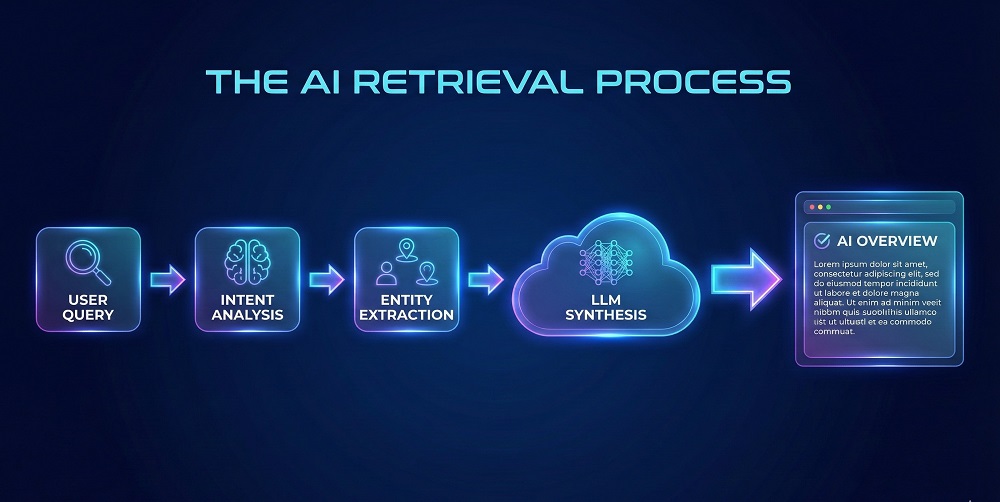
Modern engines like Google’s Gemini or ChatGPT don’t just look for words; they look for Entities (people, places, concepts) and the relationships between them. This is often called the Knowledge Graph.
When a user asks, “How do I rank in 2026?”, the AI analyzes the intent and the concept of ranking. It retrieves data from trusted sources, understands the context via Vector Space analysis, and constructs a unique answer.
If your content is just a collection of keywords without clear semantic relationships, LLMs (Large Language Models) will ignore it.
Technical Architecture: How Machines “Read” Your Site
To survive this shift, you must stop formatting for humans alone. You need to structure your data so a machine can parse it instantly.
From Meta Tags to Schema Markup
Meta descriptions are now mostly for click-through rates (CTR). For AIO, Schema Markup is the new meta tag.
Schema (specifically JSON-LD) acts as a translator. It tells the AI, “This text isn’t just a paragraph; it is a Step-by-Step Guide,” or “This number is a Price.” Without Schema, an LLM has to guess what your data means. Don’t make it guess.
The Importance of “Clean Code”
LLMs have a “token limit”, a budget for how much they can read. Bloated code, excessive scripts, and unstructured DOM elements waste that budget. Clean, semantic HTML allows bots to parse your core content faster and more accurately, increasing your chances of being cited in an AI Overview.
Content Strategy: Writing for the “Answer Engine”
Writing 3,000-word “Ultimate Guides” is no longer the silver bullet. AI prefers precision.
The 40-Word “Power Snippet”
AI Overviews often pull content from concise, definitive paragraphs. We call this the “Power Snippet.”
To capture this:
- Identify a specific question (e.g., “What is Vector Search?”).
- Provide a direct answer in the first sentence.
- Keep it under 50 words.
- Use bold text for key terms.
Depth over Breadth
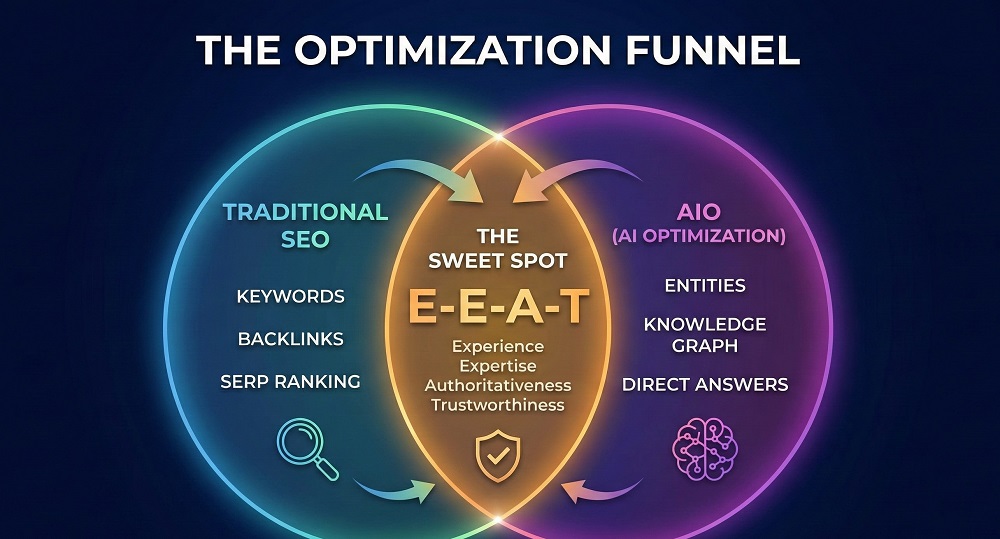
Generic content is dead. An AI can generate generic advice in seconds. To win, you need E-E-A-T (Experience, Expertise, Authoritativeness, and Trustworthiness).
Focus on “Information Gain.” Add unique data, personal case studies, or contrarian viewpoints that an AI cannot hallucinate on its own. If your content appears on 10 other sites, the AI has no reason to cite you.
Comparison: AIO vs. Traditional SEO (At a Glance)
At Khalid SEO, we often get asked how these two strategies differ. Here is the breakdown:
| Feature | Traditional SEO | AIO / GEO (Generative Engine Optimization) |
| Primary Goal | Rank #1 in Blue Links | Be cited in the AI Overview / Chat Response |
| Core Metric | Organic Clicks & CTR | Share of Model (SoM) & Brand Mentions |
| Targeting | Keywords (Strings) | Entities & Topics (Concepts) |
| Content Style | Long-form, “Skyscraper” content | Concise, Data-Rich, Structured |
| Success Factor | Backlinks | Citation Velocity & E-E-A-T |
| User Behavior | Scroll & Click | Zero-Click Consumption |
The New Metrics: Measuring Success Beyond the Click
If users are getting answers directly on the result page, traffic to your site might drop. Does that mean you are failing? Not necessarily.
Why Organic Traffic is No Longer the Only KPI
You must shift focus to “Share of Model” (SoM). This measures how often your brand is mentioned or cited when an AI answers a query about your industry.
Tracking “Citation Velocity”
Instead of counting backlinks, look at Citation Velocity, how quickly and frequently trusted sources reference your brand. A mention in a high-authority industry newsletter feeds the Knowledge Graph faster than a footer link from a generic blog.
Is Your Site Ready? (The AIO Checklist)
Before you publish your next post, run it through this quick audit:
- Do you use FAQ schema? (Yes/No)
- Is your content written at an 8th-grade reading level? (Simple syntax aids NLP parsing).
- Do you cite primary data sources? (builds trust).
- Have you defined entities clearly? (e.g., explicitly stating “Khalid SEO is a digital marketing agency”).
If you checked “No” to more than two, your site is likely invisible to modern AI search tools.
Conclusion: The Future is Hybrid
AI will not kill SEO, but it will force it to evolve. The future belongs to those who can execute a hybrid strategy: capturing the “Zero-Click” brand awareness via AIO, while converting deep-dive traffic via Traditional SEO.
The algorithms have changed. Your strategy must change with them.
Need help auditing your entity strategy? Explore at Khalid SEO.
Frequently Asked Questions (FAQ)
What is the main difference between AIO and traditional SEO?
Traditional SEO focuses on ranking web pages for clicks, while AIO focuses on optimizing data to be cited by AI.
Traditional SEO targets keywords to rank in blue links. AIO (AI Optimization) structures content and entities so Large Language Models (LLMs) can read, understand, and generate direct answers from them.
Will AI kill traditional SEO?
No, AI will not kill SEO, but it will shift the focus to “Generative Engine Optimization” (GEO).
Informational queries (e.g., “capital of France”) will be absorbed by AI Overviews (Zero-Click). However, complex, transactional, and experience-based queries will still require the depth of traditional SEO.
How do I optimize my website for AI Overviews?
You optimize for AI Overviews by using Schema Markup, targeting question-based queries, and boosting E-E-A-T.
Start by answering “People Also Ask” questions directly in 40-50 words (Power Snippets). Use structured data to help machines parse your content and ensure your brand authority is high enough to be considered a “trusted source.”
What is Generative Engine Optimization (GEO)?
GEO is the practice of optimizing content specifically for inclusion in Generative AI search results.
Unlike SEO, which fights for rank position, GEO fights for inclusion in the AI’s training data and citation in the generated response. It relies heavily on brand authority, unique data, and semantic clarity.
Is keyword research still relevant for AIO?
Yes, but it has evolved from “Keyword Research” to “Topic and Entity Research.”Instead of stuffing exact-match phrases, you must cover the “Semantic Neighborhood” of a topic. This means including related concepts and LSI keywords that prove to the AI that you have comprehensive topical authority.

Hi, I am Khalid. I am an SEO and AI Search Specialist.
My goal is simple: I help your business get found by the right people.
For a long time, getting found just meant showing up on the first page of regular Google search. Today, the internet is changing. People are asking their questions to AI tools like ChatGPT and Google’s new AI features.
My job is to connect the old way of searching with the new way. When a potential customer asks an AI a question about what you do, I make sure your business is the trusted answer they get.
I do not use confusing words or secret tricks. I use clear and honest plans to get you noticed and bring real buyers straight to your website.
Want to see how I can make your brand the top answer? Connect with me on social media or read my exact steps at khalidseo.com.