Your analytics aren’t broken. The drop in traffic you see is real.
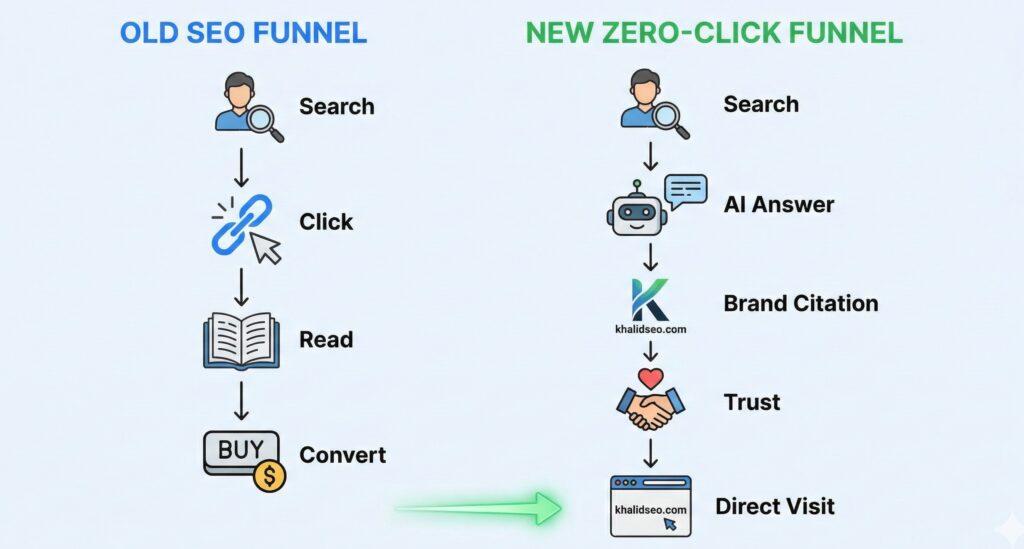
For years, the deal was simple: create content, rank high, get the click. But with the rise of Google AI Overviews (AIO) and ChatGPT Search, that deal has expired. Users are now getting their answers directly on the search results page (SERP) without ever visiting a website.
This is the “Zero-Click” reality.
If you continue chasing volume using the old SEO playbook, your business will become invisible. But if you pivot now, this shift isn’t a threat, it’s a massive opportunity to build authority where it actually counts.
Here is the strategic blueprint for Answer Engine Optimization (AEO) and how to make your brand the definitive source in the age of AI.
The “Traffic Apocalypse” is Here (And Why That’s Okay)
Panic is the default reaction to traffic loss. It shouldn’t be.
The traffic disappearing from your reports is mostly “low-intent” noise. These are users asking simple questions like “what is the weather” or “definition of SEO.” They were never going to buy from you. They just wanted a quick fact.
The clicks that remain are high-intent. A user who clicks through in 2026 isn’t looking for a definition; they are looking for deep expertise, a specific product, or a nuanced opinion that an AI summary cannot provide.
The shift is clear:
- Old Goal: Maximum Sessions (Quantity).
- New Goal: Brand Inception (Quality).
We need to stop obsessing over being the “blue link” and start focusing on being the source that Google’s AI quotes to millions of users.
What is AIO? (The Pivot from SEO to AEO)
Answer Engine Optimization (AIO) is the practice of formatting and structuring your content so that Generative AI models (like Google Gemini, ChatGPT, and Perplexity) can easily understand, verify, and cite your brand as the primary authority.
Unlike traditional SEO, which optimizes for a “ranking algorithm,” AIO optimizes for a “retrieval algorithm.”
At Khalid SEO, we define this as moving from being found to being chosen.
SEO vs. AIO: The Core Differences
To win in this new environment, you must understand how the rules have changed.
| Feature | Traditional SEO | AIO / AEO Strategy |
| Primary Goal | Drive clicks to the website. | Be cited as the answer source. |
| Target | 10 Blue Links. | Featured Snippets & AI Overviews. |
| Keyword Strategy | High volume, broad match. | Entities & conversational queries. |
| Content Style | Long-form, “skimmable” text. | Concise, data-dense, structured. |
| Success Metric | Sessions / Pageviews. | Share of Voice / Brand Mentions. |
The 3-Pillar Strategy to Win “Position Zero”
You cannot trick an LLM (Large Language Model) into ranking you. You have to prove you are the best answer. Here is the three-part framework we use at Khalid SEO to secure that top spot.
1. Structure for Machines (The Technical Reset)
AI models are hungry for structure. If your content is a wall of text, the AI will ignore it. You need to speak its language using Schema Markup.
Don’t just use standard “Article” schema. Implement Speakable, FAQPage, and Profile schema. This code tells Google explicitly: “This is the entity (Brand), this is the question, and here is the specific answer.”
2. Optimize for “Extraction Confidence”
Google’s AI will only cite you if it is confident your answer is correct. High “Extraction Confidence” comes from writing style.
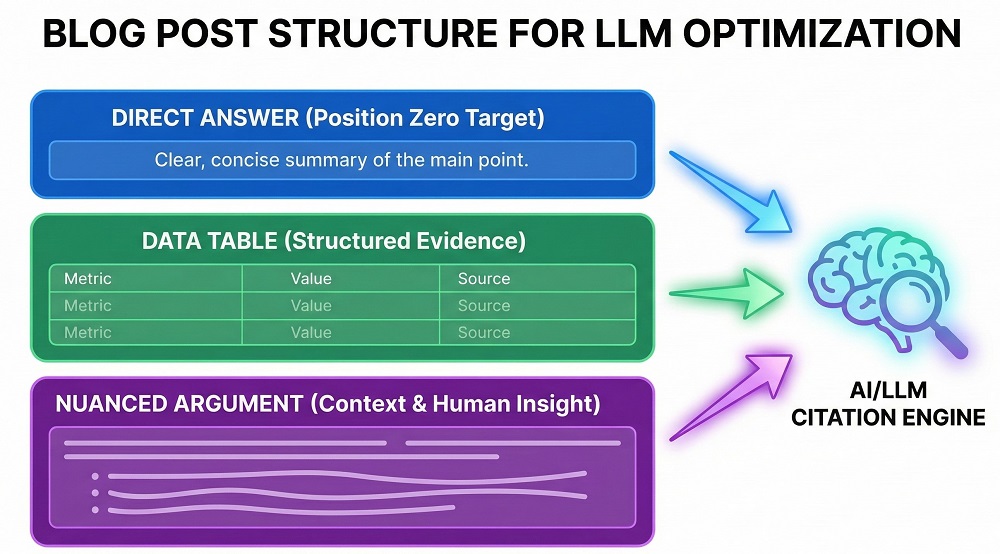
Use the Inverted Pyramid method:
- Start with the direct answer (the “what”) in the first sentence.
- Follow with data or proof (the “why”).
- End with the nuance.
Avoid vague intros. Be direct.
3. Own the Entity (Not Just the Keyword)
Keywords are strings of text. Entities are things (people, places, concepts) that Google understands.
To survive zero-click, your brand must become a recognized Entity in the Knowledge Graph. This means getting cited by other authoritative sources, maintaining a consistent N-A-P (Name, Address, Phone) across the web, and ensuring your “About” page clearly defines who you are and what you do.
Information Gain: The Only Defense Against “AI Slop”
The internet is currently flooding with generic, AI-generated content. Google knows this.
To filter the trash, Google now prioritizes Information Gain. This means your content must add something new to the conversation that isn’t already in the top 10 results.
How to add Information Gain:
- Original Data: Run a small survey or analyze your own customer data.
- Contrarian Views: Challenge a common industry belief.
- Personal Experience: Share a specific case study or failure story.
If ChatGPT can write your article, you don’t deserve to rank.
Measuring Success in a Post-Click World
Stop looking at “Sessions” in Google Analytics as your only KPI. In a zero-click world, success looks different.
You need to track Brand Visibility.
- Direct Traffic: Are more people typing “Khalid SEO” directly into the browser?
- Share of Voice: How often does your brand appear in AI summaries for your core topics?
- On-SERP Conversions: Are users calling you or booking appointments directly from your Google Business Profile?
Frequently Asked Questions (FAQ)
How do I survive zero-click searches in 2026?
To survive zero-click searches, shift your strategy from "traffic acquisition" to brand influence. Focus on Answer Engine Optimization (AEO) by structuring content with direct definitions, using Schema markup to define your entity, and providing unique "Information Gain" that AI models cannot generate themselves.
What is the difference between SEO and AIO?
SEO (Search Engine Optimization) focuses on ranking blue links to drive clicks, while AIO (AI Optimization) focuses on optimizing content to be cited as the source. AIO prioritizes brand authority and answer structure over keywords, ensuring your business is the recommended solution in AI summaries (like Google Overviews or ChatGPT).
Does zero-click search mean SEO is dead?
No, SEO is not dead; it has evolved. While "informational" clicks are declining, "transactional" intent remains strong. Zero-click search requires a pivot to Entity SEO, where the goal is to become the trusted "seed source" that AI models reference, driving higher-quality, bottom-of-funnel leads rather than volume traffic.
How do I rank in Google AI Overviews?
Ranking in AI Overviews requires high "Extraction Confidence" and structured data. You must use the "Inverted Pyramid" writing style (answer first, context later), format data in Markdown tables and bullet points, and establish high E-E-A-T (Experience, Expertise, Authority, Trust) to prove your reliability.
What metrics should I track for zero-click SEO?
In a zero-click world, stop obsessing over "Sessions" and start tracking Brand Mentions and Impressions. Focus on Direct Traffic (users typing your URL), On-SERP conversions (leads generated via local snippets), and how often your brand is cited in AI responses. These metrics indicate your authority is penetrating the AI layer.

Hi, I am Khalid. I am an SEO and AI Search Specialist.
My goal is simple: I help your business get found by the right people.
For a long time, getting found just meant showing up on the first page of regular Google search. Today, the internet is changing. People are asking their questions to AI tools like ChatGPT and Google’s new AI features.
My job is to connect the old way of searching with the new way. When a potential customer asks an AI a question about what you do, I make sure your business is the trusted answer they get.
I do not use confusing words or secret tricks. I use clear and honest plans to get you noticed and bring real buyers straight to your website.
Want to see how I can make your brand the top answer? Connect with me on social media or read my exact steps at khalidseo.com.