Ranking on the first page of Google is no longer the ultimate goal. The goal is to be the answer.
With the rollout of AI Overviews (AIO), Google has fundamentally changed how users consume information. Traffic to traditional “blue links” is dropping for informational queries, while synthesized AI answers take up the entire top half of the screen.
If your content isn’t optimized for this new reality, you are invisible.
This isn’t just about SEO anymore. It’s about Generative Engine Optimization (GEO). This guide will show you exactly how to structure your content, data, and entities to become the trusted source Google’s Gemini model cites.
From SEO to GEO: Understanding the Shift
Traditional Search Engine Optimization (SEO) was about proving relevance to a crawler. You focused on keywords, backlinks, and page speed to rank a URL.
Generative Engine Optimization (GEO) is different. It is about proving authority to a Large Language Model (LLM).
LLMs like Gemini don’t just “retrieve” links; they “synthesize” information. They read top-ranking content, cross-reference facts, and generate a new answer. To win, your content must be the easiest for the AI to parse, verify, and cite.
The Core Differences
| Feature | Traditional SEO | Generative Engine Optimization (GEO) |
| Primary Goal | Rank a URL | Earn a Citation / Brand Mention |
| Target Audience | Human Reader + Googlebot | Human Reader + LLM (Gemini) |
| Key Metric | Clicks & CTR | Share of Voice & Information Gain |
| Content Structure | Long-form, narrative flow | Structured data, lists, direct answers |
Will AI Overviews kill organic traffic?
For simple queries like “what is SEO?”, yes. Zero-click searches will rise. However, AIO creates a massive opportunity for high-intent traffic. Users who click an AI citation are often deeper in the research phase, they want expert analysis, not just definitions.
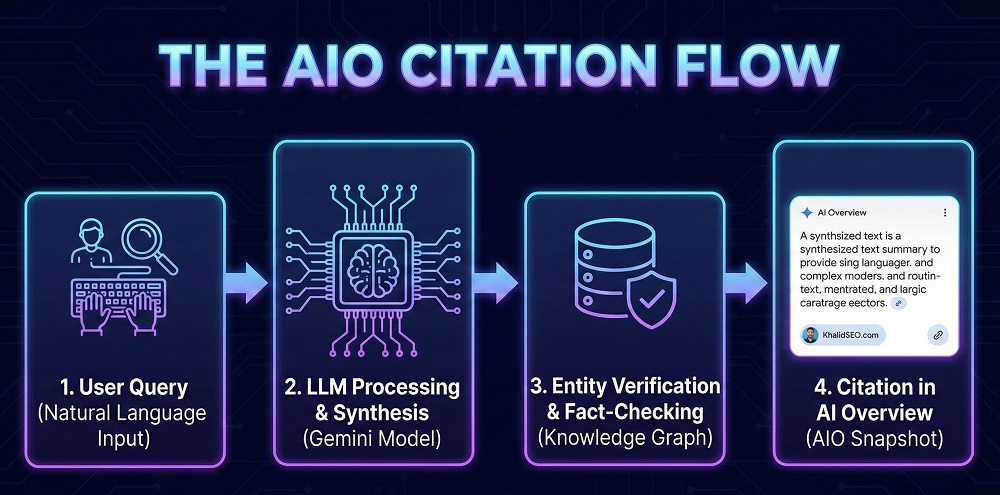
How Google’s AI Decides Who to Cite
Google’s AI doesn’t guess. It relies on a “Confidence Score” to determine which sources are trustworthy enough to build an answer from.
To rank in an AI Overview, you must satisfy three specific criteria:
- Relevance: Does the content directly answer the specific nuance of the prompt?
- Authority (E-E-A-T): Is the source a recognized entity in the Knowledge Graph?
- Consensus: Does the information align with other trusted sources? (AI models hate outliers unless they are heavily cited research).
At KhalidSEO, we emphasize that you cannot trick an LLM with keyword stuffing. You must provide Information Gain, unique data, a fresh perspective, or a more efficient structure than your competitors.
The 3 Core Pillars of AIO Optimization
To shift your strategy from SEO to GEO, focus on these three pillars.
1. Structure: The Inverted Pyramid
Stop “burying the lead.” LLMs have a limited attention span (context window prioritization).
Write your content using the Inverted Pyramid method:
- The Answer: State the core fact or answer immediately after the heading (first 40-60 words).
- The Context: Explain the “why” and “how” in the following paragraphs.
- The Evidence: Support your claims with data, quotes, or schema.
2. Entities: Speak the Machine’s Language
Google doesn’t read strings of text; it maps “Entities” (people, places, concepts).
If you are writing about “link building,” ensure you contextually link it to related entities like “PageRank,” “Domain Authority,” and “Google Search Console.” This creates a Vector Context that tells the AI your content is comprehensive and topically relevant.
3. Data: The Technical Foundation
The AI needs to know what your content is. Don’t leave it to chance.
Use Structured Data (Schema) to explicitly tell Google what is on the page. We will cover this in detail below, but know this: a page without Schema is like a book without a title for an AI.
Step-by-Step: Optimizing Content for the “Snapshot”
Want to update your existing content for AI Overviews? Follow this checklist.
- Target “People Also Ask” Queries: Look at the PAA box for your keyword. Rewrite your H2s to match these questions.
- Use “Format Forcing”: If the question implies a list (e.g., “Best tools for…”), use a bulleted list. If it implies a comparison, use a table. LLMs love structured formats.
- Shorten Your Sentences: Complex syntax confuses models. Keep sentences under 20 words where possible to reduce “hallucination” risk.
- Add Author Credentials: Ensure your author bio is detailed and links to social profiles. Google needs to verify the human behind the content.
Why Schema is Your Secret Weapon for AIO
This is the technical edge most marketers miss. Schema markup provides the "context" LLMs need to understand the relationship between entities on your page.
At KhalidSEO, we recommend implementing these specific types:
FAQPage: For Q&A sections. This is the fastest way to feed direct answers to the AI.Article: To define the headline, author, and publish date clearly.Organization: To establish your brand as a valid entity in the Knowledge Graph.Speakable: (Optional) identifying sections of the article best suited for text-to-speech or voice assistants.
When you use Schema correctly, you are essentially handing Google the answer key.
Frequently Asked Questions (FAQ)
How do I get my website in Google AI Overviews?
To get your website in Google AI Overviews, focus on Generative Engine Optimization (GEO). Structure content with clear headings and direct answers (40-60 words). Implement structured data (Schema) to help Google understand your entities, and build high E-E-A-T signals to ensure the AI trusts your domain as a citation source.
What is the difference between SEO and GEO?
SEO focuses on ranking blue links, while GEO focuses on optimizing content for AI citations. SEO prioritizes keywords and backlinks to drive clicks. GEO prioritizes entity authority, structured data, and direct, fact-based answers that LLMs can easily parse and synthesize into a generated response.
Does Schema markup help with AI Overviews?
Yes, Schema markup is critical for ranking in AI Overviews. It provides the context LLMs need to verify facts. Using FAQPage, Article, and Organization schema increases the likelihood of Google's AI accurately parsing your content and using it as a trusted source.
How does Google choose sources for AI Overviews?
Google chooses sources based on relevance, authority, and structure. It favors content that directly answers the query in simple language, is hosted on a domain with high topical authority (established Knowledge Graph), and uses a logical structure (lists, tables) that is machine-readable.
The Future of Search is Conversational
The transition to AI Overviews is not the end of SEO; it is an evolution. The winners in this new era will be those who stop writing for algorithms and start building authoritative, entity-rich knowledge bases.
Focus on being the expert. Structure your data. And let the AI do the rest.
Need help preparing your site for the AI era? Visit KhalidSEO for advanced strategies and tools.

Hi, I am Khalid. I am an SEO and AI Search Specialist.
My goal is simple: I help your business get found by the right people.
For a long time, getting found just meant showing up on the first page of regular Google search. Today, the internet is changing. People are asking their questions to AI tools like ChatGPT and Google’s new AI features.
My job is to connect the old way of searching with the new way. When a potential customer asks an AI a question about what you do, I make sure your business is the trusted answer they get.
I do not use confusing words or secret tricks. I use clear and honest plans to get you noticed and bring real buyers straight to your website.
Want to see how I can make your brand the top answer? Connect with me on social media or read my exact steps at khalidseo.com.