Is AI Traffic Really Better Than Google? The Answer Will Surprise You
Everyone’s talking about AI traffic these days. ChatGPT sends someone to your website and suddenly that visitor is “smarter,” “more ready to buy,” and “higher quality” than someone from Google.
But is that actually true?
A new study by Saltbox looked at how long visitors stayed on different types of web pages – comparing people who came from traditional Google search vs. people who arrived via AI tools like ChatGPT, Claude, or Perplexity.
The results? It’s not so simple.
What the Data Actually Shows
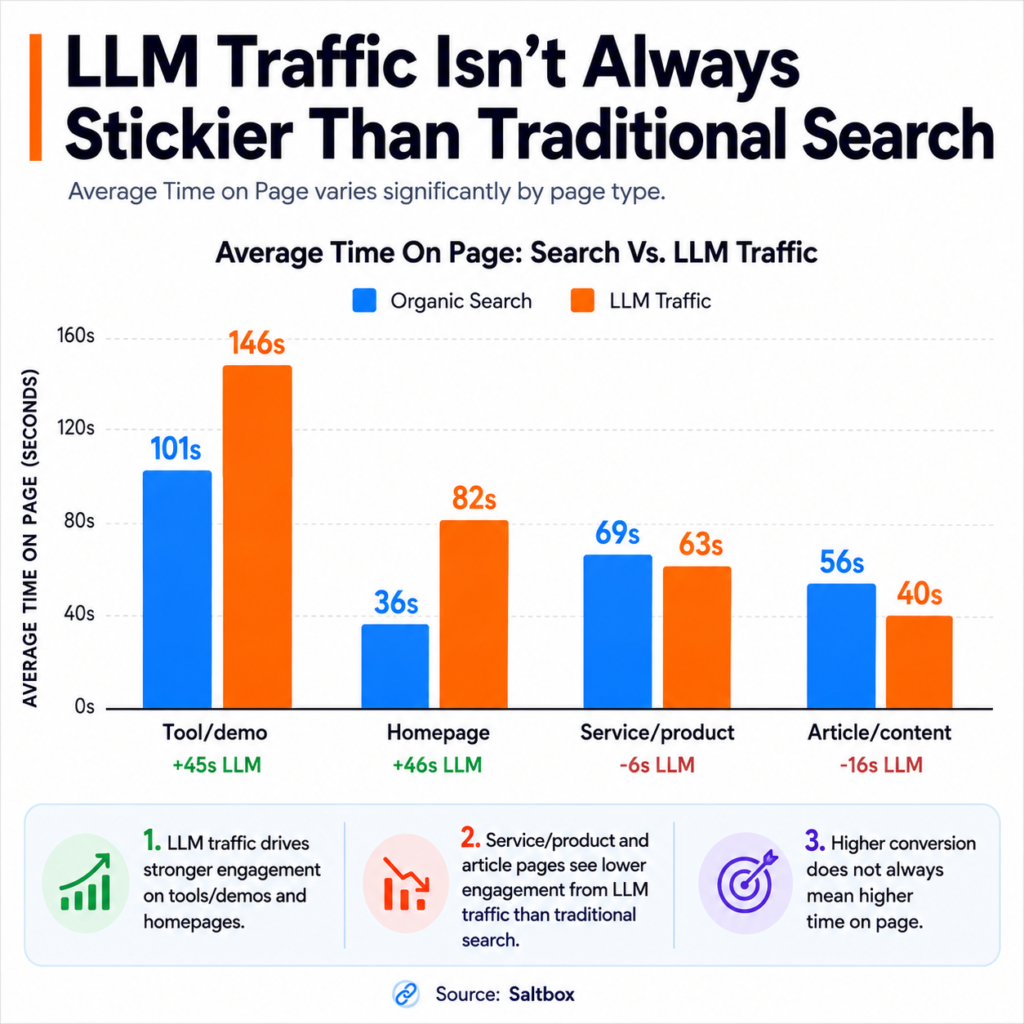
Researchers measured “average time on page” – basically, how long someone sticks around after clicking through to your site. Here’s what they found across four common page types:
Tool and Demo Pages
AI visitors: 146 seconds
Google visitors: 101 seconds
Difference: +45 seconds for AI traffic ✅
Homepages
AI visitors: 82 seconds
Google visitors: 36 seconds
Difference: +46 seconds for AI traffic ✅
Service and Product Pages
AI visitors: 63 seconds
Google visitors: 69 seconds
Difference: -6 seconds (Google wins) ❌
Article and Blog Content
AI visitors: 40 seconds
Google visitors: 56 seconds
Difference: -16 seconds (Google wins) ❌
So AI traffic wins on some pages. And loses on others.
Why Does This Happen?
Think about it from the visitor’s point of view.
When someone asks ChatGPT “What’s a good tool for scheduling social media posts?” and ChatGPT recommends your app – that person clicks your link already knowing what you do. They’re curious, ready to explore, maybe even ready to sign up. So of course they spend more time on your tool page or homepage.
But when someone asks an AI “How does SEO work?” and it links to your blog post – they might already have most of the answer FROM the AI. They click through just to double-check one thing, skim for 40 seconds, and leave. Meanwhile, the person who Googled “how does SEO work” is reading every word because they’re starting from zero.
This is the key insight: AI tools often answer the question before you even arrive. So the visitor shows up half-satisfied.
What This Means for Your Website
Here’s the practical takeaway for business owners, bloggers, and marketers:
- If you have tools or interactive demos — optimize hard for AI visibility.
This is where AI traffic really shines. Make sure your tool is mentioned in places AI models are trained on (product reviews, directories, trusted publications). This is sometimes called GEO — Generative Engine Optimization. - For product/service pages — don’t abandon traditional SEO.
Google visitors spend more time on these pages. They’re still doing the research. They need more convincing. And organic search delivers that patient, research-mode visitor better than AI tools currently do. - For blog content — Google is still king.
AI visitors skim. Google visitors read. If your content strategy depends on engagement (time on page, scroll depth, comments), traditional SEO is still your best friend for articles. - High conversion ≠ high engagement.
This is an important nuance. A visitor can convert in 30 seconds and leave. That’s not necessarily bad! But don’t confuse “they bought quickly” with “they loved my content.” These are different outcomes.
The Bottom Line
AI traffic isn’t better or worse than Google traffic. It’s different and where it lands matters a lot.
The smartest digital marketers in 2025 aren’t picking sides. They’re asking: “What kind of visitor does each page need, and how do I attract them from the right source?”
Use AI visibility to drive people to your tools, demos, and homepage.
Use SEO to drive people to your content and product pages.
Both channels have a job. Give them the right one.
Data source: Saltbox — LLM vs Organic Search Traffic Comparison Study (2025)
Written by — Khalid SEO, SEO + AI Search Specialist

Hi, I am Khalid. I am an SEO and AI Search Specialist.
My goal is simple: I help your business get found by the right people.
For a long time, getting found just meant showing up on the first page of regular Google search. Today, the internet is changing. People are asking their questions to AI tools like ChatGPT and Google’s new AI features.
My job is to connect the old way of searching with the new way. When a potential customer asks an AI a question about what you do, I make sure your business is the trusted answer they get.
I do not use confusing words or secret tricks. I use clear and honest plans to get you noticed and bring real buyers straight to your website.
Want to see how I can make your brand the top answer? Connect with me on social media or read my exact steps at khalidseo.com.