You open ChatGPT. You search for the exact problem your product solves. A competitor’s name appears three times. Yours doesn’t appear at all.
Your Google rankings haven’t moved. Your traffic is fine. Your content team published eight articles last quarter. None of it explains the gap.
That gap is AI citation decay and it’s invisible to every traditional SEO metric you’re tracking. While you’ve been optimizing for blue links, a parallel visibility system has been quietly deciding which brands exist and which ones don’t. The brands that built the right signals before the window closed are getting cited in millions of AI-generated answers every day. The ones that didn’t are nowhere.
This article gives you the exact framework to diagnose your brand’s AI citation status, rebuild the signals that matter, and show up in the answers your customers are getting right now.
What Is AI Citation Decay? (And Why It’s Not the Same as Losing Google Rankings)
AI citation decay is the process by which a brand loses visibility inside large language model responses over time. It starts when a brand’s entity signals weaken in knowledge graphs, its content falls below the citation frequency threshold LLMs use to surface sources, or its training data representation fades relative to newer, more authoritative competitors.
This is not a rankings problem. A brand can hold position one on Google for every target keyword and be completely absent from every AI-generated answer in its category. These are different systems, measured differently, built on different signals.
Google ranks documents. LLMs select entities.
That distinction matters enormously. When Google evaluates a page, it weighs backlinks, on-page relevance signals, and user engagement. When an LLM constructs an answer, it’s not browsing — it’s drawing on a compressed representation of what it learned during training. Brands that weren’t clearly established as recognized entities during that training window simply don’t come up.
You don’t rank your way out of this. You have to build your way in.
How LLMs decide which brands to reference (and which to skip)
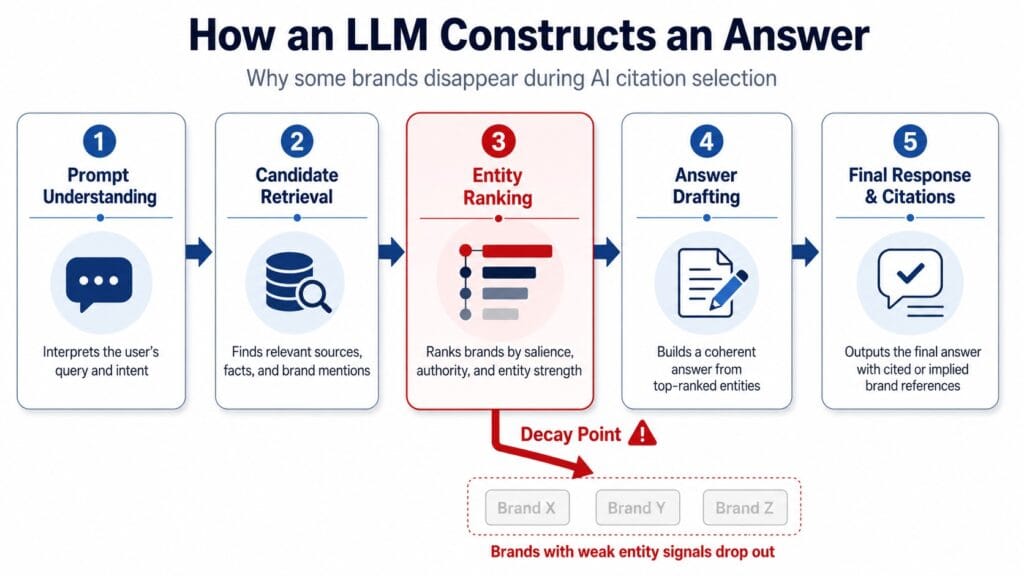
Brands are eliminated at the entity ranking stage – the third step in an LLM’s answer construction process – before a single word of the response is written.
Understanding that dropout point changes how you approach the problem entirely. The process runs like this:
- User query received
- Semantic retrieval — model searches its training data for entities and content relevant to the query
- Entity ranking — sources are scored by authority, citation frequency, and training data representation
- Citation selection — top-scoring entities are surfaced as sources or referenced implicitly
- Answer generation — the final response is composed
Most brands assume their content is being evaluated at step five — that if they write clearly and structure their pages well, they’ll get cited. That’s wrong. The decision is made at step three. By the time the model starts writing, your brand is already in or out.
The research backs this up. The Princeton GEO study (Agam Shah et al.) found that content with statistics, authoritative citations, and clear fluency improvements was cited significantly more often by LLMs. The selection isn’t random — it’s weighted toward brands that look authoritative across the entire semantic neighborhood of a topic, not just on a single page.
The training data cutoff problem: why your brand may already be fading
Every closed LLM — ChatGPT, Gemini, Claude in its base form — was trained on a snapshot of the web that ended at a specific date. After that date, nothing you publish reaches that model unless you’re being picked up by real-time retrieval tools like Perplexity or Bing Copilot.
Think of it as a half-life. The moment your brand stops generating third-party citations on authoritative sites, your signal strength starts decaying relative to competitors who are still building. Six months of publishing gaps can take a brand from consistently cited to effectively invisible — not because you did anything wrong, but because others did more.
The brands winning AI citations today started building entity signals 12–24 months ago. That’s not a reason to wait. It’s a reason to start immediately, because the next training window is already being populated.
The 5 Reasons Brands Disappear from AI Answers
Most brands don’t fail at one thing – they fail at the same five things simultaneously, which is why the decay feels sudden when it’s actually structural.
Why did my brand stop appearing in ChatGPT answers?
These are the five failure modes, in order of how much damage each one does:
1. Thin entity presence in knowledge graphs. If your brand doesn’t exist as a recognized entity in Wikidata, doesn’t have a Google Knowledge Panel, and isn’t structured with Organization schema, you’re a string of text to an LLM — not a brand. Strings don’t get cited.
2. Content not structured for answer-first retrieval. LLMs pull content that looks like an answer. Long introductory paragraphs, buried key points, and keyword-optimized prose that dances around the point all score poorly at the entity ranking stage.
3. Insufficient co-citation from authoritative third parties. Being mentioned once by a high-authority site matters less than being mentioned consistently across multiple authoritative sources in the same topic cluster. LLMs weight co-citation frequency heavily — it’s the closest analog to PageRank in the entity ranking system.
4. Publishing gaps creating training data underrepresentation. Every gap in your publishing schedule is a gap in your training data footprint. Competitors who published consistently during the window before a model’s cutoff date have denser representation — more signal, more citation.
5. Competing brands built stronger entity authority before the cutoff. This is the hardest one to accept. If a competitor got their Wikidata entry verified, earned consistent co-citations on Semrush and Ahrefs, and published original research before the training window closed, they’re in. You’re not. The answer isn’t to compete on the past — it’s to win the next window.
How to Audit Your Brand’s Current AI Citation Status
A brand’s AI citation status is determined by three independent signals – LLM prompt visibility, Knowledge Graph entity strength, and co-citation profile and each one requires a different diagnostic.
Most brands only check the first one. That’s why most brands don’t understand their actual problem.
AI Citation Readiness Score Calculator
Prioritized Action Plan
Recommendations for dimensions scoring below 70, sorted by highest priority.
Step 1: Manual prompt testing across ChatGPT, Perplexity, and Gemini
Run these five prompt categories for your brand — in each tool, separately:
Category 1 — Problem-solution: “What’s the best tool for [the problem your product solves]?” Category 2 — Category definition: “What companies are known for [your product category]?” Category 3 — Competitor comparison: “How does [Competitor A] compare to alternatives?” Category 4 — Expert recommendation: “What do experts recommend for [use case your product targets]?” Category 5 — Topic authority: “Who are the most trusted sources on [your core topic]?”
Log every response. Mark whether your brand appears, whether it’s named directly or implied, and which competitors appear instead. Do this across ChatGPT, Perplexity, and Gemini — the results will differ, and those differences tell you which visibility problem you’re dealing with. Perplexity pulls from live web content. ChatGPT base model pulls from training data. If you appear in Perplexity but not ChatGPT, your content is current but your entity signals are weak. If you appear in neither, the problem is structural.
Step 2: Check your Knowledge Graph entity status
Your brand’s Knowledge Graph presence determines whether LLMs recognize you as an entity or just a mention. These are not the same thing.
Check your status in three places. First, the Google Knowledge Graph API: search
https://kgsearch.googleapis.com/v1/entities:search?query=[YourBrand]&key=[APIKey]— a populated result means Google recognizes you as an entity. Second, Wikidata: search your brand name directly atwikidata.org/w/index.php?search=[YourBrand]. Third, your Google Search results: search your brand name in quotes and check whether a Knowledge Panel appears on the right side.
Jason Barnard, the leading practitioner in entity-based brand optimization, describes this as the difference between being “known” and being “understood” by search systems. A brand Google knows exists is indexed. A brand Google understands — one with a verified entity, clear entity type, and accurate attributes — gets surfaced in AI answers.
If you fail any of these three checks, entity layer work comes before content work. No amount of optimized articles recovers AI citation visibility for a brand that doesn’t exist in the knowledge graph.
Step 3: Evaluate your co-citation profile
Co-citation is not the same as backlinks, and conflating the two is one of the most common mistakes brands make when diagnosing AI citation decay.
A backlink is a link from another site to yours. A co-citation is a mention of your brand alongside related entities in the same topical context — with or without a link. LLMs were trained on text. They weight text-based authority signals, not hyperlink architecture. A brand mentioned by name in a Semrush industry report, cited in an Ahrefs study, and referenced in three Moz articles on the same topic has built a dense co-citation cluster that LLMs can recognize and draw from.
Run a brand mention search in your preferred tool — Ahrefs Content Explorer or Semrush Brand Monitoring both work. Filter for mentions from domains with high topical authority in your niche. If the list is thin, or if your brand is only being mentioned by low-authority sites, your third-party signal layer is the primary driver of your citation decay.
How to Get Your Brand Cited by ChatGPT and Other AI Tools: The GEO Framework
Getting cited by LLMs requires building three things in the right order: a recognized entity identity, content structured for answer-first retrieval, and consistent third-party co-citation signals.
Here’s the framework:
- Build a verified brand entity in knowledge graphs and structured data systems
- Publish answer-first content with FAQ and HowTo schema markup
- Create original research that forces authoritative sites to cite you by name
- Earn consistent co-citations across high-authority sources in your topic cluster
- Monitor citation visibility monthly and adjust based on which tool types are surfacing you
This is Generative Engine Optimization — GEO — and it runs in parallel with traditional SEO, not instead of it. The brands that get this right are building both systems simultaneously.
Layer 1 — Entity: build a brand presence that AI systems recognize
An LLM cannot cite a brand it doesn’t recognize as an entity. This is the foundation — nothing else works without it.
Three actions, in priority order. First, create or verify your Wikidata entry: your brand needs a Q-item with accurate entity type (company, product, person), founding date, industry classification, and at least two reliable external references. Second, ensure your Google Business Profile is complete and consistent — name, category, and description should all align with how your brand entity is described on your own site. Third, implement Organization schema on your homepage with legalName, url, logo, sameAs properties pointing to your Wikidata entry, Wikipedia page (if applicable), and major social profiles.
These three steps create cross-reference triangulation — multiple authoritative systems pointing to the same entity description. That’s what LLMs need to confidently include you in a generated answer.
Layer 2 — Content: format pages so LLMs want to quote them
According to the Princeton GEO study, content containing statistics, quotations from authorities, and clear fluency improvements was cited significantly more often by LLMs than equivalent content without these features.
Here’s the template that follows directly from that finding:
Sentence 1: A direct definition or claim — no preamble, no qualifications. Items 2–4: A 3-item supporting list — each item one sentence, each one specific. Item 5: A cited data point — an original statistic, a referenced study, or a sourced expert statement.
Apply this template to every section that answers a question your target audience is actively asking. Then implement FAQ schema on question-and-answer blocks and HowTo schema on any section that walks through a process. These schema types don’t just help Google — they signal to LLM training pipelines that your content is structured for answer extraction, which increases the probability of it being included and weighted in the training data.
Every piece of content you publish should be able to answer “what would a journalist quote from this page?” If the answer is nothing, the page won’t be cited. [Internal link: how to write content ChatGPT will quote]
Layer 3 — Signals: get authoritative third parties to build your citation profile
Original research is the single most powerful co-citation signal available to a brand. When you publish a data study — even a small one, based on your own platform data — high-authority sites in your niche are forced to mention your brand by name when they reference the finding.
That’s not a backlink strategy. That’s an entity authority strategy. Every time Semrush references your study, every time an industry newsletter cites your data, every time a Moz post mentions your research, you’re adding a node to your co-citation network. LLMs trained on that content don’t just see a brand — they see a brand consistently associated with a topic by multiple independent authoritative voices.
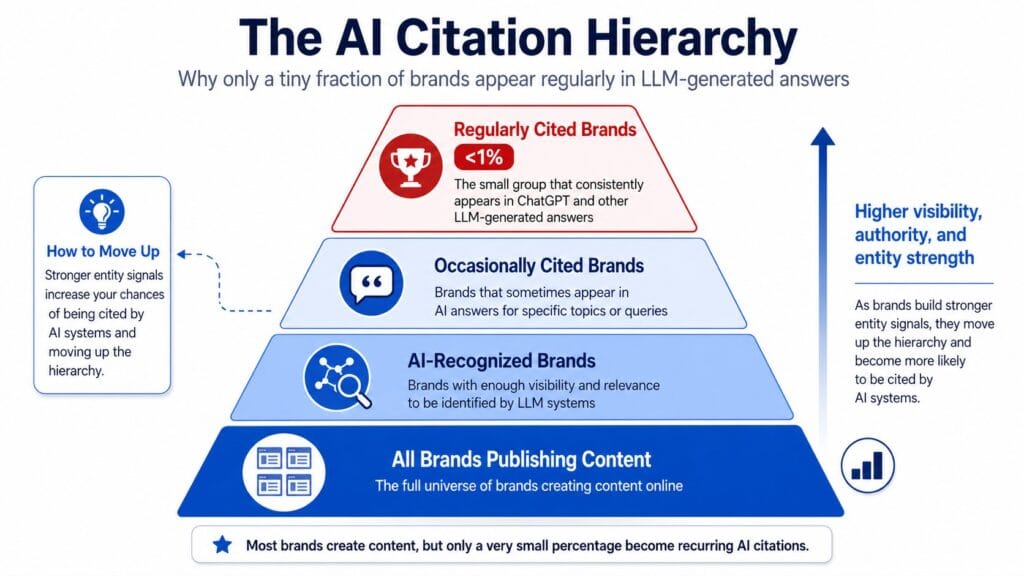
The brands at the top of the citation pyramid from Infographic #2 — the less than 1% that appear regularly in AI answers — almost universally have this signal pattern. They publish data. Other people cite it. The citation network compounds.
GEO vs. SEO: What Actually Changes When You’re Optimizing for an LLM
SEO optimizes for ranking position in a list of results. GEO optimizes for selection as a source within an AI-generated answer. The inputs, the success metrics, and the content requirements are fundamentally different.
Some SEO practices transfer cleanly to GEO. Others actively hurt your LLM citation probability.
| Dimension | Traditional SEO | Generative Engine Optimization (GEO) |
|---|---|---|
| Primary goal | Rank in a list of blue links | Be selected as a cited source in an AI answer |
| Success metric | Keyword ranking position, organic traffic | Brand mention rate in AI responses, citation frequency |
| Content structure | Keyword-optimized prose, long-form coverage | Answer-first blocks, direct definitions, structured lists |
| Authority signals | Backlinks from high-DA domains | Co-citations, entity recognition in knowledge graphs |
| Schema priority | Title tags, meta descriptions, basic structured data | FAQPage, HowTo, Organization, DefinedTerm markup |
| Keyword approach | Exact match and semantic variants | Entity and topic cluster saturation |
| What hurts | Thin content, slow pages, duplicate content | Buried answers, missing entity layer, publishing gaps |
| Best for | Capturing search intent with a ranked document | Building brand visibility inside AI-generated responses |
The critical shift is this: SEO asks “how do I rank for this query?” GEO asks “how do I become the entity an LLM references when answering this question?” They’re not the same question. A brand can answer the first question brilliantly and still fail the second entirely.
How Long Does AI Citation Recovery Take?
Recovery timelines split completely by tool type — real-time AI tools can reflect content improvements within days, while closed training-cycle models like base ChatGPT may take months to a year.
This distinction matters when you’re setting expectations with leadership.
For real-time retrieval-augmented generation (RAG) tools — Perplexity, Bing Copilot, Google AI Overviews — the pipeline pulls from live indexed content. Improvements in content structure, schema markup, and entity signals can surface in AI responses within days to a few weeks, roughly aligned with Google’s crawl and index cycle.
For closed training-cycle models — ChatGPT’s base model, Claude’s base model, Gemini’s base model — recovery depends on the next retraining cycle. These models aren’t browsing the web when they answer. They’re drawing on compressed representations from training data that was frozen at a specific date. Getting into the next version requires building the signals (entity verification, co-citation network, structured content) that will be captured when the next training window opens. Realistically, plan for 3–12 months depending on the model’s retraining frequency and how competitive your topic cluster is.
Start with RAG tools. Build entity and content signals that show up immediately. Then continue building the co-citation network that will carry you into the next closed-model training cycle.
How to Measure and Monitor AI Citation Visibility Over Time
AI citation visibility is not a metric any traditional SEO tool tracks — which means you need a manual monitoring process until purpose-built LLMO measurement tools mature.
The good news: a basic monthly audit takes under an hour and gives you the directional signal you need.
Run the same five prompt categories from the audit section above — once a month, in ChatGPT, Perplexity, and Gemini. Log each response in a simple spreadsheet: date, tool, prompt category, brand mentioned (yes/no), position in response (first mention, later mention, not mentioned), competitors mentioned instead. After three months, you’ll have a baseline. After six, you’ll see whether your GEO and entity work is moving the numbers.
Tools to add to your monitoring stack: Profound.ai and similar emerging LLMO monitoring platforms track brand mentions across AI tools at scale and surface citation frequency trends. [Internal link: tools for tracking AI citations] For teams that need to report AI visibility to leadership before dedicated tools are widely accessible, the manual prompt audit — run consistently — is still the most reliable method.
The metric that matters most is citation rate by category: of all the prompts in a given category, what percentage return your brand? Track that number monthly. A rising citation rate in RAG tools while base-model citation stays flat is a healthy leading indicator — it means your content signals are working and will carry into the next training cycle.
Frequently Asked Questions
What is AI citation decay and why does it happen?
AI citation decay is the gradual loss of a brand’s visibility inside LLM-generated answers, caused by weakening entity signals, training data underrepresentation, and insufficient co-citation from authoritative third-party sources.
It’s not a single failure — it’s a compounding one. A brand that stops publishing original research loses co-citation momentum. A brand that never built a Wikidata entry never had a solid entity signal to begin with. These gaps interact. When a competitor builds strong entity presence while your signals plateau, the LLM’s entity ranking stage drops you relative to them — even if your content quality hasn’t declined at all. The decay is relative, not absolute.
Why did my brand stop appearing in ChatGPT answers?
Your brand stopped appearing because it fell below the entity ranking threshold LLMs use during answer construction — most often due to thin Knowledge Graph presence, content not structured for answer extraction, or weak co-citation signals from authoritative third parties.
The diagnostic question is: which of the five failure modes applies? If you appear in Perplexity but not ChatGPT, your content is live and indexed but your training data representation is thin — entity layer work is the priority. If you appear in neither, the problem is structural: entity presence, content structure, and third-party signal network all need attention simultaneously. The AI Citation Readiness Score Calculator in this article runs through each signal in under five minutes.
How do I get my brand cited by ChatGPT and other AI tools?
Build a recognized brand entity in knowledge graphs, structure your content for answer-first retrieval, and create original research that generates consistent co-citations from authoritative third-party sources.
The three-layer GEO framework in this article sequences these in priority order. Entity layer first — without Knowledge Graph recognition, nothing else compounds. Content layer second — implement FAQ and HowTo schema, open every key section with a direct answer, follow the definition-list-data template from the Princeton GEO research. Signal layer third — publish original data that forces other sites to cite your brand by name. Each layer builds on the one before it. Skipping the entity layer and jumping to content optimization is the most common mistake.
What is the difference between SEO and generative engine optimization?
SEO optimizes content to rank in a list of search results. GEO optimizes content to be selected and cited within an AI-generated answer — a different goal, measured differently, requiring different signals.
The GEO vs. SEO comparison table in this article breaks down eight dimensions where the two approaches diverge. The practical implication: some SEO tactics transfer cleanly (long-form content, topical authority, structured data). Others actively reduce LLM citation probability — keyword-stuffed prose buries the direct answers LLMs want to extract, and exact-match anchor text has no analog in entity-based ranking. [Internal link: GEO vs SEO — what changes] Running both strategies in parallel, with entity optimization as the shared foundation, is the most defensible position.
How long does it take to recover AI citation visibility once you’ve lost it?
Recovery takes days to weeks in real-time RAG tools like Perplexity, and 3–12 months in closed training-cycle models like base ChatGPT — the timeline depends entirely on which type of AI tool you’re optimizing for.
This split is the most important framing point for leadership conversations. Real-time tools pull from live indexed content, so structural improvements to your content and schema show up quickly. Closed models require waiting for the next retraining cycle — which means the work you do today builds into visibility six months from now. The right strategy runs both tracks simultaneously: optimize for RAG tools to show visible progress quickly, while building the entity and co-citation signals that will carry into the next closed-model training window.
Which types of content are most likely to be cited by AI answer engines?
Original data studies, long-form definitive guides with direct answer blocks, FAQ-structured pages with schema markup, and content from brands with verified Knowledge Graph entities are cited most frequently in AI-generated answers.
The Princeton GEO study found that adding statistics, quotations from authorities, and fluency improvements significantly increased LLM citation rates. Content type matters less than content structure — a well-structured 1,500-word guide with a direct definition, three supporting claims, and a cited data point will outperform a 5,000-word guide that buries its key insight in paragraph seven. [Internal link: how to write content ChatGPT will quote] Original research is the single highest-leverage investment because it generates the co-citations that build your entity authority network at scale.
Your Brand’s AI Visibility Window Is Open Right Now
The brands getting cited in AI answers today didn’t get lucky. They built entity signals when most brands weren’t paying attention, published original research that forced authoritative sites to mention them, and structured their content for answer extraction before answer engines became the default interface for billions of searches.
That window is still open — but it closes faster than most teams realize. The next training cycle for the models your customers are using is being populated right now, from the content and signals being built right now.
Your single next action: run the five prompt categories from the audit section in ChatGPT, Perplexity, and Gemini this week. Log what you find. That audit tells you exactly which layer — entity, content, or signals — needs attention first, and it gives you a baseline to measure against as you build.
Brands that run this audit and start entity layer work in the next 30 days will be positioned for the next training cycle. Brands that wait for AI citation metrics to show up in their existing SEO dashboards will still be waiting when that window closes.
Watch the youtube video here 👇