
Something changed in March 2025, and most content teams felt it without knowing why. ChatGPT’s average number of cited domains per response dropped from 19 to 15 – a 20% contraction confirmed by Meteoria’s 14-week tracking study of 400 daily prompts. Same pie. Fewer slices. If your AI referral traffic plateaued around that time, this is almost certainly the reason.
The problem runs deeper than a model update. Most SEO teams are optimizing for a version of ChatGPT Search that doesn’t reflect how the system actually works. They’re blocking the wrong crawler, ignoring the query layer that precedes every retrieval call, and publishing content that ChatGPT-User bot literally cannot read.
This article maps the full retrieval pipeline – web.run’s architecture, fan-out query mechanics, crawler behavior, and the specific content signals that determine citation eligibility. By the end, you’ll know exactly where your content is failing the system and what to fix first.
What ChatGPT Search Is Actually Doing When You Ask It a Question
ChatGPT Search is not a search engine with an AI layer on top. It is an AI model with a retrieval layer underneath and that distinction changes everything about how you should think about visibility.
When a user submits a prompt, ChatGPT doesn’t immediately search the web. It first evaluates whether a web search is necessary at all. The decision logic comes directly from ChatGPT’s extracted system prompt (published by LLMrefs, June 2025): the model searches when the query requires recent data, when an error from stale information would be costly, when the topic requires niche knowledge not in its training data, or when local context is needed. If none of those conditions apply, ChatGPT skips retrieval entirely and answers from its training data. Your content never enters the picture.
The Decision Gate — When ChatGPT Searches and When It Doesn’t
ChatGPT searches when it needs to. The trigger conditions are specific, not vague.
The system prompt instructs the model to use web search for queries where recency matters, where the accuracy cost of being wrong is high, where the topic is narrow enough that training data is unreliable, or where the user’s location is relevant. Informational queries about stable, well-documented topics often don’t trigger a search at all.
Here’s the scope reality that most AI SEO content skips: over 90% of ChatGPT’s 900 million weekly active users are on the free plan. The free plan default triggers fewer web searches, runs fewer fan-out queries per prompt, and produces fewer citations per response. The audience you’re trying to reach is mostly getting answers from ChatGPT’s training data, not from your website. That changes how you should think about the relative value of AI citation optimization versus traditional search presence.
Two Crawlers, Two Jobs — OAI-SearchBot vs ChatGPT-User Bot
OAI-SearchBot is OpenAI’s indexing crawler – it builds the search index ChatGPT draws on when constructing retrieval queries. ChatGPT-User bot is the retrieval crawler – it fetches actual page content during a live conversation, after the fan-out queries have already run.
Most SEO teams know about OAI-SearchBot and treat it as the primary bot to accommodate. That’s wrong. OAI-SearchBot builds the index. ChatGPT-User bot reads your content. If you’re not serving pre-rendered HTML, ChatGPT-User bot – not OAI-SearchBot – is the one returning blank or garbled content to the model.
| Dimension | OAI-SearchBot | ChatGPT-User Bot |
|---|---|---|
| Primary job | Builds ChatGPT’s search index | Fetches page content during live conversations |
| When it fires | Crawls on a scheduled basis | Fires in real time after fan-out queries run |
| JavaScript rendering | Not confirmed | Does not render JavaScript |
| Crawl volume trend | Stable | Declining since GPT-5.3 switch (Oncrawl / Jérôme Salomon analysis) |
| Best for optimizing | Indexability and crawl access | Content structure and pre-rendered HTML delivery |
A Search Engine Land honeypot experiment confirmed this directly: when ChatGPT browsed the web following a search query, ChatGPT-User bot – not OAI-SearchBot – made the actual page request. If your pages rely on client-side rendering, ChatGPT-User bot cannot read your content, regardless of how well-indexed you are.
For a full technical breakdown of crawl behavior, request frequency, and how to verify which bot accessed your pages, see [OAI-SearchBot vs ChatGPT-User Bot: Which Crawler Actually Fetches Your Content].
Inside web.run — ChatGPT’s Internal Search Engine
web.run is ChatGPT’s internal search execution tool – the system that translates a user prompt into structured commands sent to the web retrieval backend. It is not the same as the Bing search API. It is the command interface that sits between ChatGPT’s reasoning layer and whatever external search infrastructure it queries.
web.run underwent a significant architectural change in GPT-5.3. Before the switch, it sent compact pipe-delimited text commands – the format looked like fast|query|recency. After GPT-5.3, it sends structured JSON objects with typed parameters. That shift isn’t cosmetic. It reflects a fundamentally different approach to how the model formulates and distributes retrieval operations.
The tool currently supports 12 distinct operations, up from 4 before GPT-5.3. The expanded set includes specialized retrieval modes and a separate widget system called genui that handles structured data queries for sports, finance, weather, and similar domains. The model doesn’t just search – it routes different query types to different retrieval pipelines.
Here’s what the format change looks like at the command level:
Pre-GPT-5.3 (pipe-delimited):
fast|best SEO tools 2025|recencyPost-GPT-5.3 (JSON):
json
{
  "query": "best SEO tools 2026",
  "recency": "month",
  "search_mode": "fast"
}
That structural shift has downstream effects for what content gets retrieved, how results are ranked within the retrieval layer, and which operations the model can chain together.
If you want to go deeper on the specific JSON parameter schema web.run uses and how to audit it, [how ChatGPT’s internal search tool formats and fires queries] covers the full reverse-engineering findings.
What Changed in GPT-5.3 and Why It Matters for Your Content
The GPT-5.3 switch in March 2025 reduced unique cited domains per response from 19 to 15 – a decline of more than 20%, confirmed by Meteoria’s 14-week tracking study.
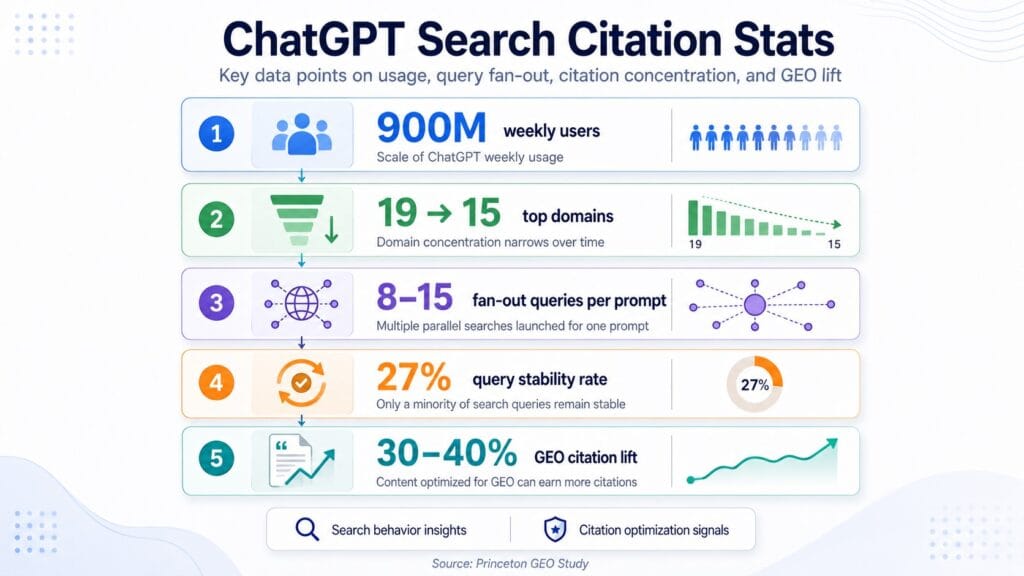
The URL-to-domain ratio held steady at 1.26 – meaning the number of links per cited domain didn’t change. What changed is how many distinct websites share those citations. The model got more selective about which sites get a seat at the table, not more selective about how many links it pulls from each one. Fewer winners. Same prize per winner.
The cause is a combination of factors: the GPT-5.3 model’s different RLHF reward shaping relative to GPT-4o/5.2, a structural shift toward higher-authority sources, and a reduction in ChatGPT-User bot crawl volume confirmed by Oncrawl log analysis. Some pages that were being crawled before GPT-5.3 simply aren’t being crawled anymore.
GPT-5.4 Thinking vs GPT-5.3 Instant — How Model Choice Changes Who Gets Cited
GPT-5.4 Thinking behaves differently from GPT-5.3 Instant in ways that directly affect citation outcomes.
GPT-5.4 Thinking uses site: operators to restrict searches to trusted domains before broadening the retrieval pool. It fires more than 10 fan-out queries per response — compared to GPT-5.3 Instant’s typical 2 or 3. It also receives more inference-time compute, which gives it more capacity to chain retrieval rounds and refine queries based on earlier results. That last point matters for content strategy: authority domain classification — whether the model has learned to treat your site as a trusted source — carries more weight at GPT-5.4 than it does at GPT-5.3, where the retrieval net is cast wider.
A single prompt can produce radically different citations depending on whether the user is on GPT-5.3 Instant, GPT-5.4 Thinking, or GPT-5.4 Extended. The divergence comes from RLHF reward shaping, supervised fine-tuning data, system prompt configuration, and compute budget — all of which differ across model variants despite the shared August 2025 knowledge cutoff. Optimize for the version your most valuable users are likely running, and test model by model.
Fan-Out Queries — The Hidden Layer Between Your Reader and Your Content
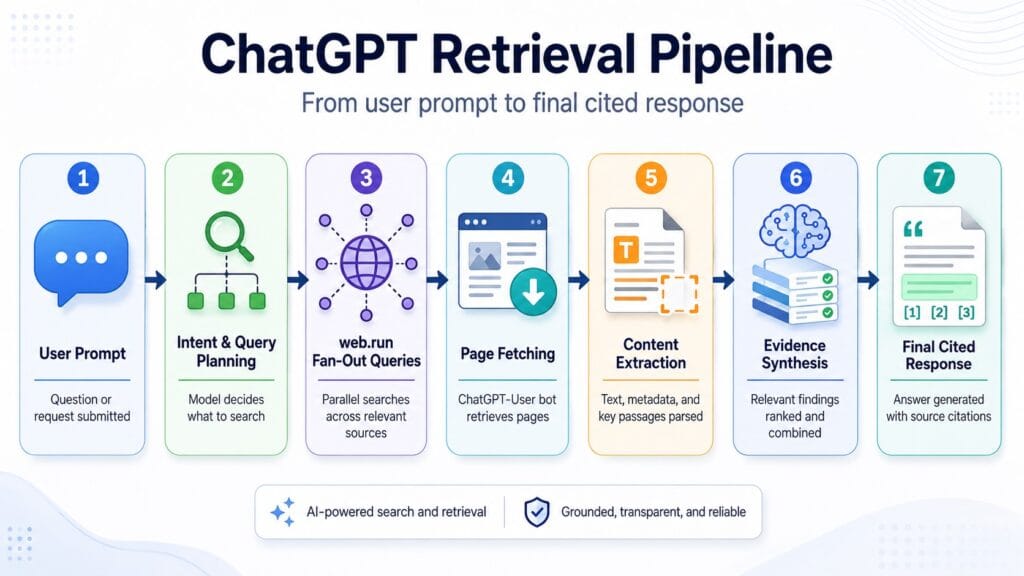
Fan-out queries are the multiple sub-queries ChatGPT generates from a single user prompt before searching the web. Instead of sending your prompt verbatim to a search engine, ChatGPT decomposes it into 8 to 15 focused sub-queries, each targeting a different intent angle, then retrieves results for each one and synthesizes them into a single response.
Here’s the process in sequence:
- User submits a prompt to ChatGPT.
- ChatGPT decomposes the prompt into 8–15 distinct sub-queries.
- web.run fires each sub-query as a structured JSON command to the search backend.
- Results are retrieved independently for each sub-query.
- ChatGPT-User bot fetches full page content from selected URLs.
- The model merges and weights the retrieved content.
- A final response is generated with inline citations and source links.
The sub-queries are not random. Aiso’s panel analysis of 5 million-plus ChatGPT conversations (February 2026) found that fan-out queries follow predictable intent decomposition patterns: a prompt about “best CRM for startups” will typically generate separate sub-queries for review aggregator content, individual brand comparisons, pricing information, feature lists, and free tier availability. The model anticipates what a thorough researcher would look up and does all of it in one pass.
[VISUAL: Interactive Element — Fan-Out Query Coverage Checker tool that scores existing content against the fan-out angles ChatGPT typically generates for a given topic — Alt text: “Interactive fan-out query coverage checker tool for SEO teams to audit content against ChatGPT’s sub-query decomposition patterns”]
How to See ChatGPT’s Fan-Out Queries for Yourself
ChatGPT’s fan-out queries are stored in the search_model_queries field of its internal network response — and you can access them without any paid tool.
Here’s the method:
- Open ChatGPT in Chrome and submit a prompt that you know will trigger a web search.
- Right-click anywhere on the page and select Inspect.
- Click the Network tab in DevTools.
- Copy the conversation ID from the URL bar (the alphanumeric string after
/c/). - Paste the conversation ID into the Network tab’s filter bar.
- Look for a JSON response file in the filtered results and click on it.
- Go to the Response tab and search for
search_model_queries— the actual sub-queries are listed there in plain text.
This method works. The limitation is significant: it shows the fan-out queries for your conversations only. You get zero visibility into the queries real customers are running when they ask about your industry or product category. That’s the gap paid tools address.
For a no-DevTools approach using browser extensions and bookmarklets, [how to extract ChatGPT’s hidden fan-out queries without developer tools] walks through every current option with honest trade-offs.
browse_rewritten_queries — The Fan-Out Type That’s Reshaping Product Search
A previously undocumented fan-out type, browse_rewritten_queries, has been confirmed in product queries on GPT-5.4 Instant.
Before GPT-5.3, product searches ran as a single bundled retrieval call. Now, the model first runs a rewrite fan-out to build the full list of candidate products, then fires a separate shopping fan-out for each individual product — fetching specs, reviews, and pricing independently, one by one. For a query like “best 3D printer to buy in 2026,” that’s potentially 8 to 12 separate retrieval calls for products that didn’t exist as distinct objects in the original single-call model.
The implication for e-commerce teams is direct: product pages need to independently answer all three query types (what it is, how it compares, what it costs) without relying on a category page to consolidate the case for each product. If your product page only handles one of those angles, ChatGPT’s shopping fan-out may retrieve a competitor’s page for the other two.
Why Only 27% of Fan-Out Queries Stay the Same Across Searches
Only 27% of fan-out sub-queries remain stable across repeated searches of the same prompt — a finding from Surfer SEO and Semrush research analyzing queries across ChatGPT, Google AI Mode, and Perplexity.
That number is the strategic argument against chasing specific sub-queries. You can extract the fan-outs for a given prompt today, optimize your content for those exact sub-queries, and find that tomorrow’s retrieval run generates a different decomposition. The target changes shape every time you aim at it.
The durable response is topical authority — owning a subject with enough breadth and depth that regardless of how the fan-out decomposes, your content is in the retrieval pool for multiple angles. That’s not vague advice; it’s the structural reason why Cluster 2 of the topical model is built around fan-out queries specifically rather than around individual keyword pages.
The English-Language Bias You Probably Haven’t Accounted For
ChatGPT runs fan-out queries in English more than any other language — including when the user’s original prompt is written in something else entirely.
Tomek Rudzki at Peec AI and ZipTie.dev analyzed more than 20 million fan-out queries across more than 10 million user prompts. The findings are stark. Across all non-English prompts in the dataset, 43% of the background searches ran in English. In nearly 78% of non-English prompt runs, at least one fan-out query was conducted in English.
The practical consequence shows up clearly in the Allegro/eBay example from the research. Polish users asking ChatGPT about local auction portals received eBay recommendations — not Allegro, Poland’s dominant platform — because ChatGPT’s English-language fan-outs surface global platforms that rank in English-language search results. The local brand was invisible to the retrieval layer because it hadn’t established English-language content authority.
If your brand operates in a non-English market, the question is whether you have any English-language presence that ChatGPT’s fan-out queries can find. Not translated content for English speakers — English-language content that establishes your brand as relevant to the queries ChatGPT is actually running. This is a genuine blindspot in most international SEO strategies, and it has real citation consequences.
What Actually Determines Whether ChatGPT Cites Your Content
Getting cited by ChatGPT requires meeting three conditions simultaneously: your content must be technically accessible to ChatGPT-User bot, it must be authoritative enough to reach the retrieval pool, and it must answer the specific sub-query angles the fan-out generates. Miss any one of them and the other two don’t matter.
The Princeton, Georgia Tech, and Allen Institute GEO study established the citation lift benchmark: content with original quotes, statistics, and credible citations is cited 30–40% more often than baseline content covering the same topic. That’s the content quality lever. The technical accessibility lever and the domain authority lever are separate, and all three interact.
The Technical Floor — What ChatGPT-User Bot Can and Can’t Access
Before content quality matters, your pages have to be readable.
ChatGPT-User bot does not render JavaScript. If your pages deliver their primary content through client-side rendering — React, Vue, Angular, or any framework that builds the DOM in the browser — ChatGPT-User bot sees an empty shell. It returns that empty shell to the model. The model either skips your page or extracts garbled content from whatever pre-rendered HTML was present in the initial server response. Neither outcome is visible to your analytics.
The second constraint is extraction depth. ChatGPT-User bot pulls approximately 200 characters per page in snippet mode. That makes the first meaningful paragraph after each heading disproportionately important. What appears in the first two sentences after an H2 is what the model is most likely to see and most likely to surface. Content buried in paragraph four of a section may never reach the retrieval layer at all.
Content Signals That Raise Citation Probability
The four-factor citation eligibility model:
- Original data or unique insights — This is the highest-impact lever. The Princeton/Georgia Tech GEO study found a 30–40% citation lift for content that includes original statistics, data, or quotes not available elsewhere. [Why unique data gets cited 30–40% more often in AI search] walks through how to apply information gain principles to your editorial process.
- Clear semantic structure with discrete answers — Every H2 and H3 should answer a single, specific question. Passage indexing — and AI citation — both depend on the model’s ability to extract a self-contained answer from a bounded section of text. Sections that meander across multiple ideas without a clear open-and-close answer structure get skipped.
- Schema markup for answerability — FAQ schema, HowTo schema, and Definition schema all signal to retrieval systems that specific sections of your page are intended as direct answers. ChatGPT’s retrieval layer isn’t explicitly driven by schema, but the formatting discipline that schema requires — a clear question, a direct answer, a bounded explanation — is exactly the format the model extracts most reliably.
- External citations to authoritative sources — AI models are risk-averse about citing content that makes claims without backing. Citing primary sources (research papers, official documentation, published data) tells the model that the claim has already been validated somewhere it trusts. That reduces the perceived risk of surfacing your content as an answer.
How to Track Whether Any of This Is Working
Most teams are underreporting their AI search visibility — by a lot. ChatGPT visits that arrive without a citation link (brand mentions in responses, referenced but not hyperlinked) show up as direct traffic in GA4, not as AI referral traffic. The referral data you’re looking at is only capturing a fraction of your actual ChatGPT-sourced visits.
That means two separate measurement problems: knowing what queries ChatGPT is running for your topic, and knowing how much of your traffic is actually coming from AI sources.
The Free Method — DevTools + search_model_queries
The DevTools method described in H3 3.1 gives you the search_model_queries field for any conversation you run yourself. It’s fast, free, and requires nothing beyond Chrome.
The ceiling is the problem. It shows you the fan-out queries for your sessions — not for your customers’ sessions. When your audience asks ChatGPT about your category, you have no visibility into the sub-queries it generates. That gap matters most when you’re trying to understand competitor visibility, market-level query patterns, or how ChatGPT is framing your product category to buyers who’ve never heard of you.
Use the free method for prompt-specific content audits. Pair it with another signal — GA4 referral data, direct traffic trend analysis, or prompt testing across multiple sessions — to get a wider picture.
When to Use a Paid AI Visibility Tool — and Which Ones Are Worth It
The tool decision should follow the use case, not the feature list.
Aiso is the right choice for teams that need panel-based data on real customer prompts — conversations from actual users, not just your own test sessions. Their panel of 5M+ ChatGPT conversations gives you visibility into the fan-out queries your customers are actually generating, which is a fundamentally different dataset than anything you can extract yourself.
Profound is the enterprise option. If you’re running millions of prompt analyses, need deep fan-out analysis at scale, and have the budget for it, Profound gives you the most complete picture of how answer engines interpret your category. It’s significantly more expensive than the alternatives.
Peec AI has the strongest published research credentials — their 20M+ query analysis is the primary dataset behind most of what’s now known about fan-out query behavior, including the English-language bias finding. The platform is worth considering if cross-model analysis and research-grade data matter to your team.
Surfer AI Tracker makes the most sense for content teams already operating inside the Surfer ecosystem. The Sources tab shows which pages AI models cite most often for tracked queries, which is practical for identifying what content already has traction.
Backlinko’s ChatGPT Query Fan-Out Tool (a Chrome extension) is free and useful for spot-checking. It’s browser-session-limited and can’t scale to systematic analysis, but for a quick read on how ChatGPT decomposes a specific prompt, it does the job.
For a head-to-head feature and pricing comparison, [ChatGPT fan-out query tools compared] covers each platform in full.
Frequently Asked Questions
What are fan-out queries in ChatGPT Search?
Fan-out queries are the multiple sub-queries ChatGPT generates from a single user prompt before searching the web. Instead of sending your words verbatim to a search engine, the model decomposes your prompt into 8 to 15 focused sub-queries, retrieves results for each one, then synthesizes everything into a single response.
The sub-queries aren’t random. Research from Aiso’s panel of 5M+ ChatGPT conversations shows they follow predictable intent decomposition patterns — a single “best CRM for startups” query typically generates separate sub-queries for reviews, brand comparisons, pricing, features, and free tiers. Understanding those patterns is the foundation of any serious AI visibility strategy. Because only 27% of fan-out sub-queries stay stable across repeated searches (Surfer/Semrush research), chasing specific sub-query terms is less durable than building topical authority across the full subject domain.
What is web.run and how does ChatGPT use it?
web.run is ChatGPT’s internal search execution tool — the system that translates user prompts into structured commands sent to the web retrieval backend. It supports 12 distinct operations and uses JSON-formatted parameters since the GPT-5.3 update.
Before GPT-5.3, web.run sent pipe-delimited text commands like fast|query|recency. After the March 2025 switch to GPT-5.3, it moved to structured JSON objects, reflecting a different approach to query formulation and retrieval routing. The expanded 12-operation set includes a separate widget system called genui for structured data queries (sports, finance, weather). GPT-5.4 can chain 5 to more than 10 retrieval rounds per response using web.run, refining queries based on earlier results — compared to GPT-5.3 Instant’s typical 2 to 3 rounds.
How do I get my content cited by ChatGPT Search?
To increase your citation probability: (1) Include original data — the Princeton/Georgia Tech GEO study found a 30–40% citation lift for content with original statistics. (2) Structure content so each H2/H3 answers one discrete question. (3) Serve pre-rendered HTML — ChatGPT-User bot does not render JavaScript. (4) Apply FAQ or HowTo schema to signal answerability.
None of these four factors operates independently. Technical accessibility is the floor — if ChatGPT-User bot can’t read your page, content quality is irrelevant. Domain authority determines whether your content enters the retrieval pool at all, especially for users on GPT-5.4 Thinking, which uses site: operators to restrict early retrieval to trusted sources. Content quality and structure determine whether, once retrieved, your content gets surfaced in the final response.
Which crawler does ChatGPT use to fetch web pages?
ChatGPT uses two crawlers for different purposes: OAI-SearchBot builds ChatGPT’s search index, while ChatGPT-User bot fetches actual page content during live conversations. ChatGPT-User bot does not render JavaScript.
This distinction is the most commonly misunderstood technical fact in ChatGPT SEO. A Search Engine Land honeypot experiment confirmed it directly: after a user triggered a web search in ChatGPT, ChatGPT-User bot — not OAI-SearchBot — made the actual page request. OAI-SearchBot crawls on a scheduled basis to maintain the index; ChatGPT-User bot fires in real time, after fan-out queries have already run, to retrieve the specific content the model needs for its response. If your pages require JavaScript to render their main content, ChatGPT-User bot returns nothing useful.
Why does ChatGPT cite fewer websites than it used to?
Since ChatGPT’s default model switched to GPT-5.3 Instant in March 2025, the average number of unique domains cited per response dropped from 19 to 15 — a decline of more than 20%, tracked by Meteoria across 400 daily prompts over 14 weeks.
The URL-to-domain ratio held steady at 1.26, meaning the model is pulling roughly the same number of links per cited domain. What changed is how many distinct websites share those citations. GPT-5.3 implemented a structural shift toward higher-authority sources, and ChatGPT-User bot crawl volume has declined since the switch — confirmed by Oncrawl log analysis from Jérôme Salomon. GPT-5.4 Thinking amplifies the concentration further: it uses site: operators to restrict early retrieval to trusted domains, narrowing the field before the broader search even begins.
Does ChatGPT search in English even when I ask in another language?
Yes. Research by Peec AI and Tomek Rudzki analyzing 20M+ fan-out queries found that 43% of background searches for non-English prompts run in English — and in 78% of non-English prompt runs, at least one fan-out query was conducted in English.
The Allegro/eBay case from the research makes the consequence concrete: Polish users asking ChatGPT about local auction platforms received eBay recommendations because ChatGPT’s English-language fan-outs surfaced global platforms with strong English-language authority. Allegro, Poland’s dominant platform, was invisible to the retrieval layer. For brands operating in non-English markets, the question isn’t whether to have English content — it’s whether your English-language content presence is strong enough for ChatGPT’s fan-outs to find you when the answer matters.
The Real Goal Isn’t Ranking for Fan-Out Queries
Every tactic in this article points toward the same underlying shift in thinking.
The goal is not to rank for the specific sub-queries ChatGPT generates today. Those sub-queries will be different tomorrow. Twenty-seven percent of them stay stable across repeated runs — the rest are in motion. Trying to reverse-engineer and optimize for a query set that changes shape every time the model processes a prompt is a maintenance burden with a ceiling.
The goal is to be the kind of source a model trusts enough to retrieve regardless of how it phrases the question. That means technical accessibility (pre-rendered HTML, clean crawl paths for ChatGPT-User bot), content quality that generates information gain (original data, primary research, specific findings that don’t exist anywhere else), and topical breadth that covers enough angles of a subject that the fan-out almost always hits something you own.
Run the fan-out coverage audit on your three highest-priority topics — the Fan-Out Query Coverage Checker above takes under five minutes per topic. For each gap the audit surfaces, you now know exactly what’s missing and why it matters.
[VISUAL: Interactive Element — Fan-Out Query Coverage Checker that scores existing content against ChatGPT’s typical fan-out decomposition patterns and outputs specific gap recommendations — Alt text: “Interactive fan-out query coverage checker tool allowing content teams to input a topic and receive a scored audit of which sub-query angles their content covers and which it misses”]
Fix the technical floor first. Then build the content. If ChatGPT-User bot can’t read what you’ve written, nothing else matters.
The Real Picture
Most people overcomplicate ChatGPT Search visibility. Strip away the noise and one truth remains: ChatGPT doesn’t find your content — it decides whether to retrieve it, and that decision happens before your page is ever read.
Two numbers that reframe everything:
27% — Only 27% of fan-out sub-queries stay stable across repeated searches of the same prompt, which means optimizing for specific AI sub-queries is a strategy built on sand.
19 → 15 — The average number of unique domains cited per ChatGPT response dropped by more than 20% after the GPT-5.3 switch in March 2025, which means the window for new entrants is closing faster than most teams have noticed.
(Source: Surfer SEO / Semrush, 2025 / Meteoria × Search Engine Land, 14-week tracking study, 2025)
The Insight That Changes How You Think About This
“ChatGPT-User bot does not render JavaScript — so if your pages rely on client-side rendering, ChatGPT cannot read your content at all, regardless of how well-indexed you are.” — Search Engine Land, honeypot experiment findings, 2025
What this actually means in practice: Your indexability and your readability are two different problems, and most SEO teams are only solving one of them. OAI-SearchBot may have crawled your site perfectly. That tells you nothing about what ChatGPT-User bot — the crawler that actually fetches content during a live conversation — can extract. If your pages need JavaScript to render their main content, ChatGPT is working with a blank page. No amount of schema markup or topical authority fixes that.
What You Actually Need to Know (At a Glance)
| Factor | Why It Matters | What to Do With It |
|---|---|---|
| ChatGPT-User bot doesn’t render JavaScript | If your content is client-side rendered, ChatGPT retrieves an empty shell — content quality is irrelevant if the bot can’t read the page | Audit your highest-priority pages for server-side or pre-rendered HTML delivery; fix this before any content optimization |
| Fan-out queries decompose your topic into 8–15 sub-queries | ChatGPT isn’t searching for your page — it’s searching for answers to multiple specific angles of your topic simultaneously | Map your content against the intent decomposition pattern for your target topic: reviews, comparisons, pricing, how-to, and recency angles all need coverage |
| 43% of non-English prompts generate English fan-out queries | If your brand operates in a non-English market and lacks English-language content authority, ChatGPT’s retrieval layer may surface global competitors instead of you | Build English-language content that establishes topical authority for your category — not for English speakers, but for the queries ChatGPT actually runs |
Three Things You Can Apply Before Tomorrow
1. Fix the technical floor before touching your content strategy. The single constraint that makes everything else irrelevant is JavaScript rendering. ChatGPT-User bot cannot render client-side content. Check your three highest-traffic pages right now: disable JavaScript in your browser and reload each one. What you see is roughly what ChatGPT-User bot sees. If the page is empty or broken, that’s your first and only priority — because well-structured, citation-worthy content on an unreadable page earns zero citations.
2. Audit your content against the fan-out decomposition, not the primary keyword. For your top target topic, run it through ChatGPT and extract the fan-out sub-queries using the DevTools method (Network tab → filter by conversation ID → search for search_model_queries). Map those sub-queries against your existing content. The gaps you find are not keyword gaps — they’re intent angle gaps. A page that answers the primary query but misses the pricing, comparison, and recency sub-queries will get partially retrieved at best.
3. Pull your GA4 direct traffic trend from March 2025 forward. ChatGPT visits that arrive without a citation link — brand mentions in responses, referenced but not hyperlinked — register as direct traffic in GA4, not as AI referral. If your direct traffic increased after March 2025 while referral traffic from search stayed flat or declined, some portion of that direct traffic is AI-sourced and currently invisible in your attribution model. Knowing the true scale of your AI visibility gap is the prerequisite for making a case to invest in fixing it.
The Counterintuitive Truth Most People Miss
Here’s what the data actually shows: the brands most likely to appear in ChatGPT citations are not the ones that optimized for AI search — they’re the ones that built topical authority for traditional search and happened to meet the technical requirements for ChatGPT-User bot retrieval.
The default assumption is that AI search visibility requires a separate, new optimization strategy. Peec AI’s analysis of 20M+ fan-out queries found the opposite mechanism at work: ChatGPT’s retrieval layer draws heavily from the same authority signals that drive traditional search rankings, specifically domain trust, content depth, and the presence of original data. The GEO study from Princeton, Georgia Tech, and the Allen Institute confirmed that content with original statistics and credible citations gets cited 30–40% more often than baseline — which is precisely the content that traditional SEO has always rewarded.
This one shift — from “how do I optimize for AI search” to “how do I be the most authoritative source on this subject, technically accessible to any crawler” — is where most of the real results come from. The teams winning AI citations aren’t running a parallel AI SEO program. They fixed their rendering, deepened their content, and let the retrieval logic do the rest.
Watch the youtube video 👇

Hi, I am Khalid. I am an SEO and AI Search Specialist.
My goal is simple: I help your business get found by the right people.
For a long time, getting found just meant showing up on the first page of regular Google search. Today, the internet is changing. People are asking their questions to AI tools like ChatGPT and Google’s new AI features.
My job is to connect the old way of searching with the new way. When a potential customer asks an AI a question about what you do, I make sure your business is the trusted answer they get.
I do not use confusing words or secret tricks. I use clear and honest plans to get you noticed and bring real buyers straight to your website.
Want to see how I can make your brand the top answer? Connect with me on social media or read my exact steps at khalidseo.com.