Most of your traffic will soon arrive without a single human eye landing on your page. An AI agent will visit, extract what it needs, and report back to its owner – who may never click through at all. If your site isn’t built for that interaction, you’re already invisible to a growing share of search.
The downstream cost is real. Every AI-generated answer that names a competitor instead of you is a customer your funnel never sees. No bounce rate spike. No failed A/B test. Just silence, and a competitor’s brand in the answer.
Agentic SEO is the practice of optimizing for the AI doing the searching, not the human who asked. This article gives you the framework, the implementation steps, and the measurement approach to stop being invisible to autonomous agents.
By the end, you’ll know exactly where your site stands, what to fix first, and how to track results without a single pageview.
What Is Agentic SEO? (And Why It’s Not Just “AI SEO”)
Agentic SEO is the discipline of optimizing a website for autonomous AI agents that search, evaluate, and make decisions on behalf of human users — not for the humans themselves. Unlike traditional SEO, which targets a person navigating a browser, or AEO (Answer Engine Optimization), which targets AI systems surfacing answers to human readers, Agentic SEO targets the AI that is the decision-maker. That distinction changes your entire optimization strategy.
“AI SEO” has become a catch-all term for two very different problems. The first is getting your content to appear in ChatGPT or Perplexity answers when a human types a question. The second — and far less discussed — is getting your content selected by an AI agent that is autonomously completing a task. These agents don’t read your page. They parse it, score it, and either use it or discard it in under a second.
When a human searches, they browse. When an AI agent searches, it decides.
How Agentic Search Actually Works (The Agent Confidence Pipeline)
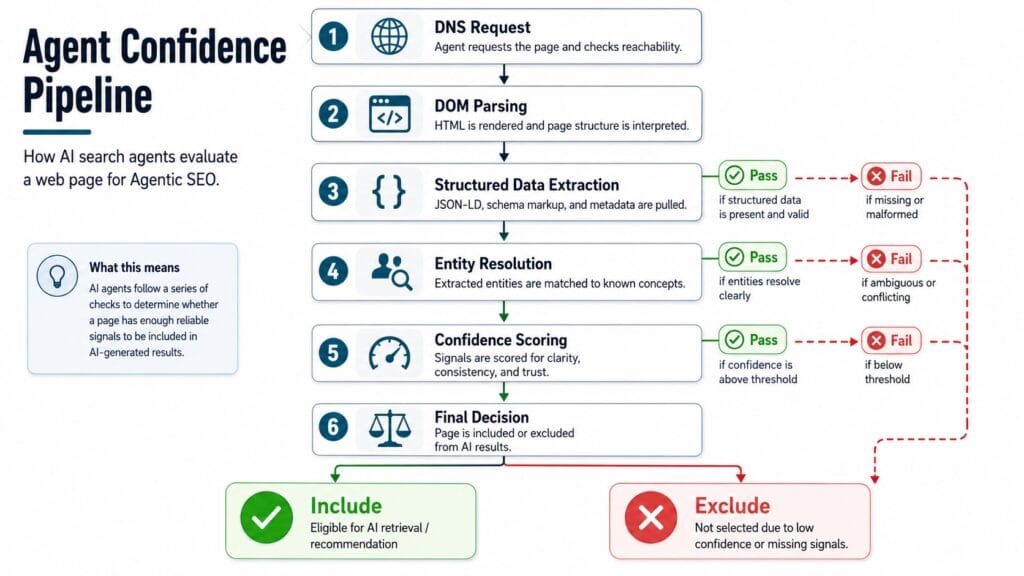
When an AI search agent evaluates a web page, it follows a sequence of discrete parsing steps — each of which can result in your content being included or excluded from its output. The process takes roughly 300 milliseconds and produces a confidence score that determines whether your data makes it into the agent’s response.
Here’s how that pipeline runs:
- DNS + HTTP Request — The agent hits your URL and immediately clocks server response time. Slow servers signal low-quality infrastructure. Some agents apply a threshold here and don’t proceed.
- DOM Parse — The agent strips your visual layer entirely. It reads raw HTML structure. Non-semantic markup — div soup, generic class names — reduces the signal quality at this stage.
- Structured Data Extraction — The agent scans for JSON-LD, microdata, and Open Graph tags. If valid, machine-readable structured data is present, it extracts it directly. If not, it attempts to infer meaning from context — with a much lower confidence score.
- Entity Resolution — The agent cross-references your brand name, product identifiers, and author names against its knowledge graph. Known entities get a trust boost. Ambiguous ones stay neutral or get penalized.
- Confidence Score Assignment — Every data point extracted from your page receives a 0–1 confidence score. Scores aggregate into a page-level rating.
- Include or Exclude Decision — Pages above the agent’s confidence threshold make it into the comparison or answer. Pages below get dropped. You don’t get a second chance.
Call this the Agent Confidence Pipeline. It’s what your structured data, semantic HTML, and entity markup are ultimately serving.
Agentic SEO vs. Traditional SEO vs. AEO — What’s Actually Different
These three disciplines share some tools but optimize for fundamentally different visitors. Getting them confused leads to wasted effort.
| Dimension | Traditional SEO | AEO | Agentic SEO |
|---|---|---|---|
| Who the visitor is | Human, navigating a browser | Human, reading an AI-generated answer | AI agent, acting on a human’s behalf |
| What they care about | Relevance, UX, page authority | Direct answers, authority signals | Structured data, entity clarity, confidence score |
| Primary success metric | Rankings, organic sessions, conversions | Featured snippet position, AI citation frequency | Agent confidence score, inclusion in AI-generated outputs |
| Key optimization lever | Content quality, backlinks, technical health | Direct-answer formatting, FAQ/HowTo schema | JSON-LD density, entity chaining, public content API |
| Analytics visibility | Full (GA4, Search Console) | Partial (manual spot-checks, GSC AI Overview data) | Near-zero (server logs, brand mention monitoring) |
Each column requires a different mindset. You can run all three in parallel — but conflating them means doing none of them well.
The Four-Tier Agentic SEO Readiness Scale
The Agentic SEO Readiness Scale is a four-tier model for evaluating how reliably an AI search agent can extract usable data from your website. Most sites cluster in the bottom two tiers — not because they’ve done anything wrong, but because the web was never designed for machine-to-machine data consumption. That’s changing now.
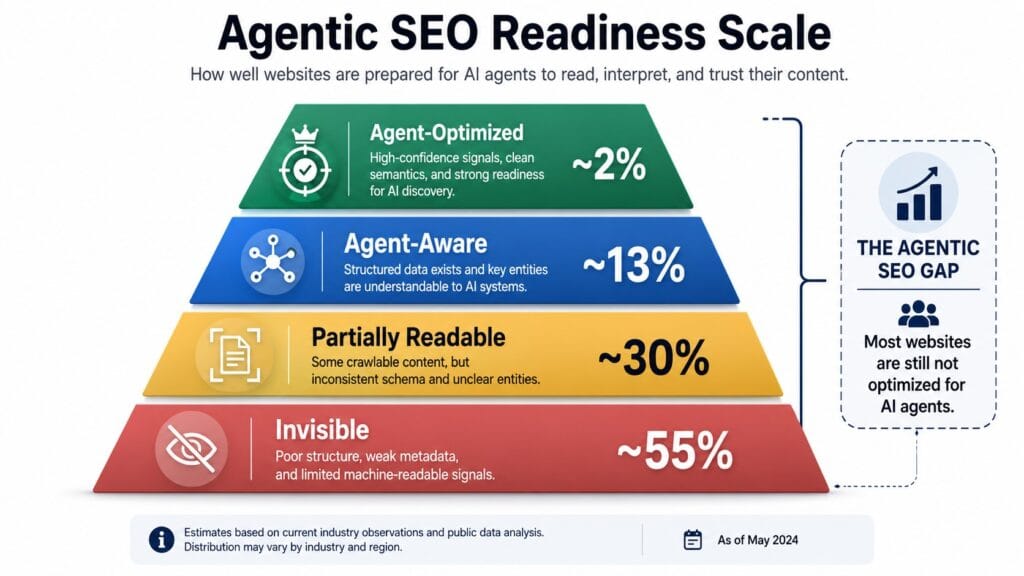
Tier estimates are extrapolated from W3C Web Almanac structured data adoption data and Semrush crawl coverage reports.
Tier 1 — Invisible: What Makes a Site Unreadable to AI Agents
An Invisible site isn’t necessarily a bad site. It may have excellent content, strong backlinks, and solid Google rankings. But to an AI agent, it’s noise.
Three specific failure modes push a site into Tier 1. First: non-semantic HTML. A page built on nested divs with generic class names gives an agent almost nothing to parse. It can’t distinguish a product name from a footer link. Second: absent or broken structured data. If your JSON-LD has validation errors or doesn’t exist — the agent attempts inference, which almost always produces a lower confidence score than validated schema. Third: blocked AI crawlers. Many sites added blanket blocks to AI user agents in 2023 as a reflex against scraping. The side effect is that those sites are now excluded from AI-generated answer pools entirely.
Any one of these three problems can make your site invisible to an agent, even if two of the three are clean.
Tier 4 — Agent-Optimized: What Best-in-Class Actually Looks Like
An Agent-Optimized site treats AI agents as first-class visitors and builds infrastructure specifically to serve them well.
In practice, this means four things. A public REST or GraphQL content API that exposes structured product, pricing, or editorial data without requiring a browser render. JSON-LD with sameAs entity links pointing to Wikidata QIDs, Freebase MIDs, or established knowledge graph anchors — so agents can resolve your brand and products unambiguously. A sitemap that includes content type metadata, not just URLs. And server log monitoring configured to surface AI crawler hits (GPTBot, ClaudeBot, PerplexityBot, Google-Extended) as a meaningful traffic segment.
Here’s what entity chaining looks like at the schema level:
{
  "@type": "Organization",
  "name": "Acme Corp",
  "sameAs": [
    "https://www.wikidata.org/wiki/Q12345678",
    "https://en.wikipedia.org/wiki/Acme_Corp"
  ],
  "brand": {
    "@type": "Brand",
    "name": "Acme"
  }
}
That sameAs property is the difference between an entity an agent recognizes with high confidence and one it treats as ambiguous. Ambiguous entities get lower trust scores. Lower trust scores mean lower inclusion rates.
Structured Data That Actually Works for AI Agents (Not Just Google)
Traditional structured data advice optimizes for Google’s Rich Results parser — a rules-based system with clear pass/fail validation. AI agents are different. They evaluate structured data probabilistically, which means a JSON-LD block that passes Google’s validator can still produce a low confidence score if the data is sparse, the entity names are ambiguous, or the schema types don’t map to the query the agent is trying to answer.
The concept that separates Agent-Aware sites from Agent-Optimized ones is semantic density: how much unambiguous, cross-referenced information you pack into your schema. A Product schema with a name and a price is readable. A Product schema with a name, price, availability, aggregateRating, brand (linked via sameAs to a known entity), and offers (with priceCurrency and priceValidUntil) is high-confidence.
Every additional cross-referenced field is an additional signal the agent can verify. More verification = higher confidence score.
The Schema Types AI Agents Actually Use (Ranked by Impact)
There are five schema types that meaningfully affect how AI agents evaluate your content. Implement them in this order:
- Product — Price, availability, and aggregateRating are the three data points agents use most in comparison queries. Without Product schema, your product pages are Tier 1 for commercial queries regardless of everything else.
- Organization (with sameAs) — Entity recognition is a prerequisite for trust. Before an agent assigns confidence to any data on your site, it tries to resolve who you are. A verified
sameAslink to Wikidata or Wikipedia short-circuits that ambiguity. - FAQ — Direct-answer content formatted as FAQ schema maps cleanly to the output format most agents use when reporting to users. It’s also the highest-probability schema for featured snippet capture.
- HowTo — Agents handling task-completion queries prioritize sources that break processes into discrete, numbered steps. HowTo schema tells them your content is structured that way before they even parse your HTML.
- Article (with author entity markup) — Authorship signals matter more to AI agents than most SEOs expect. An Article linked to a named author who has a verifiable web presence and associated expertise gets a trust bonus. Anonymous content gets none.
Hyper-Dense JSON-LD: Going Beyond Basic Schema
Entity chaining is the technique that moves you from Agent-Aware to Agent-Optimized. The concept is simple: connect your schema types to each other and to external knowledge graph anchors so agents can verify your data through multiple independent paths.
A basic implementation has your Product schema referencing a brand name as a string. A chained implementation connects your Product schema to your Organization schema, which connects to a Wikidata QID, which connects to an established Wikipedia entity. Each link in that chain is a verification point. Each verification point increases the agent’s confidence in your data.
The same logic applies to reviews. Don’t just add an aggregateRating to your Product schema. Reference the review source explicitly, and ensure that source has its own schema and web presence. An agent can verify a rating from a named, known source. It can’t verify a rating from nowhere.
Site Architecture for AI Agents — What to Build, What to Change
The standard question in technical SEO is “can Googlebot crawl this?” The right question for Agentic SEO is different: “can an AI agent extract clean, structured, high-confidence data from this page in a single HTTP request?” Those two criteria point to different optimizations. Googlebot tolerates client-side rendering and JavaScript-heavy pages. Most AI agents don’t. Googlebot is patient. AI agents aren’t.
Think of your site architecture as a data delivery system, not a user experience. The agents consuming it don’t experience anything. They query, parse, score, and move on.
Your robots.txt Is Probably Blocking the Wrong Bots
Blocking AI crawlers in robots.txt has no direct effect on your Google rankings. Googlebot is a separate crawler and follows its own rules. But blocking GPTBot, ClaudeBot, PerplexityBot, or Google-Extended removes your site from the data pools those systems use to build answers — which means your content won’t appear in their outputs, regardless of how good it is.
Many sites added these blocks in 2023 in response to concerns about AI training data scraping. That was a reasonable reflex at the time. The problem is that these same user agents now power AI-generated search results and autonomous agents. Blocking them for training purposes blocks them for search purposes too.
Check your robots.txt for these exact user-agent strings:
User-agent: GPTBot          # OpenAI
User-agent: ClaudeBot       # Anthropic
User-agent: PerplexityBot   # Perplexity AI
User-agent: Google-Extended # Google AI training + SGE
If you want to allow AI search crawlers while blocking training scrapers, check each provider’s documentation — some have begun separating these functions into distinct user agents. For most sites, a full allow for all four is the right call.
Building an Agent-Friendly Sitemap (Beyond Just URLs)
A standard XML sitemap tells crawlers where your pages are. An agent-optimized sitemap tells agents what each page contains before they visit it.
The extension is simple. Use the existing <news:> or <image:> namespace pattern to add lightweight metadata to each sitemap entry: content type (product, article, FAQ, howto), primary entity referenced, last meaningful content update (not just the file modification date), and schema types present. A developer can implement this in an afternoon. The payoff is that agents can pre-filter your sitemap by content type before making a single page request — which means they spend more of their crawl budget on pages that actually match their query.
Should You Expose a Public Content API?
A public content API is worth building when your site publishes structured data that changes frequently and that agents need to compare across sources — product pricing, availability, specifications, ratings. If an agent can query your API endpoint directly and get a clean JSON response, it bypasses the entire confidence pipeline uncertainty. Your data arrives pre-structured, pre-validated, and without parsing ambiguity.
If your site publishes editorial content — articles, guides, opinion — a full REST or GraphQL API is probably overkill. A well-structured RSS feed with full content, rich metadata, and schema-consistent tagging gets you 80% of the way there with 10% of the engineering effort.
| Publish structured product/pricing/spec data | Build a public content API |
|---|---|
| Publish editorial or long-form content | Optimize RSS feed with full content + metadata |
| High update frequency, multi-source comparison queries | API endpoint is the right call |
| Low update frequency, informational queries | Enhanced sitemap + validated schema is sufficient |
The question isn’t whether an API would help. It’s whether the engineering cost justifies the marginal confidence score improvement for your specific content type. For most editorial publishers, it doesn’t.
Measuring Performance When There’s No Browser Session to Track
Traditional web analytics tools — including GA4 and Google Search Console — are effectively blind to agentic search traffic. AI agents don’t trigger JavaScript. They don’t create sessions. They leave no pageview events, no funnel steps, no conversion data. If an agent visits your site, extracts your product data, and reports back to its human user who then buys through a different channel, your analytics show nothing.
That doesn’t mean measurement is impossible. It means you need different signals:
- AI Crawler Frequency (server logs) — How often are GPTBot, ClaudeBot, PerplexityBot, and Google-Extended hitting your site? High crawl frequency is a leading indicator that these systems are indexing you regularly. Reliability: Medium.
- Brand Mentions in AI Outputs (manual monitoring) — How often does your brand appear in AI-generated answers across Perplexity, ChatGPT Search, and Google AI Overviews for relevant queries? This is the closest proxy to “ranking” in agentic search. Reliability: Medium.
- Content API or RSS Endpoint Hit Rates — If you expose a public API or full-content RSS feed, hits to those endpoints from AI user agents are a direct signal of agent consumption. Reliability: High (if you have these endpoints).
- Unexplained Shifts in Branded Direct Traffic — When an AI agent recommends your brand to a user by voice or text, the user often searches your brand name directly. A sustained increase in branded direct traffic without a corresponding paid campaign is worth investigating as potential agent-referred demand. Reliability: Low (correlational only).
None of these signals are perfect. The measurement landscape for agentic search is genuinely immature. But imperfect signals beat no signals — and the sites that build measurement infrastructure now will be ahead when better tooling arrives.
How to Detect AI Agent Crawls in Your Server Logs
AI crawlers identify themselves clearly in HTTP request headers. GPTBot announces itself as GPTBot. ClaudeBot announces itself as ClaudeBot. They are not hiding. Your server is recording them. You’re probably just not looking.
Run this against an Nginx access log to surface AI crawler hits from the past 30 days:
grep -E "GPTBot|ClaudeBot|PerplexityBot|Google-Extended" /var/log/nginx/access.log | \
  awk '{print $1, $7, $9}' | \
  sort | uniq -c | sort -rn | head -50
This outputs IP, URL path, and response code, grouped by frequency. What you’re looking for: which pages are these agents crawling most, how often, and whether they’re getting 200 responses or hitting errors. A high crawl rate on your product or FAQ pages is a positive signal. A pattern of 404s or 403s on those pages tells you exactly where your data delivery is breaking down.
Set up a daily log monitoring alert for these user-agent strings using Cloudflare Log Push, your SIEM, or a simple cron job piping grep output to email. Treat it like you’d treat Googlebot monitoring — because it matters just as much now.
Tracking Brand Mentions in AI Outputs
The most direct way to know whether AI agents are selecting your brand is to ask the agents. Run a structured weekly spot-check: pick 10 category-level queries relevant to your products or services, run each through Perplexity, ChatGPT Search, and Google AI Overviews, and record which brands appear in each output. Do this consistently for 8 weeks before drawing conclusions.
Tools like Semrush’s AI Overview tracking and BrandMentions.com are beginning to automate this process. They’re imperfect and coverage is incomplete — but they’re improving. The sites that instrument this tracking now will have a benchmark when the tooling matures. The sites that wait will have nothing to compare against.
One important nuance: appearing in an AI-generated answer doesn’t always mean the agent parsed your site. Sometimes it means your brand is well-established in the training data. High brand mention rates with low AI crawl frequency suggests brand strength but weak on-site optimization. High crawl frequency with low mention rates suggests the opposite — agents are visiting but not finding what they need.
Content Format for AI Agent Output — How to Get Quoted, Not Skipped
When an AI agent reports back to its human user, the format of that answer is shaped by the format of your source content. An agent doesn’t editorialize much. It extracts, structures, and presents. If your answer is buried three paragraphs deep after a context-setting introduction, the agent either summarizes it poorly or skips to a cleaner source. If your answer opens with a direct declarative sentence followed by a short numbered list, it maps cleanly to the agent’s output format.
This is the same logic as featured snippet optimization. The difference is the stakes. A human who doesn’t find their snippet answer in your featured snippet might still click through. An AI agent that can’t cleanly extract an answer from your content just moves to the next source in its queue.
Writing Direct-Answer Content That AI Agents Can Actually Use
The rewrite below shows the difference between content written for human engagement and content written for agent extraction.
Before (written for human readers):
“When it comes to understanding how long a standing desk motor typically lasts, there are several factors to consider. Quality varies widely across brands, and usage patterns play a significant role in determining longevity. Generally speaking, most experts in the ergonomic furniture space suggest that…”
After (written for agent extraction):
“A standing desk motor typically lasts 10,000 to 15,000 cycles, which equates to roughly 3 to 5 years of regular use. Cheaper motors fail earlier — often under 5,000 cycles. Commercial-grade motors from brands like Uplift and Autonomous are rated at the higher end of that range.”
The after version answers the question in sentence one. It gives a specific range, a timeframe, and brand references the agent can resolve against its knowledge graph. The agent can extract that answer and quote it directly. The before version requires summarization — and summarization introduces uncertainty that lowers the confidence score of the extracted data.
Apply this rewrite logic to every section that answers a specific, extractable question. Your intro, transitions, and contextual paragraphs can still be written for humans. The answers need to work for machines.
Frequently Asked Questions
What is Agentic SEO and how is it different from regular SEO?
Agentic SEO optimizes a website for autonomous AI agents that search and decide on behalf of humans — not for human visitors directly. The key difference: you’re no longer optimizing for a person’s experience, you’re optimizing for a machine’s data extraction.
Traditional SEO assumes a human will land on your page, read it, and convert. Agentic SEO assumes an AI agent will hit your page, parse its structured data, and either include your content in a comparison or exclude it — all without a human ever seeing your site. The optimization targets are completely different: instead of page experience and content quality signals, you’re optimizing for machine-readable schema, entity clarity, and confidence scores. Most SEO advice conflates these two disciplines, which is why most sites are unprepared for agentic traffic.
How do AI search agents actually read and evaluate websites?
AI agents skip your visual design entirely. They parse raw HTML, extract structured data, resolve entities against a knowledge graph, and assign a confidence score. Pages with validated schema and clear entity markup score higher and get included. Pages without it get dropped or deprioritized.
The evaluation happens in milliseconds through what we call the Agent Confidence Pipeline: DNS request, DOM parse, structured data extraction, entity resolution, confidence score assignment, and an include/exclude decision. At each stage, the agent is looking for signals it can verify. Non-semantic HTML, missing schema, and unresolvable entity names all reduce the confidence score. A low score doesn’t mean your page gets penalized — it means it gets passed over in favor of a cleaner source. There’s no manual review, no second chance, and no appeals process.
What schema markup should I use to optimize for AI search agents?
Prioritize these five schema types in order: Product (with price, availability, and aggregateRating), Organization (with sameAs links to Wikidata or Wikipedia), FAQ, HowTo, and Article (with author entity markup). Implement all as JSON-LD.
The ranking reflects how AI agents use each type during common query patterns. Product schema directly serves comparison queries — the most commercially valuable agentic use case. Organization with sameAs resolves entity ambiguity, which is a prerequisite for trust on everything else. FAQ and HowTo schema map your content format to the output format agents use when reporting to users. Article schema with authorship signals matter more than most expect — agents apply trust discounts to anonymous content. Validate everything with Google’s Rich Results Test before deploying.
How can I tell if AI agents are crawling my website?
Check your server access logs for these user-agent strings: GPTBot (OpenAI), ClaudeBot (Anthropic), PerplexityBot (Perplexity AI), and Google-Extended (Google). They identify themselves clearly in every HTTP request.
Most analytics platforms don’t surface AI crawler traffic because it never triggers JavaScript. The data exists in your raw server logs — you just need to look for it. Run a grep against your Nginx or Apache access logs for the four user-agent strings above. What you’re looking for is crawl frequency (how often they visit), page targeting (which pages they hit most), and response codes (are they getting clean 200 responses or hitting errors). High crawl frequency on your product and FAQ pages is a positive signal. Set up an automated log monitoring alert so you’re notified of significant changes in AI crawler behavior.
Should I block AI crawlers in robots.txt, or will that hurt my search rankings?
Blocking AI crawlers in robots.txt has no effect on your Google rankings. But it removes your site from the data pools that power AI-generated answers, shopping comparisons, and voice responses — which is where significant search traffic is heading.
The robots.txt blocks many sites added in 2023 were aimed at preventing AI training data scraping. That concern was legitimate. The problem is that the same user agents now power AI-generated search results. GPTBot, ClaudeBot, PerplexityBot, and Google-Extended all use the same crawler identity for both training and search functions. Blocking one blocks both. For most sites, the right call is to allow all four — the traffic and visibility upside outweighs the training data concern, particularly for brands whose content is already publicly indexed.
How do you measure ROI from SEO when AI agents are doing the searching?
You can’t use traditional conversion tracking. Instead, measure four proxy signals: AI crawler frequency in server logs, brand mention volume in AI-generated answers, API or RSS endpoint hit rates from AI user agents, and unexplained shifts in branded direct traffic.
Each signal has limitations. Server log frequency tells you agents are visiting but not what they’re reporting. Brand mention monitoring tells you what’s being cited but not whether it’s driving sales. API hit rates are high-reliability but only relevant if you’ve exposed an endpoint. Branded direct traffic shifts are correlational and noisy. Used together, they give you a reasonable picture of agentic visibility. Build this measurement infrastructure now — not because it’s perfect, but because the sites that have a baseline when better tooling arrives will be able to show progress. The sites that don’t will be starting from zero.
The Window Is Open Now. Not For Long.
The web has always had a lag between when search behavior changes and when optimization practice catches up. The sites that figured out structured data in 2012 owned featured snippets in 2015. The sites that understood E-E-A-T early built the authority profiles that held through every subsequent update. Agentic SEO is the same pattern, earlier in the cycle.
Right now, the bar is low. Most sites are Tier 1 or Tier 2 on the Agentic SEO Readiness Scale — not because they’re behind, but because almost no one has started. Getting to Tier 3 (Agent-Aware) is achievable in a few weeks of focused technical work. Getting to Tier 4 requires infrastructure investment. But the gap between Tier 3 and your current competitors is probably larger than any gap you’ve tried to close in search in years.
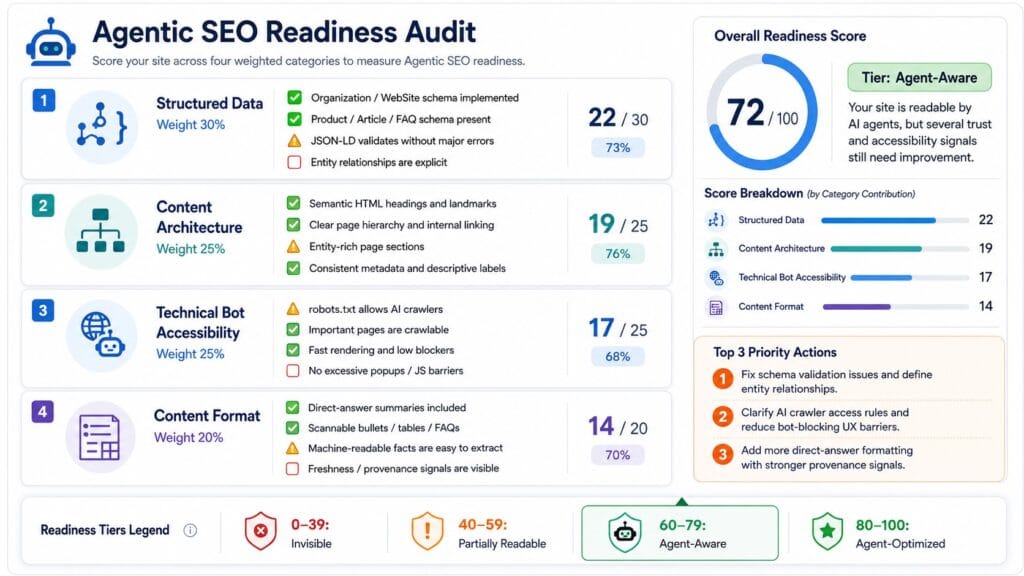
Your first action is specific and takes less than an hour: run the Agentic SEO Readiness Audit checklist, then check your robots.txt for the four AI crawler user-agent strings. Those two steps will tell you whether you’re Tier 1 or higher, and whether you’re visible to AI search systems at all.
If you skip this, your structured data stays sparse, your entities stay unresolvable, and AI agents keep selecting your competitors with high confidence. The agents don’t know you’re working on it. They just move to the next source.

Hi, I am Khalid. I am an SEO and AI Search Specialist.
My goal is simple: I help your business get found by the right people.
For a long time, getting found just meant showing up on the first page of regular Google search. Today, the internet is changing. People are asking their questions to AI tools like ChatGPT and Google’s new AI features.
My job is to connect the old way of searching with the new way. When a potential customer asks an AI a question about what you do, I make sure your business is the trusted answer they get.
I do not use confusing words or secret tricks. I use clear and honest plans to get you noticed and bring real buyers straight to your website.
Want to see how I can make your brand the top answer? Connect with me on social media or read my exact steps at khalidseo.com.