Published April 2026 · Data sourced from Adobe Digital Insights · 5,000+ U.S. consumer survey · 1 trillion+ site visits analyzed
Here’s the problem: paid search has been the gold standard of high-intent traffic for over a decade. You bid on keywords, you got buyers. That logic is being dismantled.
The agitation: while most retailers are still obsessing over Google rankings, a different kind of visitor has quietly started showing up – one who already knows what they want, already trusts the recommendation, and converts at rates that would make your paid search team jealous.
The solution: understand where these visitors come from, why they behave differently, and how to make sure your site is visible to the channel that’s sending them. That channel is AI.

What the Data Actually Shows
Adobe Digital Insights published findings in April 2026 based on over one trillion visits to U.S. retail websites, paired with a survey of more than 5,000 consumers. This isn’t a niche study. It’s as close to ground truth as e-commerce data gets.
The headline number is striking but the full picture is even more interesting.

The conversion reversal, a 12-month timeline
To understand why this matters, you need to see how fast it moved. Twelve months ago, the math ran in the opposite direction entirely.
- January 2025: AI traffic converted 49% worse than non-AI sources
- April 2025: That gap narrowed to 38% worse
- July 2025: Down further to 23% worse
- November 2025 (holiday peak): Near parity
- March 2026: AI traffic now converts 42% better
Read that reversal again. A visitor arriving from ChatGPT or Perplexity went from being your least likely buyer to your most likely buyer in just over a year. Revenue per visit followed the same arc – AI referrals now generate 37% more revenue per visit than non-AI traffic, after sitting 128% below it a year earlier.
Traffic volume: 393% growth in Q1 2026 alone
Volume matters as much as quality. And on volume, the growth trajectory is hard to overstate.
- Q1 2026: AI referral traffic to U.S. retail sites grew 393% year-over-year
- March 2026 alone: Up 269% year-over-year
- Holiday season 2025: Retail AI traffic up 693% year-over-year
- November 2025 peak: 769% above the prior November
Other industries are seeing it too. Travel AI traffic is up 539%, financial services up 266%, and tech and software up 120%. But retail is leading by a significant margin and it’s accelerating.
Why AI Visitors Are Different: They Arrive Already Decided
Conversion rate is a downstream metric. The real story is what happens upstream in the research phase before a visitor ever lands on your site.
The pre-filtered shopper
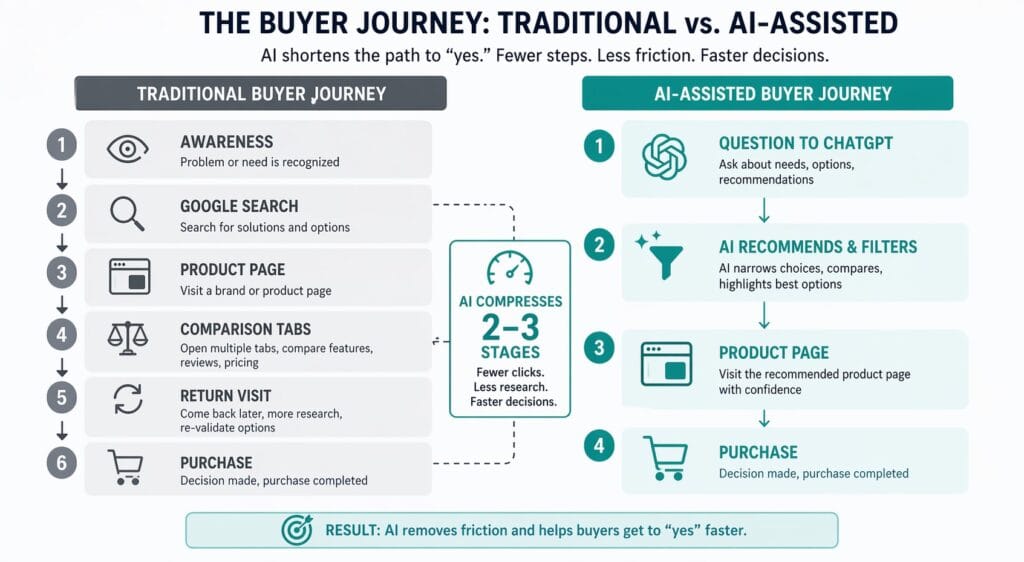
When someone types “running shoes” into Google, they might be curious, comparing, or browsing. They still have decisions to make. When someone asks ChatGPT “what’s the best running shoe for flat feet under $150” and clicks through, those decisions are already made. The AI did the research. The visitor arrives at the decision point.
This is what makes AI referral traffic structurally different from search or social. It’s not just higher intent – it’s further along the purchase journey than any channel you’ve optimized for before.
The engagement numbers confirm it. AI-referred visitors spend 48% more time on product pages, browse 13% more pages per visit, and show a 12% higher overall engagement rate.
Consumer trust is driving this, not novelty
A year ago, you could argue AI shopping was an experiment. The survey data suggests it’s become a habit.
- 39% of consumers surveyed said they used AI for online shopping
- 85% said the experience improved their shopping
- 66% believe AI tools provide accurate results – a meaningful trust signal
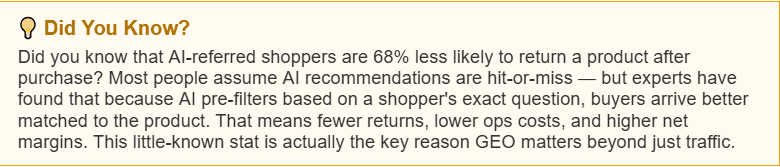
- Shoppers using AI were 68% less likely to return a product afterward
That last point matters for operations and margins, not just marketing. The reduced return rate (online returns were down 1.2% year-over-year in the 2025 holiday season) suggests AI is helping shoppers make better decisions upfront – not just faster ones.
The Optimization Gap: Why Most Retailers Are Invisible to AI
Here’s where the report gets uncomfortable. Adobe didn’t just track traffic behavior – it also looked at how well retailers’ sites are actually set up for AI visibility.
The short answer: most aren’t.
The content readability problem
Adobe found that roughly 25% of homepage content and 25% of category page content has not been optimized for LLMs. Product pages are worse – 34% of product content is unreadable or unusable by AI models.
What does “unoptimized” mean in practice? Vague product descriptions. Thin metadata. No structured context for AI systems to parse and reference. If an LLM can’t clearly understand what your product is, who it’s for, and what problem it solves, it won’t recommend it.
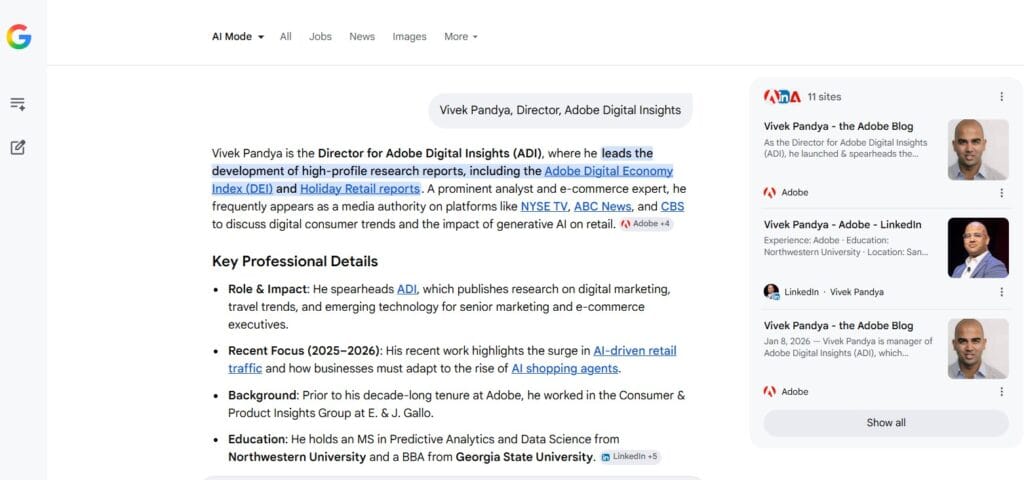
As Vivek Pandya put it in Adobe’s webinar: “In the LLM world, LLMs are deciding what gets seen and what gets trusted. It’s not just about how you show up on your own website. It’s about how you show up in the ecosystem.”
GEO vs. SEO – what’s actually different
Most retailers understand SEO. GEO (Generative Engine Optimization) is the newer practice of structuring your content so AI models can find, parse, and surface it in response to user queries. The goal is the same: get discovered. The intermediary is different.
SEO vs. GEO (side-by-side comparison):
| Factor | Traditional SEO | Generative Engine Optimization (GEO) |
| Goal | Rank pages in search results | Get recommended by AI assistants |
| Primary signal | Backlinks, keywords, authority | Content clarity, entity coverage, context |
| Discovery path | User types query → sees link list | User asks question → AI surfaces the answer |
| Content format | Keyword-optimized headings & meta | Conversational, question-answering prose |
| Measurement | Rankings, organic click volume | AI referral sessions, revenue per visit |
| Timeline to impact | Weeks to months | Faster – LLMs re-read pages frequently |
| Cost if ignored | Drop in organic traffic | Invisible to the highest-converting channel |
The key shift: search engines rank what they index; AI assistants recommend what they understand. Your content needs to be comprehensible, not just crawlable.
How to Actually Optimize for AI Traffic: A Practical Framework
This is where most articles on this topic end at ‘you should probably look into this.’ Let’s be more specific.
Write for questions, not keywords
AI users don’t type keyword strings. They ask conversational questions: “What’s the warmest waterproof jacket under $200?” “Best mattress for side sleepers with back pain?” Your product content needs to answer those questions directly – not just include the keywords.
Practically, this means writing product descriptions that start with what the product does and for whom, not just what it is. A description that says “Lightweight trail shoe designed for overpronators running on technical terrain” is far more useful to an LLM than “Premium athletic footwear model XR7.”
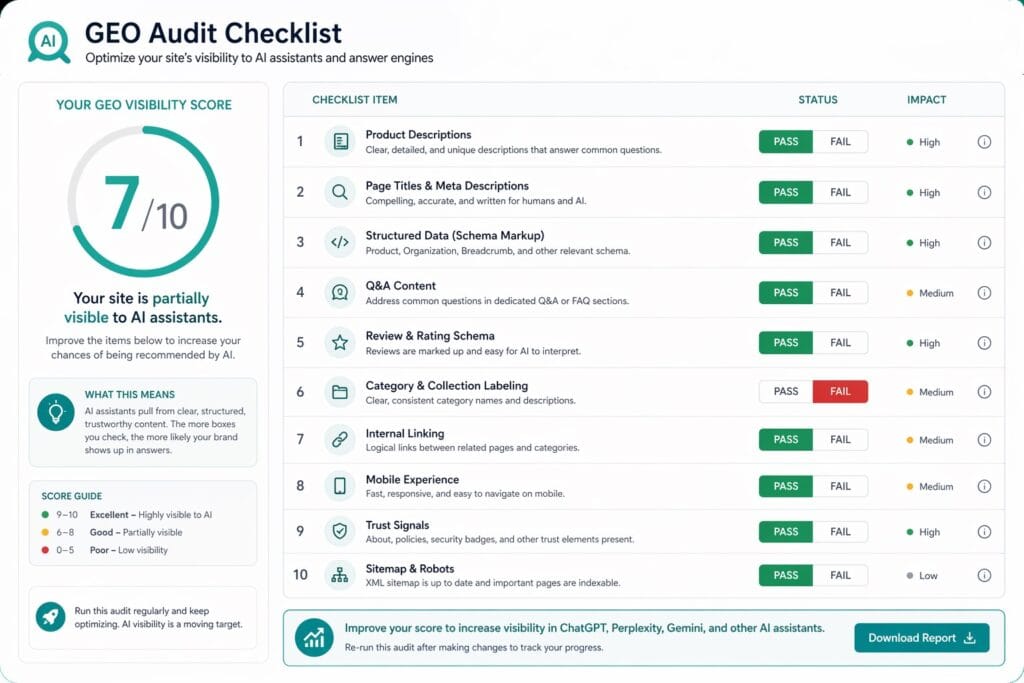
Structure your data so AI can parse it
LLMs don’t browse your site the way a human does. They process text at a structural level. A few high-impact fixes:
- Schema markup: Product, Review, FAQ, and BreadcrumbList schema give AI systems structured data to extract
- Spec tables: Organize technical specs in clean tables, not buried in paragraph copy
- FAQ sections: Actual questions and answers on product pages are gold for AI extraction
- Review aggregation: Structured review data helps LLMs understand what real buyers think about the product
- Clear category hierarchy: Logical, labeled category pages help AI map your inventory
Segment AI traffic in your analytics – now
Most retailers are lumping AI referrals into “other” or misclassifying them as direct traffic. You can’t optimize what you can’t see.
In Google Analytics 4, create a custom channel group filtering for referrers including openai.com, perplexity.ai, gemini.google.com, claude.ai, and similar. In Adobe Analytics, set up a traffic segment using those same referrer strings. Once segmented, track conversion rate, revenue per visit, time on site, and return rate separately. The numbers will look different from any other channel you track.
Where This Goes Next: What the Trajectory Tells Us
The 12-month arc from AI traffic underperforming to outperforming every major channel didn’t happen by accident. It happened because the tools got better, consumer habits shifted, and the path from AI recommendation to actual purchase got shorter.
That last part is still in progress.
OpenAI’s “Instant Checkout” feature inside ChatGPT – which lets users complete purchases directly inside the AI is collapsing the funnel further. If a shopper can go from question to purchase without ever visiting your product page, your AI visibility isn’t just a traffic issue. It’s an existential channel question.
AI shopping agents – tools that browse, compare, and buy autonomously on behalf of users are also moving from experiment to product. When an AI agent is making the purchase decision, your content needs to be legible to machines, not just persuasive to humans.
The retailers who move now on GEO are building compound advantages. An LLM trained on or referencing your well-structured content will surface you more often. The more you’re surfaced, the more traffic. The more traffic, the more behavioral data confirming your relevance. The flywheel is early. It won’t stay early.
THE REAL NUMBERS
| +42%AI traffic conversion advantage over non-AI (March 2026) |
| 393%Year-over-year growth in AI referral traffic to retail sites, Q1 2026 |
A WISE WORD
| “Rising consumer trust has played a factor, with Adobe’s survey showing that 66% of respondents believe AI tools provide accurate results. This is giving shoppers confidence and driving more transaction activity.”— Vivek Pandya, Director, Adobe Digital Insights |
This means that instead of worrying about ranking algorithms, we should focus on the simple truth: if your content clearly answers what a shopper is asking, AI will send them to you – already ready to buy.
KEY INFORMATION AT A GLANCE
| Feature | Why It Matters | How It Helps You |
| AI Traffic Growth | 393% YoY in Q1 2026 – it’s not a blip, it’s a shift | More high-intent buyers landing on your pages |
| Conversion Rate | AI visitors convert 42% better than all other sources | Higher ROI without increasing ad spend |
| Revenue Per Visit | 37% more revenue generated per AI referral session | Each AI visitor is worth more to your bottom line |
| Consumer Trust | 66% of shoppers trust AI recommendations | Buyers arrive pre-sold, not just curious |
SIMPLE TIPS YOU CAN USE TODAY
- Start Small: Don’t try to rewrite your whole site. Pick your top 3 product pages and rewrite descriptions to answer a real question – e.g. “Best for flat-footed runners who need cushioning.”
- Ask Why: If your AI traffic is low, look at your content. The goal of GEO is comprehensibility. Ask: can an AI clearly understand what this product is, who it’s for, and what problem it solves?
- Keep Track: Segment AI referral traffic in GA4 today. Filter for openai.com, perplexity.ai, gemini.google.com, and claude.ai. Write down your baseline conversion rate – you’ll want to compare it in 90 days.
A SURPRISING FACT
The Bottom Line
A year ago, the question in marketing circles was whether AI traffic was even worth tracking. Today it outperforms every traditional channel on conversion rate, revenue per visit, and engagement – while growing at nearly 400% year-over-year.
The retailers winning this channel aren’t necessarily the biggest or the ones with the most sophisticated tech stacks. They’re the ones who made their content clear, structured, and useful enough for AI models to trust and recommend.
That bar is achievable. Run the GEO audit checklist above. Segment your AI traffic today. Rewrite three product descriptions to answer real questions instead of just describing the product. Start small, measure it, and build from there.
This isn’t a trend to monitor anymore. It’s a channel to build for.
FAQ
Structured for direct extraction by AI assistants and search engines.
Does AI-generated traffic convert better than organic search?
Yes. As of March 2026, visitors from AI tools convert 42% better than non-AI traffic, and generate 37% more revenue per visit – a complete reversal from a year earlier when AI traffic underperformed by 38%.
The improvement is driven by behavioral differences. AI visitors arrive after a research process that happened inside the AI tool itself. By the time they reach your site, they’re further along the purchase journey than visitors from any other channel. Adobe’s analysis of over one trillion U.S. retail visits confirms this pattern holds across categories.
Why do AI shoppers convert at higher rates?
AI visitors are pre-filtered. They asked a specific question, received a targeted recommendation, and clicked through with purchase intent already formed. The consideration phase happened before they arrived at your site.
Traditional search puts the comparison work on the visitor. AI-assisted shopping compresses that process. The result is a visitor who arrives closer to the decision point, spends more time on product pages (48% more, per Adobe), and is 68% less likely to return a product after purchase.
Do consumers trust AI product recommendations?
Increasingly, yes. Adobe’s consumer survey found that 66% of respondents believe AI tools provide accurate results, 39% used AI for online shopping, and 85% said it improved their experience.
Trust has been the key variable in AI shopping adoption. In early 2025, most consumers used AI for research but completed purchases through traditional paths. By late 2025 and into 2026, that pattern shifted – consumers are completing transactions based on AI recommendations at a meaningfully higher rate, reflected in the conversion data.
How do I make my website visible to AI search tools?
Focus on four areas: question-answering product descriptions, schema markup (Product, FAQ, Review), structured spec data, and logical category hierarchy. Avoid thin, vague content that AI systems can’t extract meaning from.
AI tools don’t rank pages the way search engines do – they extract answers. Your content needs to clearly state what a product is, who it’s for, and what problem it solves. Schema markup gives AI systems structured data to work with. Review aggregation and FAQ sections on product pages are particularly high-value for LLM visibility.
What is Generative Engine Optimization (GEO) for e-commerce?
GEO is the practice of structuring your content so AI assistants can understand, extract, and recommend it in response to user queries. It differs from SEO in that the goal is comprehensibility to AI models, not rankings in a search index.
In traditional SEO, you optimize for crawlers that rank pages by signals like backlinks and keyword relevance. In GEO, you optimize for language models that decide what to recommend based on how clearly and completely your content answers a user’s question. The destination is the same – your product but the intermediary has changed. Adobe found that 34% of retailer product page content is currently unoptimized for LLMs, meaning those products are effectively invisible to the highest-converting traffic channel in e-commerce today.
Watch the Youtube video here 👇

Hi, I am Khalid. I am an SEO and AI Search Specialist.
My goal is simple: I help your business get found by the right people.
For a long time, getting found just meant showing up on the first page of regular Google search. Today, the internet is changing. People are asking their questions to AI tools like ChatGPT and Google’s new AI features.
My job is to connect the old way of searching with the new way. When a potential customer asks an AI a question about what you do, I make sure your business is the trusted answer they get.
I do not use confusing words or secret tricks. I use clear and honest plans to get you noticed and bring real buyers straight to your website.
Want to see how I can make your brand the top answer? Connect with me on social media or read my exact steps at khalidseo.com.