Top-of-funnel traffic is vanishing across the web. You check your analytics, and the numbers are steadily dropping.
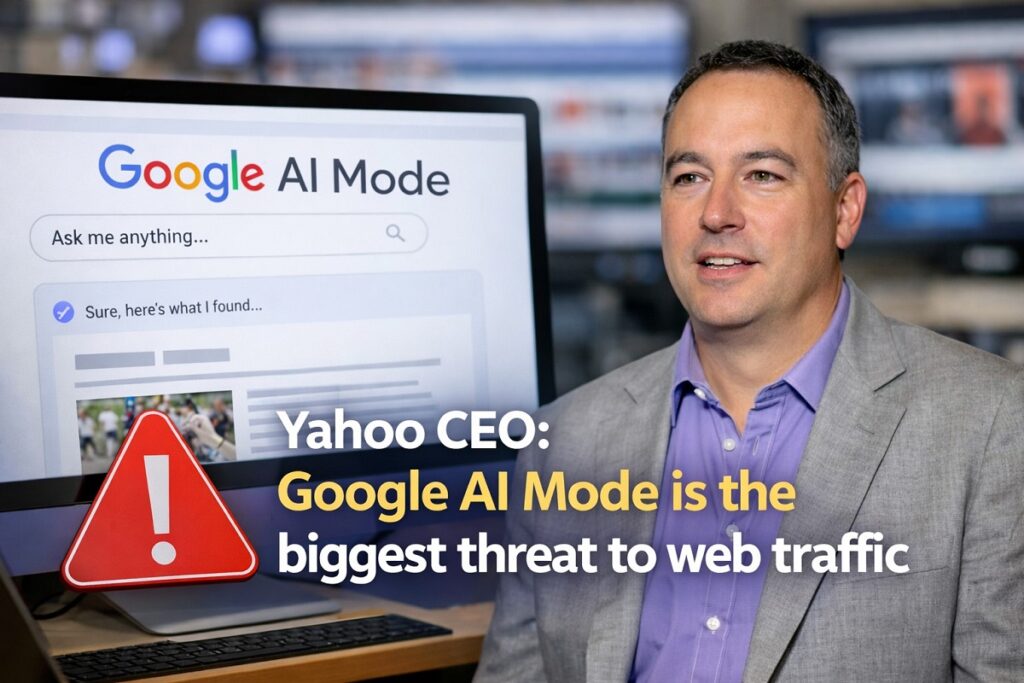
You haven’t been penalized by a core update. You are losing clicks to Google AI Mode. Yahoo CEO Jim Lanzone recently called this the “biggest challenge” facing the open web today. Large language models (LLMs) are scraping publisher content and serving it as zero-click answers.
Panic isn’t a business strategy. Generative Engine Optimization (GEO) is. Here is how to adapt your site to survive the answer engine era.
The Core Threat: Why Google AI Mode is Starving Publishers
Lanzone did not mince words during his recent Decoder podcast interview. He views Google AI Mode as a direct threat to the open web’s traditional traffic model.
When an LLM synthesizes your article into a neat summary at the top of the SERP, users stop clicking. The monetization ecosystem that funds content creators begins to collapse.
Key Impacts of AI Search on Publishers:
- Drastic reduction in click-through rates (CTR) for informational queries.
- Rapid rise of zero-click answer synthesis.
- Immediate disruption of traditional display ad monetization.
- A massive shift toward “agentic actions” that bypass websites entirely.
Yahoo Scout vs. Google AI: The Battle for the Open Web Ecosystem
Not all search engines are adopting the same aggressive AI strategy. Yahoo is taking a distinctly different approach with its new tool, Scout.
Paragraph-Driven Answers vs. Conversational Chatbots
Scout is built differently. It acts as a paragraph-driven answer engine, not a conversational chatbot trying to be your friend. It is designed to find information, not write code or hold long conversations.
| Feature | Yahoo Scout | Google AI Mode / Chatbots |
| Primary Format | Paragraph-driven answers | Conversational, synthesized text |
| Publisher Focus | High priority on external linking | High priority on keeping users on-SERP |
| Core Function | Answer engine | All-in-one AI assistant |
The Promise of “Downstream Traffic”
Yahoo’s explicit goal is to send downstream traffic back to content creators. Lanzone noted that they “bent over backwards” to highlight sources. Without a healthy, profitable publisher ecosystem, AI models will eventually run out of fresh content to consume.
The “Agentic” Future: When Search Becomes Action
The threat goes far beyond simple text summaries. We are entering an era of personalized results and “agentic actions.”
Soon, search engines will execute tasks directly. Users will analyze stocks or summarize emails right inside the search bar. This completely removes the need to visit external websites.
Relying heavily on LLM intermediaries is incredibly risky. Lanzone warned publishers against this, comparing these AI platforms to the “big bad wolf” coming to your door offering false security.
The Survival Guide: Pivoting to Generative Engine Optimization (GEO)
Traditional keyword strategies will no longer protect your traffic. You must evolve.
From Traditional SEO to Answer Engine Optimization (AEO)
Keyword density is obsolete. You now need to optimize for answer engines. This means structuring your content so AI models can easily parse, understand, and cite your data. You must use clear headings, concise direct answers, and structured data markup.
Forcing Citations with Unshakeable Topical Authority
How do you win in a zero-click world? By publishing highly opinionated, first-hand data.
You must force the AI to cite you because you are the absolute definitive source on the topic. This is the exact framework I implement at Khalid SEO. I build unshakeable topical authority that protects your brand and ensures your organic traffic survival in an AI-first landscape.
Frequently Asked Questions
What is Google AI Mode?
Google AI Mode is a search feature that uses large language models to generate direct answers at the top of results, bypassing the need for users to click traditional links. It synthesizes information from multiple websites to provide immediate, conversational responses to user queries.
Why is the Yahoo CEO warning publishers about Google AI?
Yahoo CEO Jim Lanzone warns that Google’s AI Mode acts as an “answer engine” that starves publishers of essential clicks and disrupts the open web’s traffic model. By providing full answers directly in the search results, it threatens the fundamental content monetization strategies publishers rely on.
What is Yahoo Scout?
Yahoo Scout is an AI-powered answer engine designed to be paragraph-driven. Unlike closed-loop AI competitors, Scout explicitly links sources and sends traffic downstream to original content creators.
It focuses on delivering accurate answers while maintaining a healthy, mutually beneficial relationship with the publisher ecosystem.
How can publishers protect their website traffic from AI search?
Publishers must pivot to Generative Engine Optimization (GEO) by creating highly opinionated, first-hand content and building deep topical authority that AI models are forced to cite.
Optimizing for long-tail conversational queries and providing structured, direct answers will help secure visibility in AI overviews.
Will AI search engines replace traditional SEO completely?
AI search will not replace SEO, but it forces a massive evolution. Optimizing for entity recognition, brand authority, and direct answer formatting is now essential for survival.
Traditional keyword stuffing is dead. Partnering with an AI Search Specialist is critical for brands looking to maintain visibility.

Hi, I am Khalid. I am an SEO and AI Search Specialist.
My goal is simple: I help your business get found by the right people.
For a long time, getting found just meant showing up on the first page of regular Google search. Today, the internet is changing. People are asking their questions to AI tools like ChatGPT and Google’s new AI features.
My job is to connect the old way of searching with the new way. When a potential customer asks an AI a question about what you do, I make sure your business is the trusted answer they get.
I do not use confusing words or secret tricks. I use clear and honest plans to get you noticed and bring real buyers straight to your website.
Want to see how I can make your brand the top answer? Connect with me on social media or read my exact steps at khalidseo.com.