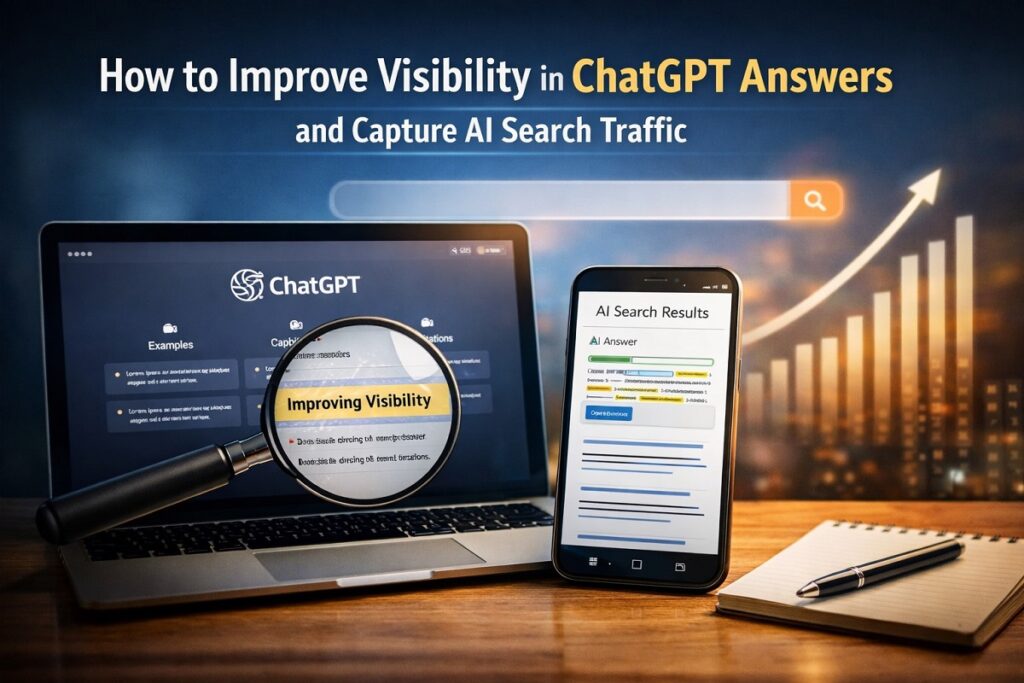
Organic search traffic is dropping across major industries. Users are increasingly bypassing traditional search engines. They are asking ChatGPT, Perplexity, and AI Overviews directly.
If your brand is not cited in these AI responses, you are invisible to a massive segment of highly qualified buyers. Your competitors are likely already shifting their budgets to optimize for Large Language Models (LLMs).
You must adapt to Generative Engine Optimization (GEO). As an AI Search Specialist running Khalid SEO, I help brands globally transition from chasing clicks to securing AI citations. Here is the exact blueprint to structure your data so AI models extract, trust, and recommend your brand.
The Shift from Traditional Search to Generative Engine Optimization (GEO)
Traditional SEO focuses on ranking ten blue links. GEO focuses on being the single, definitive synthesized answer. This requires a fundamental shift in how you produce and structure content.
You can no longer rely on keyword density. You must build entity clarity.
| Feature | Traditional SEO | Generative Engine Optimization (GEO) |
| Primary Goal | Rank #1 on SERPs | Earn citations in AI answers |
| Key Metric | Organic Clicks & CTR | Brand Mentions & Zero-Click Dominance |
| Content Focus | Long-form keyword targeting | Factual density and structured data |
| Off-Page Signal | Dofollow Backlinks | Brand Co-citations and NLP relevance |
How ChatGPT Retrieves Data: Understanding RAG
ChatGPT does not “read” your website like a human. It relies on Retrieval-Augmented Generation (RAG).
When a user asks a question, the AI searches its vector database for relevant facts. It retrieves discrete chunks of information from the live web to formulate an answer.
To improve visibility in ChatGPT answers, you must format your content into easily digestible chunks. The system favors strong Semantic Web connections and clear Knowledge Graph entities.
The AI Search Specialist’s Blueprint for Content Structuring
To capture the AI Featured Snippet, your content structure must be mathematically favorable for extraction. Follow these 5 steps to optimize content for AI extraction:
- Target specific prompt intents. Anticipate exact user questions.
- Provide the answer immediately. Do not bury the lede.
- Use structured formatting. Rely on lists, tables, and bolded logic.
- Cite original data. LLMs prioritize unique statistics.
- Maintain high factual density. Remove all filler text.
The 3-Sentence Rule for Passage Extraction
AI models pull small, discrete passages of text. Long walls of text confuse the extraction process.
Keep your paragraphs under three sentences. Make sure every single sentence contains a standalone fact. This isolates your core entities, making retrieval simple for the LLM.
Leveraging Factual Density and Original Data
Large Language Models crave statistics, hard data, and expert quotes. Vague marketing copy gets ignored.
Inject high E-E-A-T signals directly into your headers and first paragraphs. When you provide unique data, the AI has no choice but to cite you as the source.
Building Entity Authority and Brand Co-Citations
Traditional backlinks are losing their absolute power. AI models evaluate trust through brand co-citations.
When authoritative industry hubs mention your brand alongside relevant semantic entities, the AI connects the dots. Unlinked brand mentions hold massive weight in NLP processing.
Focus your digital PR on securing mentions in expert roundups, credible forums, and niche publications. This builds the topical authority required for AI recommendation.
Assess Your LLMO Readiness
Are you prepared for the reality of zero-click search? Guessing what AI wants will drain your marketing budget.
[Insert Interactive Element: The ChatGPT Visibility Score Calculator widget]
At Khalid SEO, I build custom GEO architectures that force AI models to recognize your authority. Stop fighting for obsolete blue links. Let’s optimize your digital presence for the future of search.
ChatGPT Visibility Score Calculator
Check the Generative Engine Optimization (GEO) strategies you currently implement to assess your AI search readiness.
Your LLMO Readiness Score: 0%
Need expert help optimizing for AI?
I am an AI Search Specialist. I build custom GEO architectures that force AI models to recognize your authority.
Frequently Asked Questions
How do I get my website mentioned in ChatGPT?
To get mentioned in ChatGPT, structure your content for easy AI extraction using concise formats, bulleted lists, and clear headers while incorporating original statistics and building authoritative third-party brand mentions.
This requires moving away from generic fluff. You must focus on factual density. When your site is frequently cited by other trusted entities in your niche, ChatGPT learns to trust your data.
What is Generative Engine Optimization (GEO)?
Generative Engine Optimization (GEO) is the practice of optimizing digital content to appear in AI-generated answers on platforms like ChatGPT, Perplexity, and Google AI Overviews by prioritizing passage extraction.
It is the evolution of search. Instead of optimizing for a search engine crawler to rank a link, you optimize for an LLM to read, understand, and regurgitate your specific data points.
How does ChatGPT decide which websites to cite?
ChatGPT relies on Retrieval-Augmented Generation (RAG) to fetch real-time data, selecting sources based on contextual relevance, semantic clarity, authoritative brand mentions, factual density, and high E-E-A-T signals.
It heavily favors structured content that directly and clearly answers the user's specific prompt. If your data is buried inside long, unstructured paragraphs, the AI will pull from a competitor who uses better formatting.
Is traditional SEO still relevant for ChatGPT visibility?
Yes, traditional SEO remains the strict foundation for AI search visibility, as fast load times, clean HTML architecture, and comprehensive content ensure web crawlers can actually index your data.
If a search engine cannot crawl your site, an AI cannot retrieve your information. Technical SEO is the prerequisite for any successful GEO campaign.
Why are brand mentions important for Answer Engine Optimization?
Answer engines treat brand mentions even unlinked ones as critical trust signals. When third-party review sites and industry publications discuss your brand alongside related entities, it builds essential topical authority.
This is how AI models establish context. A high volume of positive, contextually relevant brand mentions proves to the AI that you are a recognized entity, increasing the likelihood of recommendation.

Hi, I am Khalid. I am an SEO and AI Search Specialist.
My goal is simple: I help your business get found by the right people.
For a long time, getting found just meant showing up on the first page of regular Google search. Today, the internet is changing. People are asking their questions to AI tools like ChatGPT and Google’s new AI features.
My job is to connect the old way of searching with the new way. When a potential customer asks an AI a question about what you do, I make sure your business is the trusted answer they get.
I do not use confusing words or secret tricks. I use clear and honest plans to get you noticed and bring real buyers straight to your website.
Want to see how I can make your brand the top answer? Connect with me on social media or read my exact steps at khalidseo.com.