Organic traffic is dropping across the board. Traditional search algorithms are losing ground to AI platforms.
Users no longer click through ten blue links. They ask a question and get a synthesized, direct answer. If your content is not structured for these models, your brand disappears.
This creates a massive visibility gap. The solution is entirely architectural. You must optimize your website for AI search engines. This means shifting your focus from keyword density to semantic relevance.
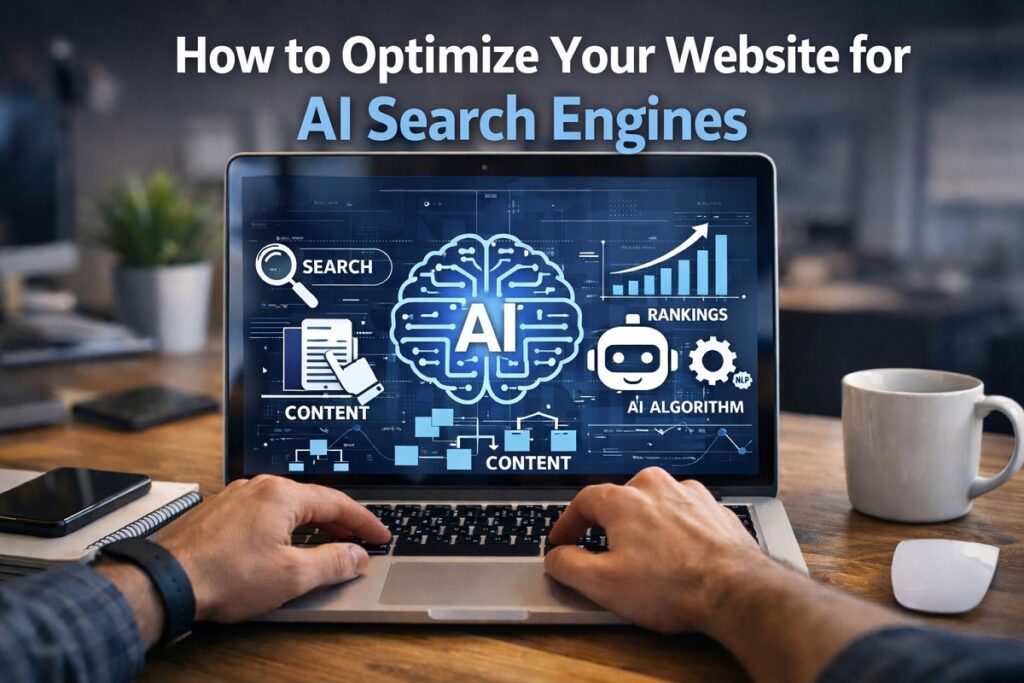
The Evolution of Search: From Keywords to Generative Engines
Search has moved from retrieval to generation. Platforms like SearchGPT and AI Overviews synthesize information to provide immediate value. This drives the rise of zero-click search.
You are no longer competing for clicks. You are competing for citations. This requires Generative Engine Optimization (GEO).
What is Generative Engine Optimization (GEO)?
Generative Engine Optimization (GEO) structures content so AI models understand and cite it. * Entity Alignment: Connecting your brand to established knowledge graphs.
- Direct Answers: Providing clear, concise responses to user queries.
- Semantic Relevance: Building topical authority around specific subjects.
To understand the shift, look at the core differences:
| Focus Area | Traditional SEO | AI Search (GEO/LLMO) |
| Primary Goal | Rank URLs on search engine result pages. | Earn citations within AI-generated answers. |
| Core Metric | Click-through rate (CTR) and backlinks. | Brand mentions and entity resolution. |
| Content Strategy | Keyword density and search volume. | Semantic proximity and topical authority. |
Technical Setup for Large Language Model Optimization (LLMO)
AI bots read the web differently than traditional crawlers. They look for structured data extraction. If your technical foundation is messy, Large Language Models will ignore you.
Large Language Model Optimization (LLMO) starts with your code. You must implement robust Schema Markup. This acts as a universal translator for AI bots.
You also need to optimize your crawler directives. Ensure your robots.txt file permits AI bot access. Consider adding an llms.txt file to provide clean, markdown-formatted data directly to language models.
Answer Engine Optimization (AEO): Writing for the AI Brain
Great code needs great content. Answer Engine Optimization (AEO) bridges this gap. You must format your writing into machine-readable chunks.
AI relies on E-E-A-T (Experience, Expertise, Authoritativeness, Trustworthiness). It looks for patterns in the Knowledge Graph. It evaluates semantic proximity to determine if you are a credible source.
To capture conversational queries, write in a Q&A format. Use lists, bold text, and clear headings.
Measuring Success and Brand Visibility in a Zero-Click World
Tracking traditional metrics will mislead you. Clicks are no longer the only sign of success. You must measure your presence within the AI ecosystem.
Track your brand mentions in ChatGPT and Perplexity. Monitor how often you are cited as a source. Citation optimization is the new link building.
Watch your overall brand sentiment. Are AI models associating your company with the correct semantic entities? This is the true measure of modern visibility.
Future-Proofing Your Digital Footprint with Khalid SEO
Adapting to these new requirements takes specialized focus. As an AI SEO, AEO, and GEO Specialist, I build semantic architectures designed for the future of search.
At Khalid SEO, I transition your brand from legacy strategies to AI-first dominance. I ensure your website speaks the language of modern language models.
Ready to become the cited authority in your industry?
Frequently Asked Questions
What is Generative Engine Optimization (GEO)?
GEO is the process of structuring website content so AI platforms recognize, understand, and cite your brand directly.
Traditional search relies on keyword matching. GEO focuses on entity alignment, direct answers, and deep semantic relevance to ensure AI models confidently use your data.
How do I optimize my website for AI search engines?
Implement structured data, write in clear machine-readable chunks, and establish deep topical authority to optimize for AI.
You must ensure AI crawler accessibility via robots.txt. Always prioritize direct, natural language answers to long-tail conversational user queries over generic keyword placement.
What is the difference between SEO and LLMO?
Traditional SEO targets ranking links via keywords, while LLMO structures content using semantic clarity for AI retrieval.
LLMO focuses heavily on technical architecture. It ensures Large Language Models easily extract facts and understand relationships to cite your brand in conversational answers.
Why is schema markup important for AI search?
Schema markup acts as a universal translator, providing explicit, structured context that AI bots can instantly parse.
By using Article, FAQ, and Organization schemas, you help LLMs extract facts effortlessly. This greatly increases the chances of your website being cited as an authoritative source.
How does Khalid SEO improve AI search visibility?
I apply advanced AI SEO, AEO, and GEO methodologies to future-proof your digital footprint and increase citations.
I leverage semantic entity optimization, technical schema markup, and topical cluster architecture. This ensures your brand consistently appears as a trusted resource across all major generative AI engines.

Hi, I am Khalid. I am an SEO and AI Search Specialist.
My goal is simple: I help your business get found by the right people.
For a long time, getting found just meant showing up on the first page of regular Google search. Today, the internet is changing. People are asking their questions to AI tools like ChatGPT and Google’s new AI features.
My job is to connect the old way of searching with the new way. When a potential customer asks an AI a question about what you do, I make sure your business is the trusted answer they get.
I do not use confusing words or secret tricks. I use clear and honest plans to get you noticed and bring real buyers straight to your website.
Want to see how I can make your brand the top answer? Connect with me on social media or read my exact steps at khalidseo.com.