
Organic traffic models are breaking. Users ask complex questions, and AI engines answer them directly.
If your strategy relies entirely on blue-link clicks, you are losing market share. Large Language Models (LLMs) are intercepting your users before they ever reach your site.
You must adapt to survive. The solution is Generative Engine Optimization (GEO). Here at Khalid SEO, we are shifting our focus from simply ranking pages to becoming the definitive, cited source for AI engines. Here is how you do it.
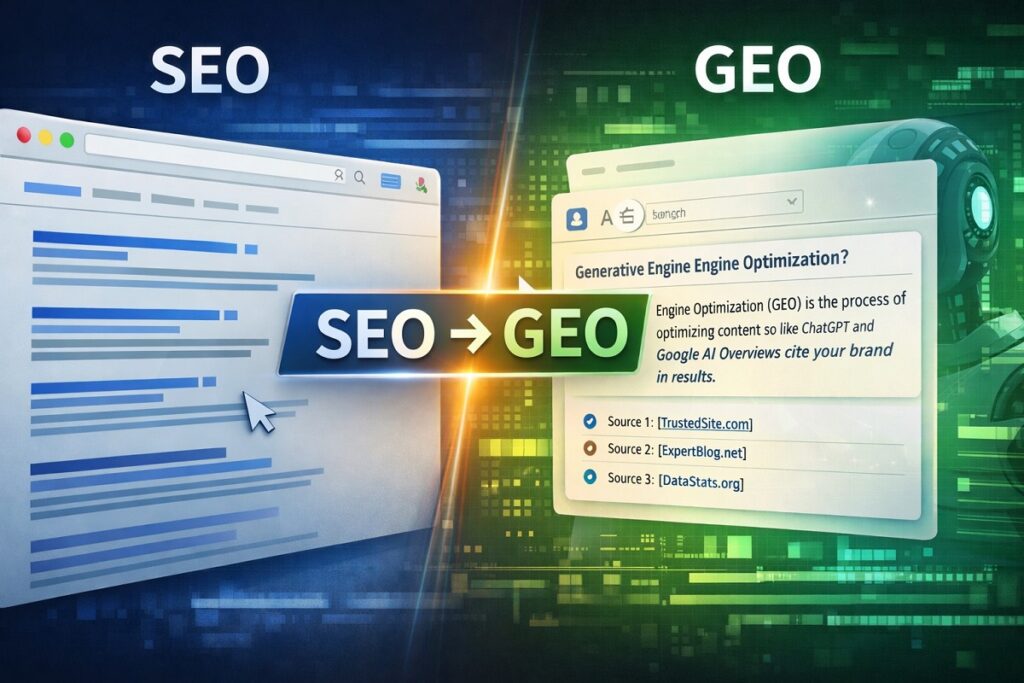
The Shift from Clicks to Citations
Search intent is evolving rapidly. Users want immediate answers, not a list of ten competing websites. This creates a zero-click environment.
AI search visibility is the new primary metric. If ChatGPT or Google AI Overviews cannot read your site easily, you do not exist to them. You must build content that machines prefer to parse.
What is Generative Engine Optimization (GEO)?
Generative Engine Optimization (GEO) is the practice of structuring content so AI models like ChatGPT, Perplexity, and Google AI Overviews can discover, understand, and cite it.
It is not about keyword density. It is about semantic relevance. GEO ensures your content feeds directly into AI answers, positioning your brand as the source of truth.
GEO vs. Traditional SEO: Understanding the Paradigm Shift
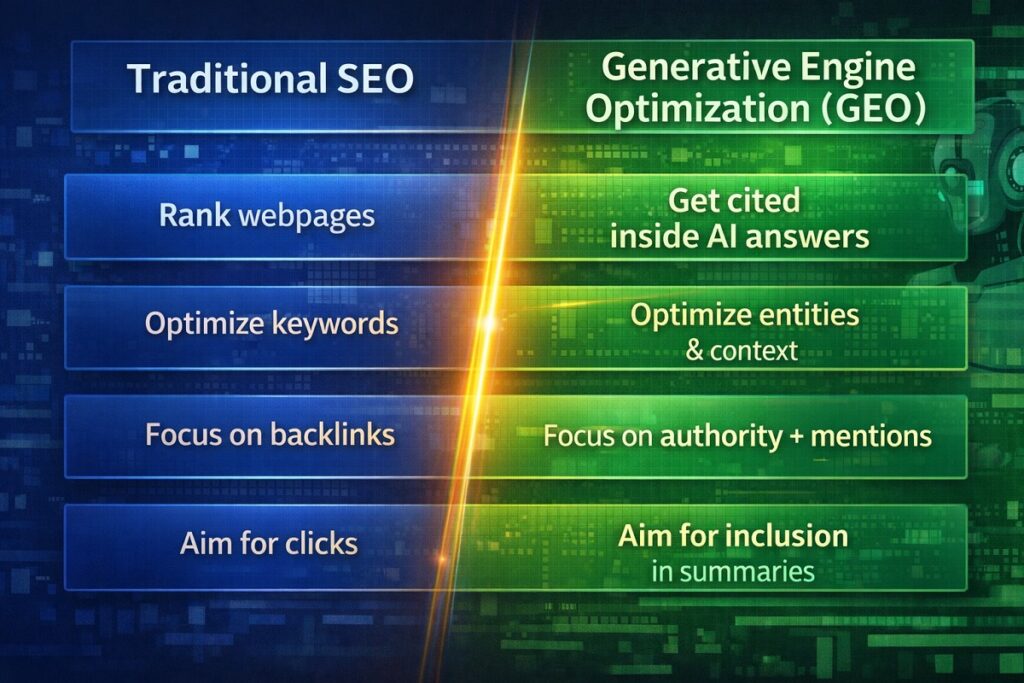
Traditional SEO optimized for crawlers like Googlebot. It chased keywords, backlinks, and search volumes.
GEO optimizes for neural networks. It targets entities, semantic proximity, and the Knowledge Graph. It answers the question precisely.
Here is how the two approaches compare:
| Metric / Strategy | Traditional SEO | Generative Engine Optimization (GEO) |
| Primary Goal | Ranking #1 on SERPs | Being cited in AI-generated answers |
| Core Tactic | Keyword targeting & Backlinks | Entity relationships & NLP structuring |
| Success Metric | Organic Clicks & Traffic Volume | Share of Voice & Brand Citations |
| Content Format | Long-form, narrative blog posts | Data chunking & inverted pyramids |
How Retrieval-Augmented Generation (RAG) Evaluates Content
To win at GEO, you must understand RAG. Retrieval-Augmented Generation is how AI systems pull facts to answer user queries accurately.
When a user asks a question, the AI searches a vector database. It looks for content with high semantic relevance to the prompt.
It then retrieves that data and synthesizes an answer. If your content lacks clear vector context or uses confusing tokenization, the RAG pipeline ignores it.
The Core Pillars of a Winning GEO Strategy
How do you execute this? You build content that machines can parse effortlessly.
Structuring for Answer Engine Optimization (AEO)
Direct questions demand direct answers. Use the inverted pyramid structure for your content.
Place a concise, 40-word answer immediately below a heading. Expand on the nuanced details and context afterward.
Improving LLM Readability Through Data Chunking
LLMs process text in chunks. Break your data into logical, self-contained sections.
Use clear headers, bullet points, and markdown tables. This chunking strategy improves extraction accuracy and prevents AI hallucinations.
Building Unshakable Topical Authority and Entity Relationships
You need to establish strong entity relationships. Mentioning related NLP concepts proves your depth of knowledge to an AI.
At Khalid SEO, we map out entity clusters before writing a single word. We connect topics using structured data to feed the broader Knowledge Graph.
Measuring Your GEO Success in the Zero-Click Era
Traffic volume alone is an outdated KPI. You must measure brand authority and E-E-A-T signals.
Track your citation frequency. Are tools like Claude or OpenAI actively linking to your domain in their outputs?
Monitor your share of voice in AI-generated answers. A high inclusion rate means your GEO strategy is working flawlessly.
Frequently Asked Questions (FAQ)
What is Generative Engine Optimization (GEO)?
Generative Engine Optimization (GEO) is the strategy of formatting and writing content so that generative AI search engines, like ChatGPT and Perplexity, can easily read, understand, and cite it.
Unlike traditional ranking methods, GEO focuses on machine-readable structures. It bridges the gap between human content and AI extraction, ensuring your data is the source for synthesized answers.
How is GEO different from traditional SEO?
Traditional SEO targets keyword rankings and blue link clicks. GEO optimizes for visibility within AI-generated responses, prioritizing natural language processing, entity relationships, and highly factual citations.
SEO relies heavily on building backlinks to signal authority. GEO relies on semantic relevance, clear data chunking, and providing the most direct, accurate answer to a specific prompt.
Does Generative Engine Optimization replace SEO?
No, GEO does not replace SEO. It acts as an optimization layer built on top of a strong technical SEO foundation, focusing specifically on LLM comprehension.
You still need fast load times, mobile optimization, and logical architecture. Without solid technical SEO, AI crawlers cannot reach or index your content in the first place.
How do I optimize my content for AI search engines?
To optimize for AI search, use the inverted pyramid structure. Provide a direct 40-word answer immediately after heading questions, use robust schema markup, and keep paragraphs highly concise.
Maintain clear entity references throughout your text. This helps language models connect your content to established facts and people within the broader Knowledge Graph.
How do you measure GEO success?
You measure GEO success by tracking brand citations, referral traffic from AI bots, and your overall share of voice across major AI platforms like Google AI Overviews.
Traditional metrics like organic clicks will inevitably drop as zero-click searches rise. Focus instead on how often your brand appears as a cited, authoritative source in synthesized responses.

Hi, I am Khalid. I am an SEO and AI Search Specialist.
My goal is simple: I help your business get found by the right people.
For a long time, getting found just meant showing up on the first page of regular Google search. Today, the internet is changing. People are asking their questions to AI tools like ChatGPT and Google’s new AI features.
My job is to connect the old way of searching with the new way. When a potential customer asks an AI a question about what you do, I make sure your business is the trusted answer they get.
I do not use confusing words or secret tricks. I use clear and honest plans to get you noticed and bring real buyers straight to your website.
Want to see how I can make your brand the top answer? Connect with me on social media or read my exact steps at khalidseo.com.