AI search engines are answering user queries directly. Your traditional organic traffic is likely dropping as zero-click searches rise.
If ChatGPT does not cite your website as a source, you become invisible. Your competitors are already adapting to generative search models.
You need to optimize for large language models (LLMs). Here is exactly how to get cited in ChatGPT answers and secure your visibility.
Understanding How ChatGPT Retrieves Information
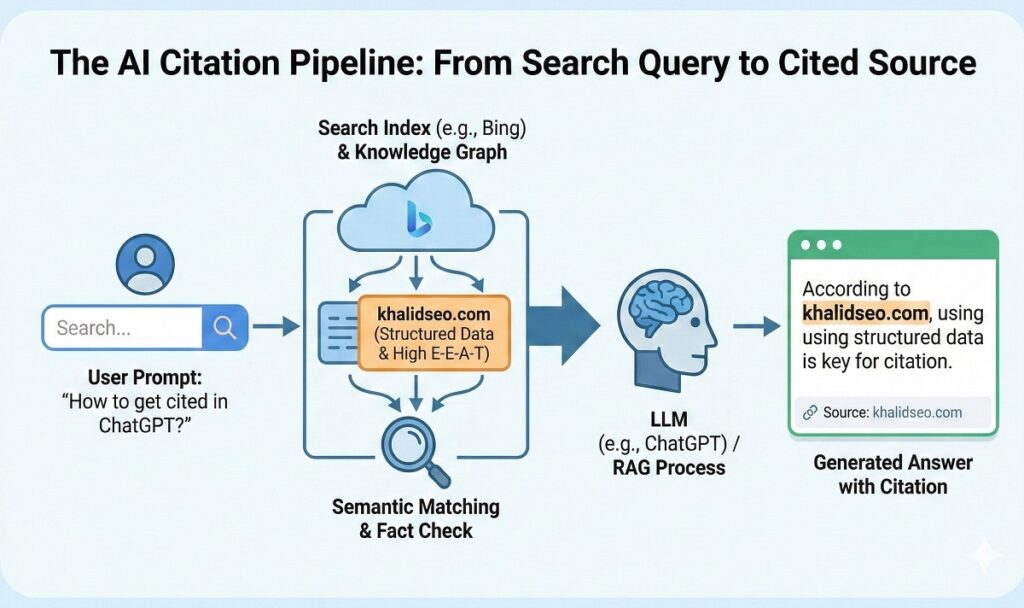
ChatGPT does not just guess answers. It uses Retrieval-Augmented Generation (RAG) to find factual data.
When a user asks a question, the AI queries a search index like Bing. It pulls relevant web chunks into its context window.
To become a recognized entity in the Knowledge Graph, your data must be highly accessible. The model synthesizes these extracted chunks to generate the final response.

Generative Engine Optimization (GEO) vs. Traditional SEO
You cannot abandon traditional SEO. However, Generative Engine Optimization (GEO) requires a strategic shift.
Traditional search relies heavily on exact keyword matching and backlinks. LLM SEO prioritizes semantic relationships, entity density, and direct answers.
Traditional SEO vs. GEO
| Feature | Traditional SEO | Generative Engine Optimization (GEO) |
| Primary Goal | Rank #1 on standard SERPs | Secure citations in AI-generated answers |
| Keyword Focus | Search volume and exact match | Semantic proximity and NLP nodes |
| Content Style | Long-form, narrative-driven | Chunkable, direct, structured data |
| Crawler Focus | Googlebot | OAI-SearchBot, Bingbot |
Technical SEO for AI Bots: Ensuring Crawlability
AI bots must be able to read your site. If your server blocks them, you will never get cited.
You must explicitly allow crawlers like OAI-SearchBot in your robots.txt file. A fast, clean site architecture is still mandatory.
At khalidseo.com, we are developing an interactive AI Search Indexability & Crawlability Checker. This tool will let you instantly test your server responses against specific AI bot user-agents to ensure you are fully visible.
Content Chunkability & Semantic Structuring
LLMs process text in tokens. You must format your pages for machine parsing.
Use clear HTML tags and schema markup. This creates semantic proximity, grouping related concepts together.
Your content needs high entity density without keyword stuffing. Keep your paragraphs short and answers direct.
How to Optimize for ChatGPT Citations (Step-by-Step)
- Unblock AI Crawlers: Verify OAI-SearchBot and Bingbot are permitted in your robots.txt.
- Implement Structured Data: Add precise FAQ and Article Schema markup to your pages.
- Write Direct Answers: Place concise, factual answers immediately below your heading tags.
- Improve Entity Density: Use related NLP nodes and contextual keywords naturally.
- Format in Chunks: Use bullet points, numbered lists, and short paragraphs.
Building Digital Trust to Secure Citations
Even with perfect technical setup, ChatGPT needs a reason to trust you. E-E-A-T signals matter heavily.
The AI evaluates trust transference from authoritative backlinks. It also looks for unlinked brand mentions across the web.
Establish your brand as a recognized entity. Publish original research and unique data points to increase your Information Gain.
Frequently Asked Questions
How does ChatGPT choose which websites to cite?
ChatGPT uses Retrieval-Augmented Generation (RAG) to prioritize websites with high semantic relevance, strong brand authority, and factual accuracy. Clear structured data and high E-E-A-T signals are essential.
The model scans indexed pages for direct answers. It cross-references facts across trusted domains before generating a citation.
Does traditional SEO still work for AI search?
Yes, traditional technical SEO remains foundational for AI bots. Fast load times and basic crawlability are required before any LLM can access your data.
However, Generative Engine Optimization (GEO) requires shifting focus. You must build strong entity relationships and write natural language answers.
What is Generative Engine Optimization (GEO)?
Generative Engine Optimization (GEO) is optimizing content for AI-driven search engines and Large Language Models. It focuses on machine readability, conversational tone, and targeting complex queries.
Instead of chasing high-volume keywords, GEO targets specific user intent. It structures data so AI can easily extract facts.
Does schema markup help rank in ChatGPT?
Absolutely. Schema markup is critical for AI search visibility. Structured data translates your web content into a machine-readable format that LLMs easily process.
By defining specific entities and FAQs, you drastically improve your chances of citation. AI models rely on clear data structures.
How can I optimize my content for SearchGPT?
Focus on Information Gain by publishing original research and structured chunks. Build digital trust through authoritative backlinks and frequent unlinked brand mentions to signal authority.
SearchGPT prioritizes fresh, verified information. Providing direct answers to complex problems is the best way to secure visibility.

Hi, I am Khalid. I am an SEO and AI Search Specialist.
My goal is simple: I help your business get found by the right people.
For a long time, getting found just meant showing up on the first page of regular Google search. Today, the internet is changing. People are asking their questions to AI tools like ChatGPT and Google’s new AI features.
My job is to connect the old way of searching with the new way. When a potential customer asks an AI a question about what you do, I make sure your business is the trusted answer they get.
I do not use confusing words or secret tricks. I use clear and honest plans to get you noticed and bring real buyers straight to your website.
Want to see how I can make your brand the top answer? Connect with me on social media or read my exact steps at khalidseo.com.