Traffic is shifting. Users want direct answers, not a list of links. Generative AI engines are fundamentally changing how people find information online.
If your strategy relies entirely on keyword density and legacy backlink profiles, your visibility will drop. Large Language Models (LLMs) do not process the web like traditional crawlers. They look for consensus, entities, and direct context.
To survive this shift, you must adopt Generative Engine Optimization (GEO). Here is exactly how to structure your data for AI extraction so your brand becomes the definitive answer.
What is Generative Engine Optimization (GEO)?
Generative Engine Optimization (GEO) is the technical process of structuring website content specifically for AI-driven search engines and Large Language Models. It prioritizes conversational keywords, rich structured data, authoritative brand mentions, and direct, clear answers to satisfy AI retrieval mechanisms.
At Khalid SEO, we firmly believe in a “no jargon, no fluff” approach to search. GEO is exactly that. It strips away keyword stuffing. It forces creators to focus purely on information gain and contextual relevance. If your content does not provide unique, verifiable value, an LLM will simply ignore it.
The Mechanics of SearchGPT: RAG and the OAI-SearchBot
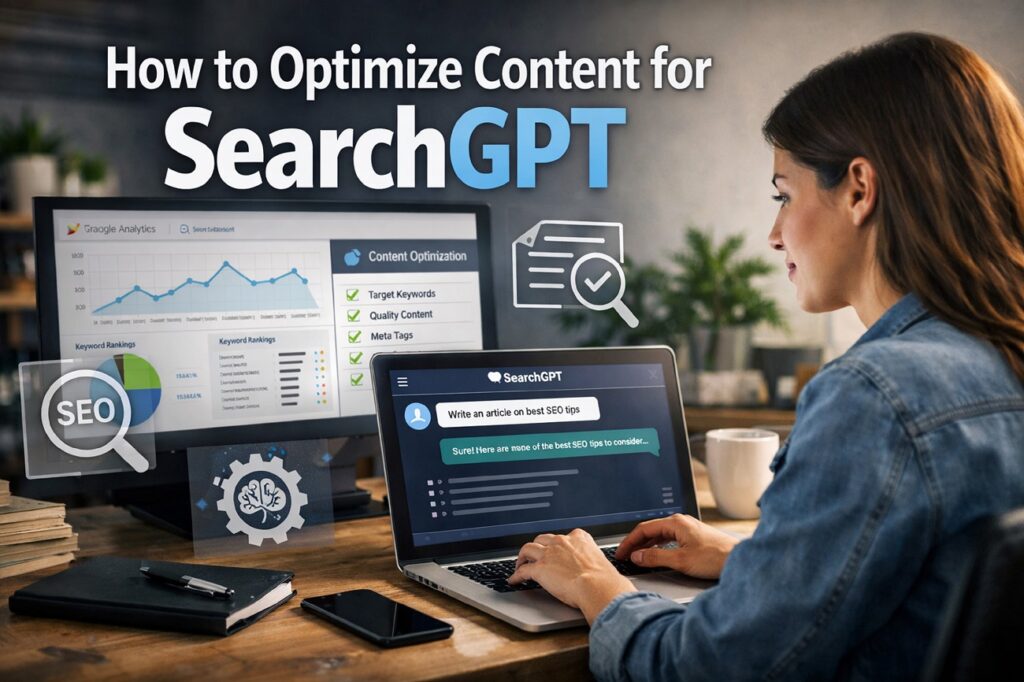
To optimize for SearchGPT, you must understand how it retrieves data. It uses a framework called Retrieval-Augmented Generation (RAG).
Traditional search matches keywords to an index. RAG systems operate differently. When a user asks a question, the AI queries a real-time index. It pulls the most relevant data chunks, synthesizes them, and generates a custom response. It cites the sources it used for that synthesis.
To be cited, the OAI-SearchBot must easily crawl your site. It also heavily relies on the Bing Search Index to find real-time information.
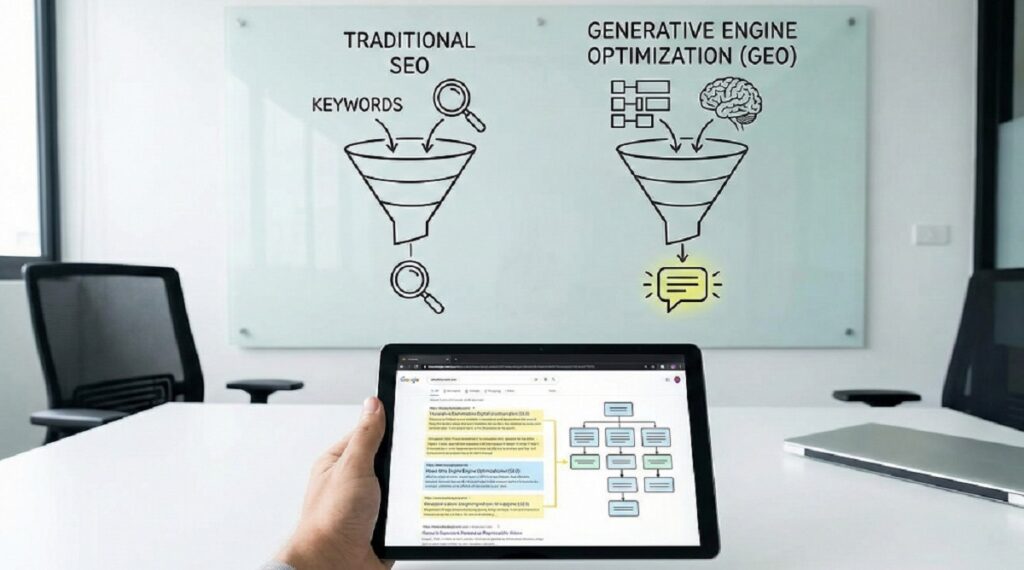
Traditional SEO vs. Generative Engine Optimization
| Feature | Traditional SEO | AI Search (GEO) |
| Primary Goal | Rank #1 on SERPs | Be cited as the definitive source |
| Key Metric | Organic Traffic & Clicks | Brand Mentions & Impressions |
| Content Focus | Keyword targeting & length | Information gain & direct answers |
| Authority Signal | Number of backlinks | Entity consensus & E-E-A-T |
Core Ranking Factors in the New “Citation Economy”
SearchGPT does not care about your domain authority score. It cares about entity authority. It operates in a “Citation Economy” where trust is the primary currency.
Entity Authority vs. Domain Authority
LLMs build relationships between entities (people, places, concepts). If your brand is consistently mentioned alongside expert topics across authoritative sources, your entity authority grows. This matters far more than a high volume of low-quality links.
The Role of Real-Time Data and Content Freshness
SearchGPT aims to provide up-to-date answers. Content freshness is critical. Regularly updating your statistics, case studies, and core pages signals to the OAI-SearchBot that your data is current and reliable for citation.
Why Brand Mentions and Co-occurrence are the New Backlinks
Unlinked brand mentions are powerful. When high-trust sites mention your brand in the context of your primary topic, LLMs take note. This semantic co-occurrence builds the necessary E-E-A-T (Experience, Expertise, Authoritativeness, Trustworthiness) for AI engines.
Structuring Content for AI Passage Extraction
Writing great content is only half the battle. You must format it so an LLM can parse it instantly.
AI bots extract “chunks” of information. To make your content chunkable, use strict semantic HTML formatting:
- Use clear H2s and H3s that ask and answer direct questions.
- Deploy bulleted and numbered lists for step-by-step processes.
- Implement comprehensive structured data markup (Schema) to explicitly define entities and relationships.
- Keep paragraphs short to allow easy passage indexing.
Your AI Search Technical Checklist
To immediately improve your AI search visibility, follow these technical steps:
- Verify your site is indexed in Bing Webmaster Tools.
- Ensure your robots.txt file does not accidentally block the OAI-SearchBot.
- Audit your content for conversational natural language intent.
- Implement FAQ schema on your core service pages.
If you are unsure how crawlers are viewing your site right now, run your URLs through our free AI Search Indexability & Crawlability Checker at khalidseo.com. It will instantly highlight technical roadblocks preventing LLMs from parsing your data.
FAQ: Answer Engine Optimization (AEO)
Does SearchGPT use traditional SEO ranking factors?
No, SearchGPT looks beyond traditional backlinks and keyword density. It prioritizes content quality, semantic relevance, authoritativeness, and real-time structured data to formulate accurate answers. While foundational technical SEO remains vital to ensure bots can crawl your pages, your optimization efforts must shift. The focus is now entirely on contextual meaning, conversational intent, and proving your expertise through consensus across the web.
How do you optimize a website for ChatGPT search?
To rank in ChatGPT search, implement Generative Engine Optimization (GEO). Write in a natural tone, directly answer user questions, acquire authoritative brand mentions, and structure your content clearly.
Format your pages with explicit headings, lists, and schema markup. This allows AI extraction tools to easily pull your data into their Retrieval-Augmented Generation (RAG) pipelines for citations.
What is Generative Engine Optimization (GEO)?
GEO is the practice of optimizing content specifically for AI engines and LLMs. It improves visibility by leveraging conversational keywords, structured data, and authoritative citations to satisfy AI retrieval.
It is the necessary evolution of SEO. Instead of optimizing for an algorithm that counts links, you are structuring data to educate an AI model about your brand’s expertise.
Does Bing ranking affect SearchGPT visibility?
Yes, a strong presence on Bing directly impacts SearchGPT visibility. SearchGPT frequently pulls real-time information and citations directly from the Bing Search Index.
Optimizing for Bing Webmaster Tools is no longer optional. Adhering to Bing’s specific technical best practices serves as a critical, direct bridge to achieving high visibility within ChatGPT search results.
How does structured data help AI search engines?
Structured data acts as a direct translator for AI models. Implementing schema markup provides explicit context about your entities, data hierarchy, and relationships, allowing for instant extraction.
It removes the guesswork for the OAI-SearchBot. When the AI can instantly parse and understand your content’s structure, it can confidently cite your pages in its generated answers.

Hi, I am Khalid. I am an SEO and AI Search Specialist.
My goal is simple: I help your business get found by the right people.
For a long time, getting found just meant showing up on the first page of regular Google search. Today, the internet is changing. People are asking their questions to AI tools like ChatGPT and Google’s new AI features.
My job is to connect the old way of searching with the new way. When a potential customer asks an AI a question about what you do, I make sure your business is the trusted answer they get.
I do not use confusing words or secret tricks. I use clear and honest plans to get you noticed and bring real buyers straight to your website.
Want to see how I can make your brand the top answer? Connect with me on social media or read my exact steps at khalidseo.com.