We have categorized these examples by Search Intent. Notice how the AI format changes based on what the user needs.
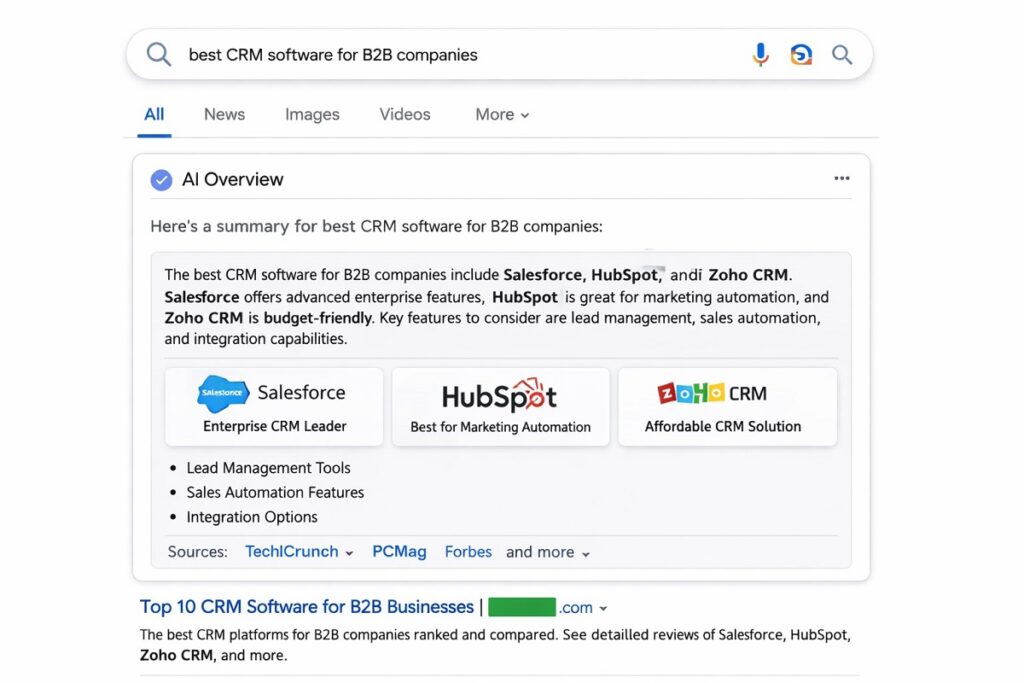
Informational Queries (Top of Funnel)
The user is learning. The AI prioritizes definitions and broad context.
1. “What is enterprise resource planning?”
- The Output: A concise definition followed by a bulleted list of key benefits (integration, automation, real-time data).
- The Winner: Sites that provided a clear, 40-word definition immediately after an H2 tag were cited here.
2. “SaaS churn rate benchmarks B2B”
- The Output: A direct data table showing average churn rates by industry.
- The Winner: A report that used an HTML table for its data, making it easy for Gemini to scrape and render.
3. “How to calculate ROI for digital marketing”
- The Output: A step-by-step numbered list explaining the formula.
- The Winner: Content that used
Step 1,Step 2formatting rather than dense paragraphs.
4. “Benefits of AI in supply chain management”
- The Output: A synthesized paragraph summarizing efficiency gains and predictive analytics.
Commercial Investigation (Middle of Funnel)
The user is comparing options. The AI prioritizes features and direct comparisons.
5. “Salesforce vs. HubSpot for enterprise”
- The Output: A side-by-side comparison highlighting pros and cons.
- The Winner: Review sites that used distinct “Pros” and “Cons” headers.
6. “Best B2B CRM for small business 2025”
- The Output: A carousel or list of top-rated tools with brief “best for” descriptors.
- The Winner: Listicles that clearly defined the target audience for each tool (e.g., “Best for Startups”).
7. “Top cybersecurity trends for banks”
- The Output: A bulleted summary of emerging threats like AI-phishing and quantum computing.
8. “Asana alternatives for large teams”
- The Output: A list of competitors like Jira and Monday.com, focusing on enterprise features.
Transactional & Local (Bottom of Funnel)
The user is ready to buy. The AI prioritizes pricing and specifics.
9. “Oracle NetSuite pricing model”
- The Output: A summary of licensing costs and implementation fees.
- The Winner: Articles that explicitly stated “Pricing starts at…” in bold text.
10. “B2B marketing agencies in London”
- The Output: A map pack integration with a summary of services offered by top agencies.
Anatomy of a Ranking AI Overview: Why These Examples Won
Why did the AI choose those specific sites to cite? It wasn’t random.
Successful AEO requires Structured Data and high E-E-A-T (Experience, Expertise, Authoritativeness, Trustworthiness). The winning content shared three traits:
- Direct Answers: They didn’t bury the lead. The answer appeared in the first sentence of the section.
- Schema Markup: They used Organization and FAQ schema to help the AI understand the content context.
- Logical Formatting: They used lists, bold text, and tables. AI models love structure.
Optimization Strategy: How to Become the “Cited Source”
You cannot force Google to show your link. But you can make your content irresistible to the algorithm.
1. The “40-Word Answer” Rule
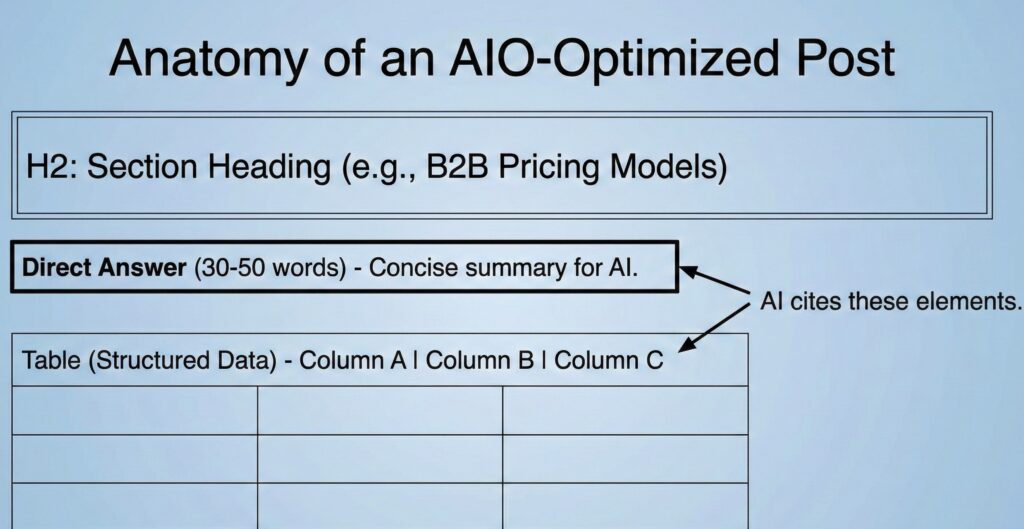
Google’s Gemini model looks for concise summaries. For every H2 in your post, write a direct, bolded answer (30-50 words) immediately following the header. This “snippet bait” is exactly what the AI pulls for its overview.
2. Leverage Unique Data
Generic AI content is flooding the web. Google filters this out by prioritizing Information Gain.
- Do not just repeat what Wikipedia says.
- Publish original case studies.
- Share unique internal data.
- Quote your own subject matter experts.
At khalidseo.com, we focus on building “Entity Authority.” We connect your brand name to specific industry concepts in the Knowledge Graph, making you a trusted entity the AI wants to cite.
3. Use “Entity-Rich” Headings
Don’t be clever. Be clear. Use headings that contain the specific entities (people, places, things, concepts) users are searching for.
- Bad: “Things to Consider”
- Good: “5 Factors for Choosing an Enterprise ERP System”
Measuring Success: Beyond the Click
If traffic drops but revenue holds steady, you are winning.
In the AI era, Share of Voice is the new traffic. If your brand is consistently cited in AI Overviews for high-value terms, you are building immense trust. Users who do click through are far more qualified than a random visitor.
AIO Readiness Checklist
Tick the boxes to see if your content is ready for AI.
Frequently Asked Questions (FAQ) regarding AI Overviews
How do Google AI Overviews impact B2B SEO?
Google AI Overviews shift B2B SEO from “ranking” to “citation.” While they may reduce top-of-funnel click-through rates by satisfying informational queries directly on the SERP, they increase the value of brand authority. B2B sites must now focus on being the source of the AI’s answer to earn high-intent traffic.
What content triggers AI Overviews for B2B?
AI Overviews are triggered by complex, multi-step queries. Content that uses structured data, distinct list formats, and direct “what is” definitions in the first paragraph is most likely to be cited by Google’s Gemini models.
Can you opt out of Google AI Overviews?
Yes, but it is not recommended for B2B growth. Site owners can use the “nosnippet” meta tag to prevent Google from using specific text. However, opting out removes your brand from the most prominent real estate on the search results page.
How do I optimize my B2B site for AI Search?
Optimize for AI search by focusing on Answer Engine Optimization (AEO). This involves: 1) Structuring content with clear H2/H3 questions, 2) Providing concise 40-word answers immediately following headers, 3) Using Organization and FAQ schema, and 4) Building entity trust.
Are AI Overviews accurate for B2B industries?
Accuracy varies, which is why Google prioritizes trusted sources. While Google’s AI aims to synthesize high-quality data, “hallucinations” can occur. For B2B industries like finance, Google relies heavily on authoritative, consensus-based sources (like yours) to minimize risk.

Hi, I am Khalid. I am an SEO and AI Search Specialist.
My goal is simple: I help your business get found by the right people.
For a long time, getting found just meant showing up on the first page of regular Google search. Today, the internet is changing. People are asking their questions to AI tools like ChatGPT and Google’s new AI features.
My job is to connect the old way of searching with the new way. When a potential customer asks an AI a question about what you do, I make sure your business is the trusted answer they get.
I do not use confusing words or secret tricks. I use clear and honest plans to get you noticed and bring real buyers straight to your website.
Want to see how I can make your brand the top answer? Connect with me on social media or read my exact steps at khalidseo.com.